
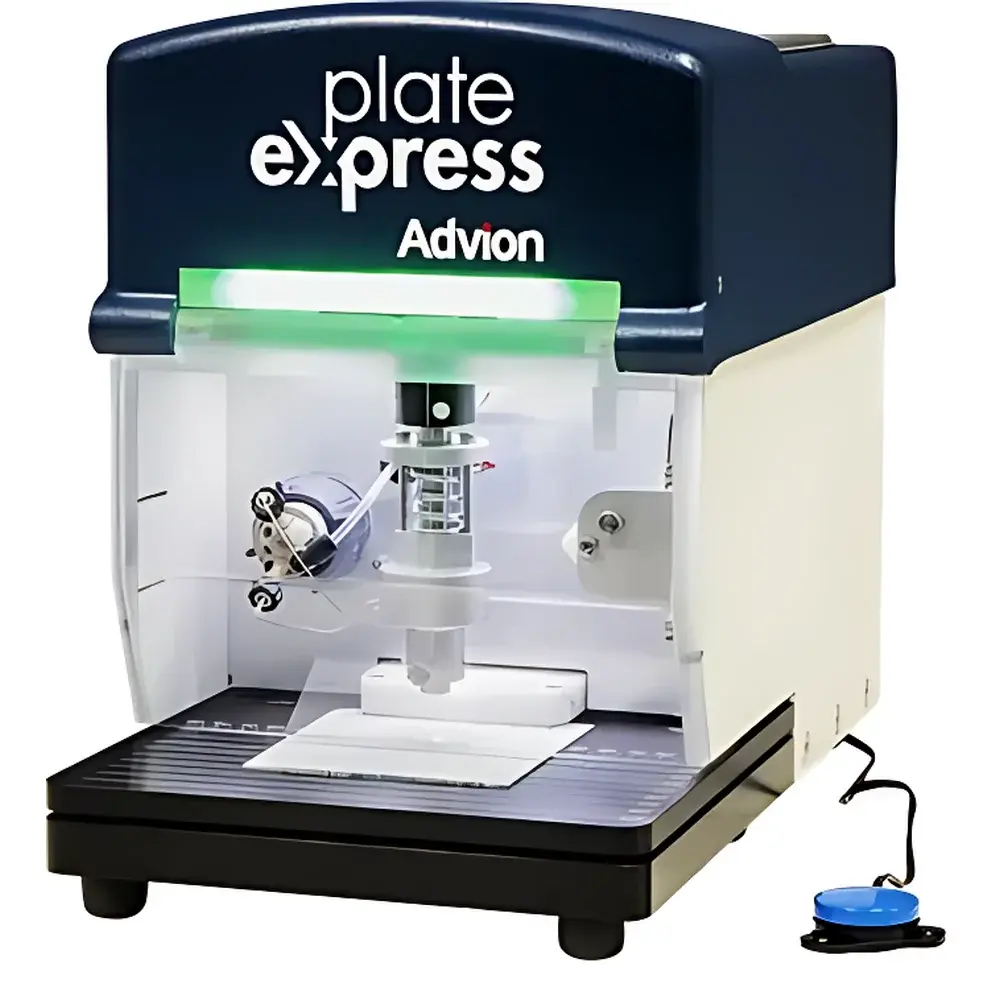
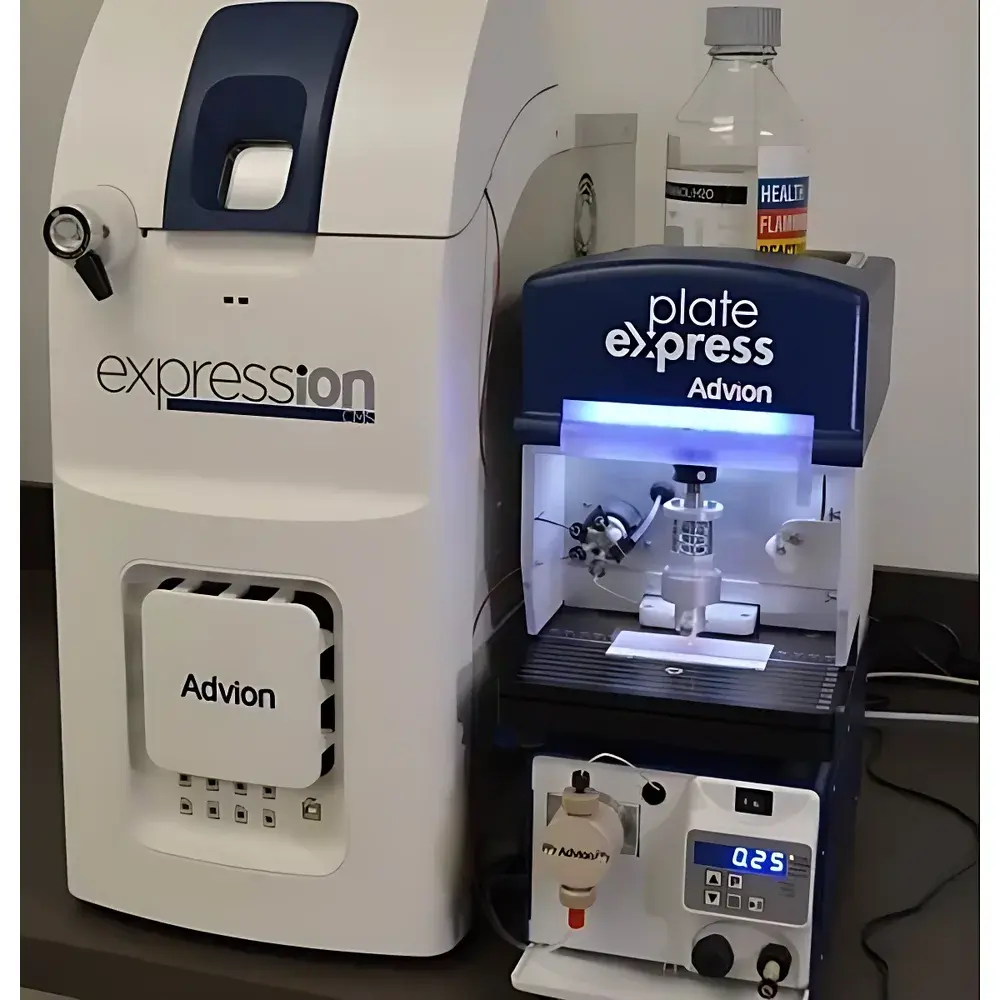
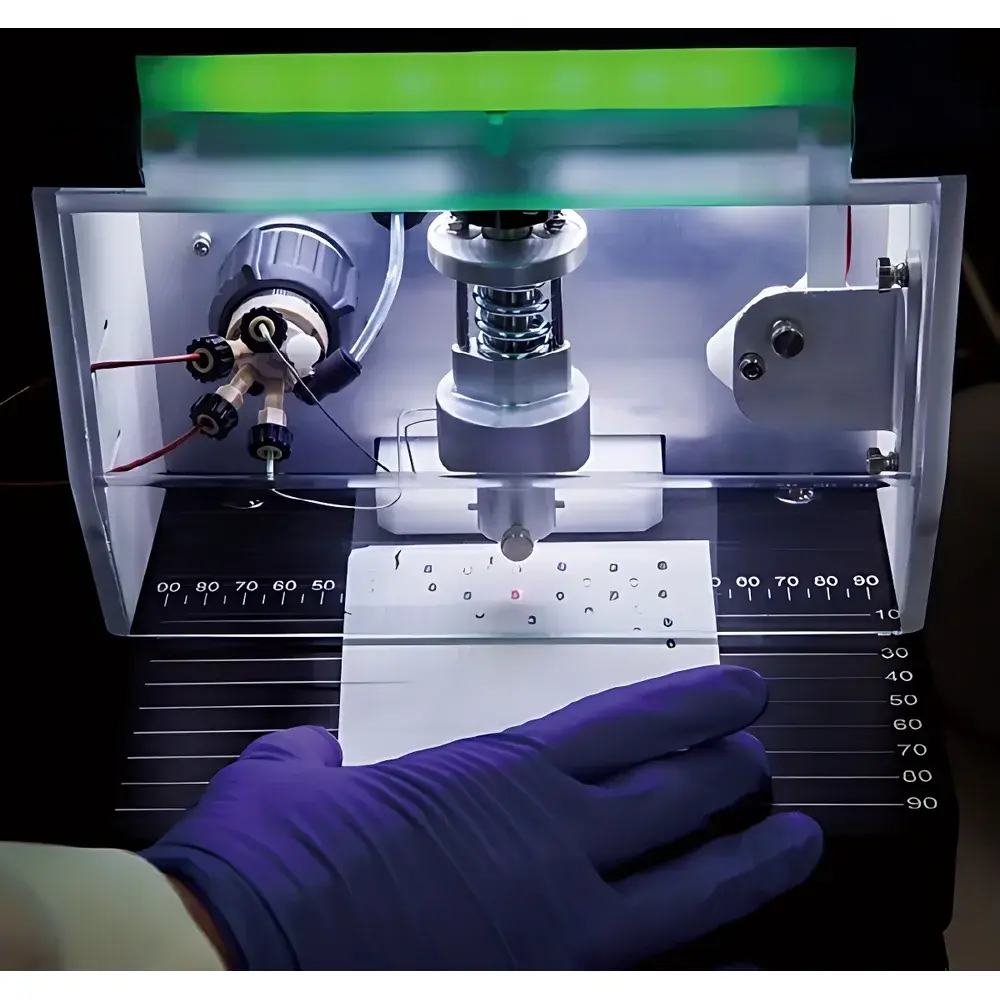
Advion Interchim Scientific Plate Express TLC–MS Interface
| Brand | Advion Interchim Scientific |
|---|---|
| Origin | USA |
| Distributor Type | Authorized Distributor |
| Import Status | Imported |
| Model | Plate Express TLC |
| Operation Mode | Automated |
| Desolvation | Nitrogen Purge |
| Sample Platform | Adjustable for Standard TLC Plates (e.g., 20 × 20 cm, 10 × 20 cm, 5 × 10 cm) |
| Compatibility | Designed for Integration with Expression® CMS Compact Mass Spectrometer |
Overview
The Advion Interchim Scientific Plate Express TLC–MS Interface is an automated, ambient-ionization coupling device engineered to bridge thin-layer chromatography (TLC) and compact mass spectrometry. It enables direct, on-plate analysis of separated analytes without mechanical scraping, solvent extraction, or sample transfer—eliminating cross-contamination risks, solvent handling hazards, and procedural variability inherent in traditional off-line TLC–MS workflows. Based on atmospheric pressure matrix-assisted laser desorption/ionization (AP-MALDI) and nitrogen-purged desolvation principles, the interface delivers reproducible ion signals directly from silica- or alumina-based TLC plates under ambient conditions. Its integration with the Expression® CMS—a benchtop, self-shielded, single-quadrupole mass spectrometer—provides lab-scale structural elucidation capability for organic molecules ranging from pharmaceutical intermediates to natural product isolates, all within a GLP-compliant, footprint-efficient workflow.
Key Features
- Automated, software-controlled sampling sequence: No manual scraping, elution, or reconstitution required.
- Nitrogen-purged ion source environment: Minimizes ambient moisture interference and improves signal stability during desorption.
- Adjustable extraction force and dwell time: Programmable parameters allow optimization across diverse stationary phases (e.g., silica gel 60 F254, RP-18, amino, cyano) and binder types.
- Universal plate stage: Accommodates commercially available TLC plates up to 20 × 20 cm; motorized X–Y positioning ensures precise spot targeting at ≤100 µm resolution.
- Integrated calibration and QC routines: Supports internal standard referencing and system suitability testing per USP and ICH Q2(R2) guidelines.
- Compact, modular design: Requires no dedicated vent hood or high-vacuum infrastructure—compatible with standard laboratory bench space.
Sample Compatibility & Compliance
The Plate Express TLC–MS Interface supports direct analysis of compounds resolved on conventional adsorbent layers—including silica, reversed-phase C18, cellulose, and chiral stationary phases—without derivatization or post-development treatment. It is validated for use with common developing solvents (e.g., ethyl acetate/hexane, methanol/chloroform, acetonitrile/water) and tolerates residual solvent films up to 5 µL per spot. From a regulatory standpoint, the system architecture supports audit-trail-enabled operation when paired with Expression CMS firmware v3.2+, meeting FDA 21 CFR Part 11 requirements for electronic records and signatures. Routine performance verification aligns with ASTM D7242–19 (Standard Practice for TLC Identification of Organic Compounds) and ISO/IEC 17025:2017 clause 7.7 (Ensuring Validity of Results).
Software & Data Management
Controlled via the Expression CMS Instrument Manager software (v5.0+), the interface operates through a dedicated TLC–MS acquisition module featuring method-driven workflows: users define plate layout, spot coordinates, extraction parameters, and MS scan ranges prior to run initiation. All raw spectral data are stored in vendor-neutral .mzML format, enabling downstream processing in open-source tools (e.g., MZmine 3, OpenMS) or commercial platforms (e.g., Compound Discoverer, MassHunter). The software enforces role-based access control, automatic timestamping, and full electronic logbook functionality—including operator ID, instrument state, environmental conditions (temperature/humidity logged via optional sensor input), and deviation alerts—supporting GxP-aligned documentation practices.
Applications
- Rapid identification of reaction intermediates and by-products in synthetic chemistry labs.
- High-throughput purity assessment of peptide synthesis batches without HPLC fraction collection.
- Direct profiling of plant extracts and traditional medicine formulations after multi-solvent TLC development.
- Forensic screening of seized drug samples using Rf-guided targeted MS/MS acquisition.
- Educational demonstrations of chromatographic separation coupled with real-time mass detection in undergraduate analytical labs.
FAQ
Can the Plate Express interface be used with mass spectrometers other than the Expression CMS?
No—it is mechanically, electrically, and software-integrated exclusively with the Expression® CMS platform. Interfacing with third-party instruments would require custom engineering and is not supported under warranty.
Does the system require matrix application before analysis?
No. The interface employs solvent-free, laser-assisted desorption directly from native TLC plates; no MALDI matrix spotting is needed.
What is the typical detection limit for small organic molecules?
Under optimized conditions (e.g., caffeine on silica, 260 nm UV visualization), sub-nanogram detection limits are achievable; absolute sensitivity depends on compound ionizability, plate background, and MS tuning parameters.
Is routine maintenance required beyond daily source cleaning?
Yes—quarterly alignment verification of the laser–plate–orifice optical path and biannual calibration of the X–Y stage encoder are recommended per the manufacturer’s preventive maintenance schedule.
How does the system handle overlapping spots or streaked bands?
Spatial resolution is limited by laser spot size (~150 µm); co-eluting compounds may yield composite spectra. Deconvolution is possible via retention time correlation (if coupled with imaging densitometry) or tandem MS filtering where precursor–product ion relationships are known.





