
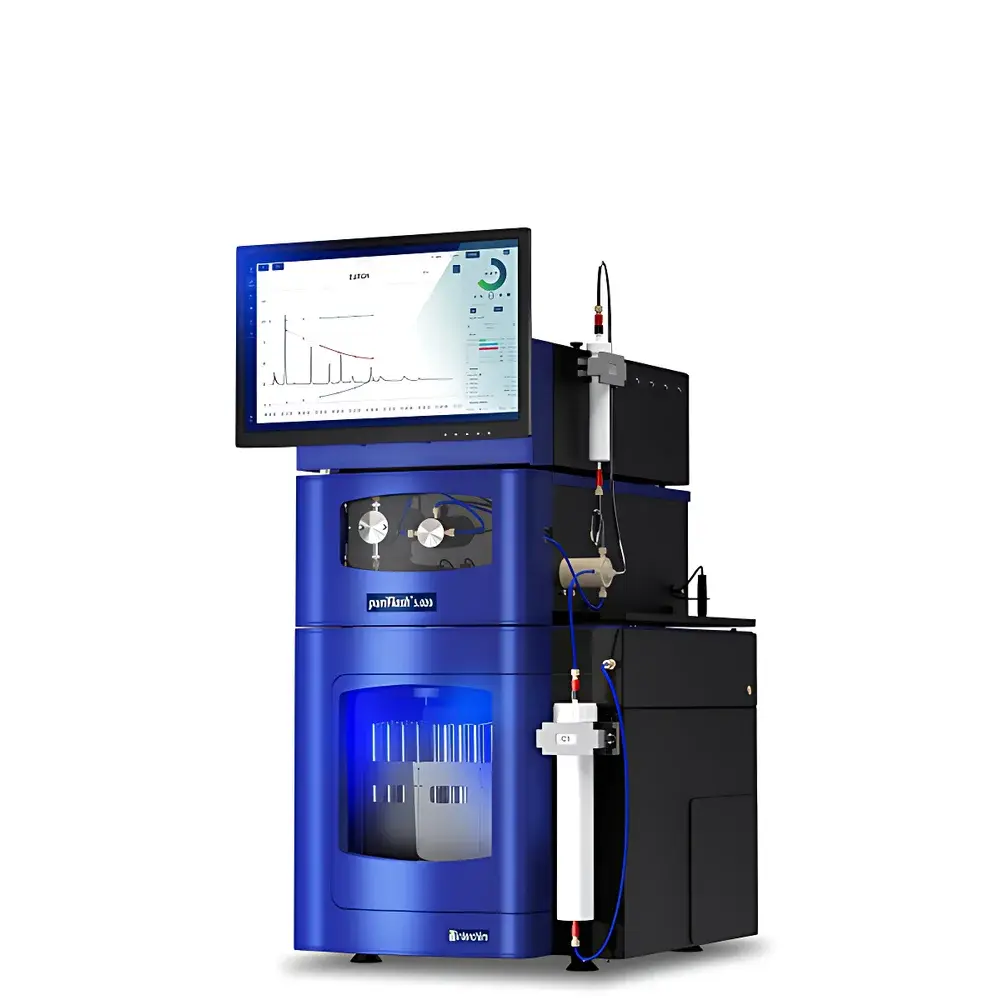
Advion Interchim Scientific puriFlash 5.020 Preparative Liquid Chromatography System
| Brand | Advion Interchim Scientific |
|---|---|
| Origin | France |
| Manufacturer Type | Authorized Distributor |
| Origin Category | Imported |
| Model | puriFlash 5.020 |
| Application Level | Laboratory Grade |
| Instrument Type | Medium- to Low-Pressure Preparative LC |
| Flow Rate Range | 0–300 mL/min |
| Maximum Operating Pressure | 20 bar |
| UV Wavelength Range | 200–800 nm (with optional extended UV pack) |
| Data Acquisition Rate | 1 Hz (not amu — corrected per instrument context) |
Overview
The Advion Interchim Scientific puriFlash 5.020 is a modular, medium-pressure preparative liquid chromatography (PLC) system engineered for robust, reproducible purification of organic small molecules, natural products, peptides, oligonucleotides, proteins, biologics, metabolites, and trace analytes. Based on classical gradient elution chromatography principles—employing high-precision quaternary solvent delivery, UV/Vis detection across a broad spectral range, and intelligent fraction collection—the puriFlash 5.020 operates within a pressure envelope of up to 20 bar, supporting column diameters up to 90 mm ID. Its architecture balances scalability with operational simplicity, making it suitable for both discovery-phase compound isolation and routine QC-driven purification workflows in academic, pharmaceutical, and contract research laboratories.
Key Features
- Quaternary gradient pump delivering precise, pulse-free flow from 0 to 300 mL/min with automatic solvent degassing and real-time pressure monitoring.
- UV/Vis detector with dual-range capability: standard 200–400 nm or extended 200–800 nm (via optional UVextended Pack), enabling detection of chromophores across diverse compound classes including conjugated aromatics, nucleic acid derivatives, and transition-metal complexes.
- 15-inch high-resolution capacitive touchscreen interface running InterSoft X Genius software—designed with KISS (Keep It Simple & Smart) philosophy for intuitive method building via drag-and-drop gradient editor, one-click method optimization, and integrated solvent management.
- Modular hardware layout supports rapid reconfiguration: pre-column holder, integrated column rack (compatible with columns up to 90 mm ID), PPS four-port valve for Load&Go dry-loading, and configurable fraction collector with 132-position tray (18 × 150 mm tubes; alternate tube formats available).
- Comprehensive fluidic safety systems including leak detection, waste diversion, and automated purge cycles—ensuring operator safety and system longevity under continuous operation.
- Remote control capability via Ethernet (RJ45) and USB interfaces; full system status and historical logs accessible through embedded web server.
Sample Compatibility & Compliance
The puriFlash 5.020 accommodates a wide range of sample introduction modes: liquid injection (via loop or direct syringe), dry-load cartridge insertion, and solid-phase extraction (SPE)-coupled workflows. Its low-to-medium pressure design is optimized for silica- and polymer-based stationary phases—including reversed-phase C18, amino, cyano, diol, and specialized chiral media—without compromising resolution or loading capacity. The system complies with laboratory quality standards aligned with GLP and GMP environments: audit-trail-enabled software logging (per FDA 21 CFR Part 11 requirements when configured with user authentication and electronic signature modules), method version control, and raw data integrity safeguards. All hardware components meet CE and RoHS directives; solvent handling conforms to IEC 61000-6-3 EMC emission standards.
Software & Data Management
InterSoft X Genius provides a unified platform for method development, execution, and post-run analysis. Gradient profiles are defined visually using an interactive timeline; retention time prediction algorithms assist in early-stage method scouting. Real-time chromatogram overlay, peak tracking, and purity assessment (based on multi-wavelength absorbance ratios) support informed fraction decision-making. All acquisition parameters, detector signals, and fraction triggers are timestamped and stored in vendor-neutral .csv and .pfd formats. Data export supports LIMS integration via OPC UA or custom API endpoints. Software updates are delivered via secure HTTPS channels with cryptographic signature verification.
Applications
- Isolation of synthetic intermediates and final APIs during medicinal chemistry campaigns.
- Purification of plant-derived natural products (e.g., alkaloids, flavonoids, terpenes) prior to structural elucidation by NMR or MS.
- Desalting and buffer exchange of peptides and oligonucleotides following solid-phase synthesis.
- Removal of endotoxins or aggregates from recombinant protein preparations at lab scale.
- Metabolite enrichment from biological matrices (plasma, urine, cell lysates) for downstream HRMS characterization.
- Preparative separation of regioisomers and diastereomers where high mass recovery (>90%) and minimal band broadening are critical.
FAQ
What is the maximum column internal diameter supported by the puriFlash 5.020?
The system accommodates preparative columns with internal diameters up to 90 mm, enabling gram-scale purifications without hardware modification.
Does the UV detector support simultaneous multi-wavelength monitoring?
Yes—the detector acquires full-spectrum data at 1 Hz, allowing retrospective evaluation of peak purity and selection of optimal collection wavelengths post-run.
Can the puriFlash 5.020 be integrated into an existing LIMS environment?
Yes, via standardized communication protocols including OPC UA and configurable RESTful API endpoints for method upload, run initiation, and result retrieval.
Is method validation documentation available for regulated environments?
Instrument qualification packages (IQ/OQ) and software validation templates compliant with ASTM E2500 and ISO/IEC 17025 are provided upon request for GxP-aligned deployments.
What maintenance intervals are recommended for routine operation?
Pump seal inspection every 6 months; UV lamp replacement every 2,000 hours; system performance checks (retention time precision, peak asymmetry, baseline noise) advised before each high-value purification campaign.




