
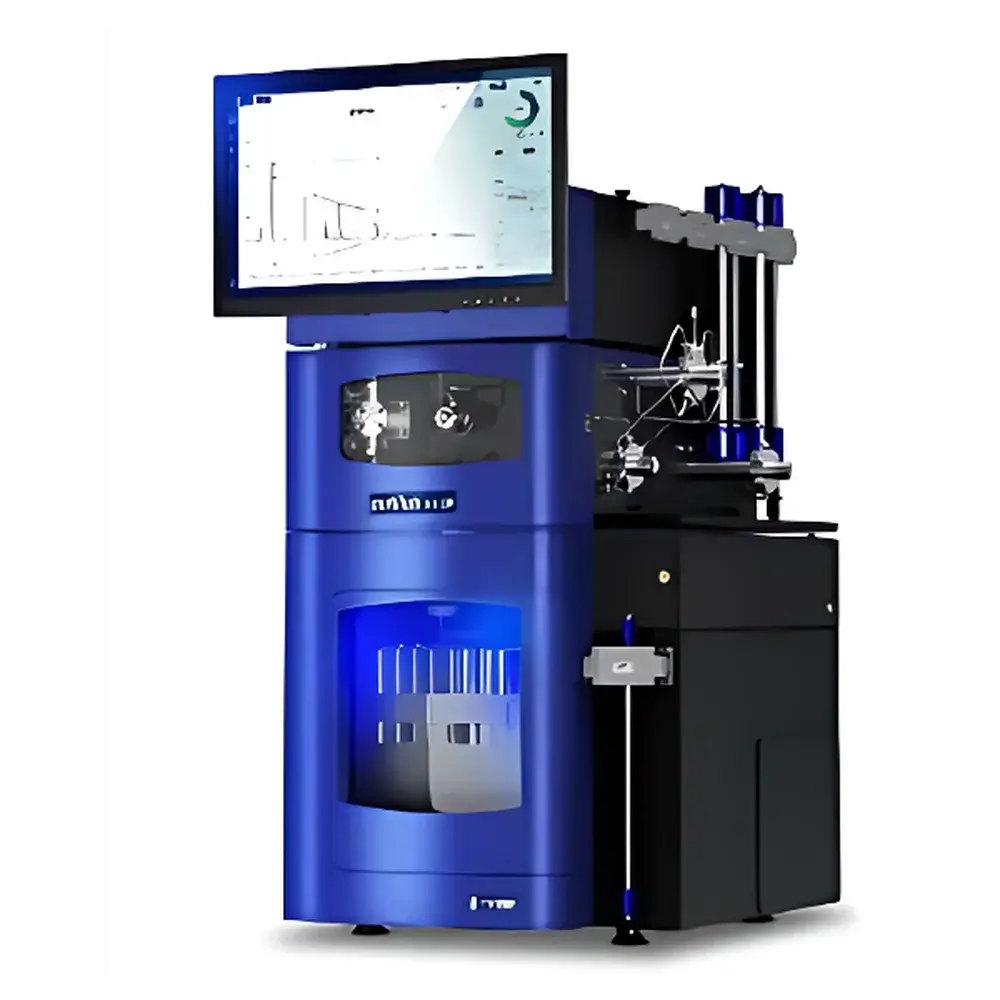
Advion Interchim Scientific puriFlash 5.250P Preparative HPLC System for Peptide Purification
| Brand | Advion Interchim Scientific |
|---|---|
| Origin | France |
| Manufacturer Type | Authorized Distributor |
| Origin Category | Imported |
| Model | puriFlash 5.250P |
| Application Level | Laboratory-Scale |
| Instrument Type | High-Pressure Preparative Liquid Chromatography |
| Flow Rate Range | 0.1–125 mL/min |
| Maximum Operating Pressure | 250 bar |
| UV Wavelength Range | 200–800 nm |
| Detection Cell | 1.3 mm pathlength, 55 µL volume |
| Gradient Capability | Quaternary solvent delivery with automated degassing |
| Column Compatibility | Up to 60 mm internal diameter |
| Fraction Collection | 132-position rack (18 × 150 mm tubes, configurable) |
| Control Interface | 15″ HD capacitive touchscreen |
| Software Platform | InterSoft X Genius (KISS-compliant, drag-and-drop gradient editor, method automation, audit-trail-ready) |
Overview
The Advion Interchim Scientific puriFlash 5.250P is a high-performance, modular preparative liquid chromatography system engineered for robust, reproducible purification of synthetic and biologically derived molecules—including peptides, oligonucleotides, natural products, metabolites, and early-stage biopharmaceutical intermediates. Based on proven flash and medium-pressure HPLC principles, the 5.250P integrates high-flow quaternary gradient pumping (up to 125 mL/min), precise pressure control (≤250 bar), and extended-range UV detection (200–800 nm) to support both analytical-scale scouting and gram-scale isolation in a single platform. Its architecture adheres to fundamental chromatographic design tenets: laminar flow optimization, minimized dwell volume, low dispersion fluidics, and thermally stable detector cell positioning—ensuring retention time reproducibility and peak fidelity across repeated runs. Designed for compliance-aware laboratories, the system supports method traceability, electronic signatures, and data integrity frameworks aligned with GLP and GMP expectations.
Key Features
- Quaternary gradient pump with integrated automatic solvent degassing, delivering stable flow from 0.1 to 125 mL/min with ≤0.5% RSD over full range
- High-pressure capability up to 250 bar enables use of sub-10 µm stationary phases and narrow-bore preparative columns (ID up to 60 mm)
- Dual-wavelength UV/Vis detection: standard 200–400 nm configuration; optional extended range (200–800 nm) for broad-spectrum compound monitoring and co-elution assessment
- 15-inch high-resolution capacitive touchscreen interface running InterSoft X Genius software—designed for KISS (Keep It Simple & Smart) operation with zero-code method building via drag-and-drop gradient editor
- Modular hardware layout with tool-free column bracket integration, pre-column holder, and leak-tolerant waste management system
- Automated solid-phase loading via dual-valve (6-port + 10-port) Load&Go architecture, compatible with dry-load cartridges and slurried samples
- Intelligent fraction collection: programmable 132-tube rack (18 × 150 mm), with optional support for alternative tube formats (e.g., 24-well plates, vials)
Sample Compatibility & Compliance
The puriFlash 5.250P accommodates diverse sample matrices—ranging from crude peptide synthesis mixtures and protected oligonucleotide cleavage solutions to plant extracts and fermentation broths. Its wide flow and pressure envelope supports reversed-phase (C4, C8, C18), ion-exchange, and hydrophobic interaction media, including polymeric and silica-based packings. The system meets core requirements for regulated environments: InterSoft X Genius provides user-level access control, electronic audit trails, method versioning, and raw data archiving compliant with FDA 21 CFR Part 11 principles. All UV spectra and chromatograms are stored in vendor-neutral formats (e.g., .cdf), enabling third-party reprocessing and long-term archival per ISO/IEC 17025 and ASTM E2524 guidelines.
Software & Data Management
InterSoft X Genius serves as the central orchestration layer—combining intuitive workflow design with engineering-grade data governance. Users construct methods through visual gradient definition, real-time flow/pressure monitoring, and on-the-fly parameter adjustment without interrupting runs. The software embeds intelligent solvent management logic (e.g., auto-purge sequences, solvent level alerts) and supports remote diagnostics via Ethernet (RJ45) or USB-to-Ethernet bridge. All acquisition and processing events—including detector calibration, valve actuation timestamps, and fraction trigger logic—are timestamped, user-attributed, and immutably logged. Export options include CSV, PDF reports, and XML metadata bundles suitable for LIMS integration and regulatory submission packages.
Applications
- Purification of linear and cyclic peptides (2–50 residues) post-Fmoc SPPS, including removal of deletion sequences and diastereomeric impurities
- Isolation of modified oligonucleotides (phosphorothioates, 2′-O-methyl, LNA) from deprotection cocktails
- Fractionation of natural product libraries for bioactivity-guided isolation
- Desalting and buffer exchange of small proteins (<25 kDa) and antibody fragments prior to characterization
- Metabolite enrichment from plasma, urine, or cell culture supernatants at semi-preparative scale
- Process development support for early-phase API purification where scalability to pilot-scale systems is required
FAQ
What column dimensions and particle sizes are supported?
The system accommodates columns from 10 mm to 60 mm internal diameter and supports packing materials with particle sizes ranging from 5 µm to 40 µm, including monolithic and superficially porous media.
Is method transfer possible to analytical or production-scale HPLC systems?
Yes—gradient delay volume is minimized (<1.2 mL), and retention time scaling follows standard linear velocity and column volume normalization rules, enabling reliable translation to Agilent 1260 Infinity II or Waters Prep 150 systems.
Does the software support compliance with 21 CFR Part 11?
InterSoft X Genius includes role-based authentication, electronic signatures, and tamper-evident audit logs—meeting foundational technical controls for Part 11 adherence when deployed on validated IT infrastructure.
Can the system perform simultaneous multi-wavelength collection during fractionation?
Yes—the extended-range UV/Vis detector acquires full spectra (1 nm resolution) at 10 Hz, allowing real-time purity assessment and wavelength-specific triggering of fraction collection.
What maintenance protocols are recommended for routine operation?
Daily: purge pump seals, inspect UV lamp intensity, verify fraction collector alignment. Quarterly: replace inlet frits, recalibrate pressure transducer, validate detector linearity using NIST-traceable standards.






