
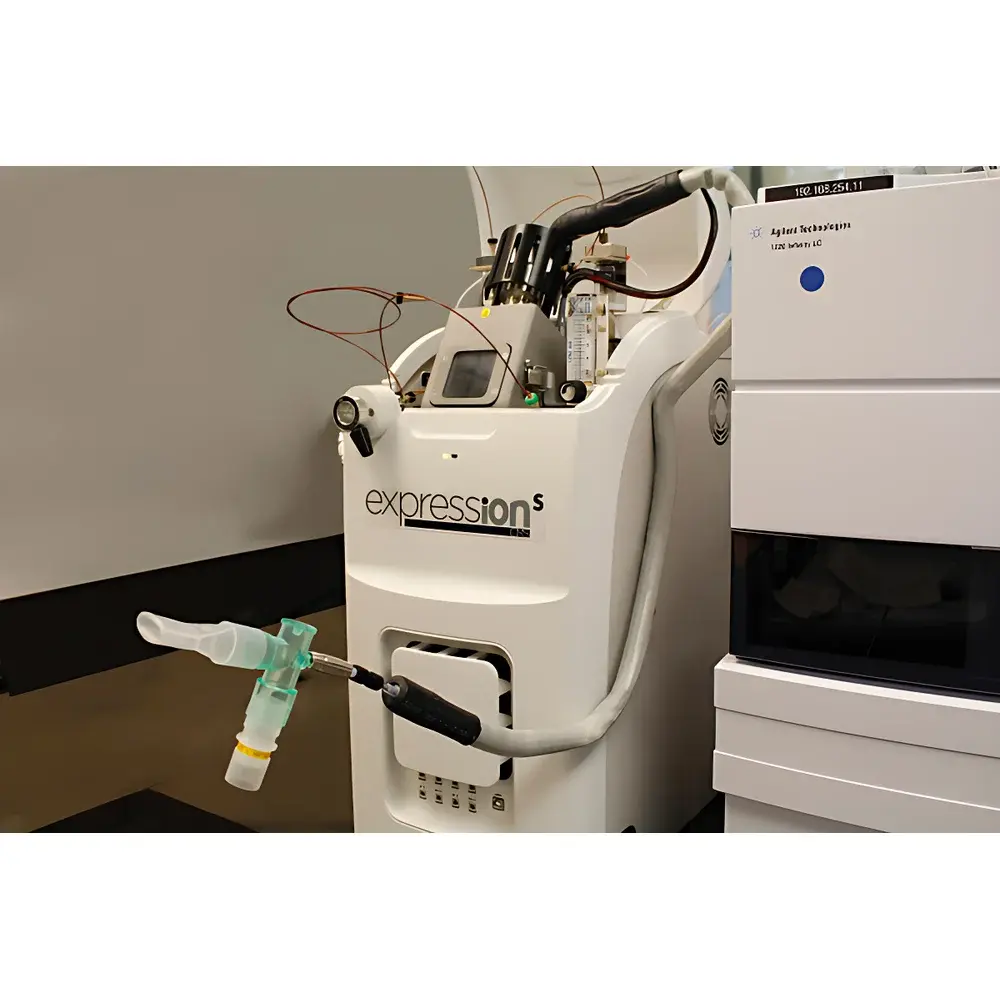
Advion Interchim Scientific vAPCI Atmospheric Pressure Chemical Ionization Source for Gas-Phase Analysis
| Brand | Advion Interchim Scientific |
|---|---|
| Origin | USA |
| Manufacturer Type | Authorized Distributor |
| Origin Category | Imported |
| Model | vAPCI |
| Instrument Type | Ion Source |
| Application Specificity | Dedicated Gas-Phase Interface |
| Analyte Polarity Range | Non-polar to Moderately Polar Compounds |
| Sensitivity | Compatible with Advion expression CMS Mass Spectrometer |
| Resolution | Defined by Coupled Mass Analyzer (e.g., Quadrupole) |
| Accurate Mass Capability | ±0.1 Da (when calibrated and operated under optimized conditions) |
| Operating Pressure | Ambient Atmospheric Pressure (~760 Torr) |
Overview
The Advion Interchim Scientific vAPCI (vapor-phase Atmospheric Pressure Chemical Ionization) source is a dedicated, solvent-free ionization interface engineered for direct, real-time analysis of volatile organic compounds (VOCs) and other gaseous analytes in ambient air, headspace, breath, or process gas streams. Unlike conventional APCI sources requiring liquid-phase nebulization and thermal desolvation, the vAPCI operates exclusively in the gas phase—introducing vaporized samples directly into a heated transfer line that delivers them to an atmospheric-pressure ionization region. Ionization occurs via corona discharge-induced proton transfer reactions between reagent ions (e.g., H3O+, NO+) and analyte molecules, enabling soft ionization with minimal fragmentation. Designed specifically for integration with the Advion expression CMS benchtop quadrupole mass spectrometer, the vAPCI eliminates chromatographic separation and sample preparation steps, delivering rapid (<30 s per analysis), reproducible, and quantitative data for applications demanding high temporal resolution and operational simplicity.
Key Features
- Solvent-free operation: Eliminates need for carrier solvents, reducing background chemical noise and maintenance overhead associated with nebulizer clogging or solvent pump calibration.
- Direct vapor introduction: Heated stainless-steel transfer line (up to 250 °C) ensures efficient transport of thermally labile VOCs without condensation or adsorption losses.
- Corona discharge ionization: Stable, low-power corona needle generates consistent reagent ion chemistry under ambient pressure, supporting robust ionization across non-polar to moderately polar compound classes (e.g., alkanes, aromatics, ketones, esters).
- Benchtop compatibility: Compact footprint (≤15 cm × 10 cm × 8 cm) enables seamless integration with the Advion expression CMS without external vacuum pumping or high-voltage infrastructure.
- Real-time monitoring capability: Supports continuous gas flow at 10–100 mL/min, enabling time-resolved profiling of dynamic emissions (e.g., breath-by-breath analysis, environmental leak detection, reaction monitoring).
- Electronically controlled temperature and discharge current: Integrated firmware allows precise tuning of ionization efficiency and selectivity via software-defined parameters.
Sample Compatibility & Compliance
The vAPCI source is validated for use with gaseous and highly volatile liquid-phase samples introduced via headspace autosamplers, Tedlar bags, sorbent tubes (with thermal desorption), or direct gas lines. It supports analysis of compounds with boiling points below ~250 °C and vapor pressures >10 Pa at 25 °C—including BTEX, formaldehyde, acetone, isoprene, and short-chain fatty acids. The system complies with standard laboratory safety practices for atmospheric-pressure ion sources (IEC 61010-1). When used with the expression CMS platform, full audit trail, user access control, and electronic signature functionality align with FDA 21 CFR Part 11 requirements for regulated environments. Data acquisition adheres to GLP-compliant metadata tagging (timestamp, operator ID, instrument configuration, calibration status).
Software & Data Management
Control and data acquisition are fully integrated within the Advion CMS Software Suite (v3.5+), offering method-driven workflows for vAPCI-specific acquisition modes: single-ion monitoring (SIM), full-scan MS, and time-segmented scanning. Real-time spectral deconvolution algorithms support automated peak identification against NIST/EPA VOC libraries. All raw data files (.cms) include embedded calibration coefficients, ion source operating parameters (discharge voltage, transfer line temperature, gas flow rate), and hardware diagnostic logs. Export formats include .csv, .mzML, and .CDF, ensuring interoperability with third-party chemometric tools (e.g., MATLAB, Python-based SciPy/MSnbase). Audit trails record all parameter changes, user logins, and report generation events with cryptographic timestamping.
Applications
- Environmental monitoring: On-site detection of fugitive emissions, landfill gas composition, and indoor air quality (IAQ) screening.
- Clinical breath analysis: Rapid profiling of metabolic biomarkers (e.g., acetone in diabetes, ethane in oxidative stress, isoprene in cholesterol synthesis).
- Industrial hygiene: Real-time workplace exposure assessment for solvents, refrigerants, and process intermediates.
- Food and fragrance: Headspace characterization of volatiles during storage, fermentation, or packaging integrity testing.
- Reaction kinetics: In situ monitoring of gas-phase catalytic reactions or pyrolysis products without quenching or dilution.
FAQ
What types of compounds can be ionized using the vAPCI source?
Non-polar and moderately polar volatile organic compounds with sufficient vapor pressure at ambient or modestly elevated temperatures—typically those with molecular weights <300 Da and boiling points below 250 °C.
Is the vAPCI compatible with mass spectrometers other than the Advion expression CMS?
The vAPCI is mechanically and electrically optimized for the expression CMS platform; interfacing with other instruments requires custom mounting, signal synchronization, and vacuum interface adaptation—not supported under warranty.
Does the vAPCI require routine calibration for quantitative analysis?
Yes—external calibration with certified gas standards (e.g., EPA TO-14/TO-15 mixtures) is required for quantitation; internal standard addition (e.g., deuterated analogs) is recommended for improved precision.
Can the vAPCI operate continuously for extended periods?
Yes—designed for unattended operation up to 72 hours with stable corona discharge performance; recommended maintenance includes weekly inspection of the discharge needle and quarterly cleaning of the ion transfer capillary.
How is system contamination mitigated during long-term gas analysis?
The heated transfer line (up to 250 °C) and inert stainless-steel flow path minimize adsorption; optional inline particulate filters and hydrophobic membrane scrubbers may be installed upstream for humid or particulate-laden streams.







