
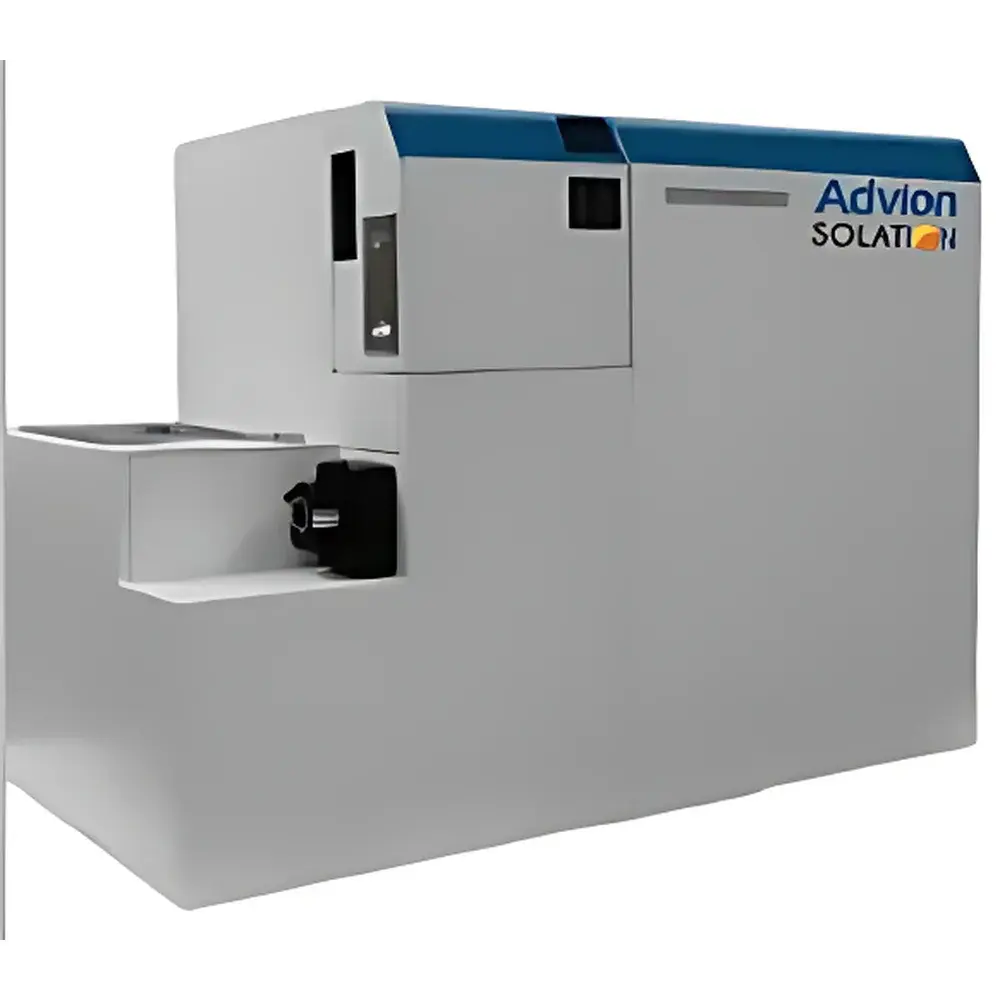
Advion SOLATION ICP-MS
| Brand | Advion |
|---|---|
| Origin | USA |
| Manufacturer Type | Authorized Distributor |
| Origin Category | Imported Instrument |
| Model | ICP-001/E01 |
| Instrument Type | Quadrupole Mass Spectrometer |
| Mass Resolution (at 10% peak height, unit mass) | 0.9 amu |
| Detection Limits (ng·L⁻¹) | Be < 1 |
| Sensitivity (Mcps / mg·L⁻¹) | Li > 20 |
Overview
The Advion SOLATION ICP-MS is a high-performance quadrupole inductively coupled plasma mass spectrometer engineered for trace-element analysis at sub-picomolar concentrations. It operates on the fundamental principle of ionizing analyte elements in a high-temperature argon plasma (~7,000–10,000 K), followed by mass separation via a radiofrequency-driven quadrupole mass filter and detection using a discrete-dynode electron multiplier. A defining architectural feature is its proprietary 90° ion optical deflection system, which physically decouples the detector and mass analyzer from the axial plasma beam path. This orthogonal geometry minimizes transmission of neutral species and non-ionized particulates—major contributors to background noise and detector contamination—thereby enhancing signal-to-noise ratio (S/N), long-term stability, and instrument uptime without compromising sensitivity or dynamic range.
Key Features
- 90° off-axis ion optics design eliminating direct line-of-sight between plasma torch and detector, reducing polyatomic and oxide interferences
- Quadrupole mass analyzer with <0.9 amu resolution (10% valley definition) enabling robust elemental mass separation across the full m/z 5–280 range
- Sub-part-per-quadrillion (sub-fg g⁻¹) detection capability demonstrated for key isotopes including 9Be, 115In, and 209Bi
- High-transmission ion optics optimized for maximum ion utilization efficiency, supporting sensitivity >50 Mcps/(mg·L⁻¹) for In and >40 Mcps/(mg·L⁻¹) for Ti and U
- Integrated RF generator with auto-matching network ensuring stable plasma ignition and operation under variable matrix conditions
- Modular vacuum architecture with dual-stage turbomolecular pumping system maintaining base pressure <5×10⁻⁸ mbar in the mass analyzer region
Sample Compatibility & Compliance
The SOLATION ICP-MS accepts liquid samples introduced via standard nebulization systems (e.g., concentric glass, microflow, or desolvating interfaces) and supports both continuous-flow and discrete-introduction modes. It is compatible with common acid matrices (HNO₃, HCl, HF at ≤2% v/v) and tolerates total dissolved solids (TDS) up to 0.2% w/v with appropriate dilution or online dilution modules. The system meets essential regulatory requirements for routine laboratory use: it supports audit-trail-enabled data acquisition compliant with FDA 21 CFR Part 11 when paired with validated software configurations; analytical workflows align with ISO/IEC 17025:2017 method validation principles; and quantification protocols are adaptable to EPA Method 6020B, ASTM D5673, and ISO 17294-2 for environmental and industrial water testing.
Software & Data Management
Control and data reduction are performed using Advion’s SOLATION Control Suite—a Windows-based application offering real-time mass calibration, automatic tuning optimization, interference correction algorithms (including mathematical correction for 40Ar35Cl⁺ on 75As⁺), and integrated internal standard normalization. All raw spectral data are stored in vendor-neutral .raw format with embedded metadata (instrument parameters, calibration history, operator ID, timestamp). The software enforces role-based access control, electronic signatures, and full audit trail logging—including parameter changes, recalibrations, and report generation events—to support GLP and GMP environments. Export options include CSV, Excel, and XML formats compatible with LIMS integration.
Applications
- Environmental monitoring: quantification of ultra-trace metals (e.g., Pb, Cd, As, U) in drinking water, wastewater, soil leachates, and airborne particulate filters per EPA and EU WFD directives
- Geochemical research: isotopic ratio measurements (e.g., 87Sr/86Sr, 143Nd/144Nd) in rock digests and mineral separates using standard-sample-standard bracketing
- Pharmaceutical QA/QC: elemental impurity testing of drug substances and excipients in accordance with ICH Q3D guidelines (Class 1–3 elements)
- Food safety: screening for toxic elements (As, Cd, Pb, Hg) in infant formula, seafood, rice, and dietary supplements
- Agricultural science: nutrient and heavy metal profiling in plant tissues, fertilizers, and irrigation water
FAQ
What sample introduction systems are supported?
The SOLATION ICP-MS is compatible with standard pneumatic nebulizers (e.g., Meinhard®), microconcentric systems, and desolvating interfaces such as Aridus® or Apex-Q™ for enhanced sensitivity and reduced oxide formation.
Does the instrument support isotope ratio analysis?
Yes—it provides stable, reproducible isotope ratio data suitable for geological and environmental tracer studies when operated in peak-jumping or multi-collection mode with appropriate calibration standards.
Is remote diagnostics available?
Instrument health monitoring and basic troubleshooting can be performed remotely via secure TLS-encrypted connection; full remote control requires on-site authorization and IT policy compliance.
What maintenance intervals are recommended?
Routine maintenance includes quarterly torch and sampler/skimmer cone cleaning, biannual vacuum pump oil replacement, and annual mass calibration verification using certified multi-element standards.
Can the system be upgraded to accommodate future regulatory requirements?
Hardware architecture supports firmware updates and optional add-ons including collision/reaction cell modules, high-efficiency interface kits, and expanded software licensing for advanced statistical reporting and compliance modules.





