
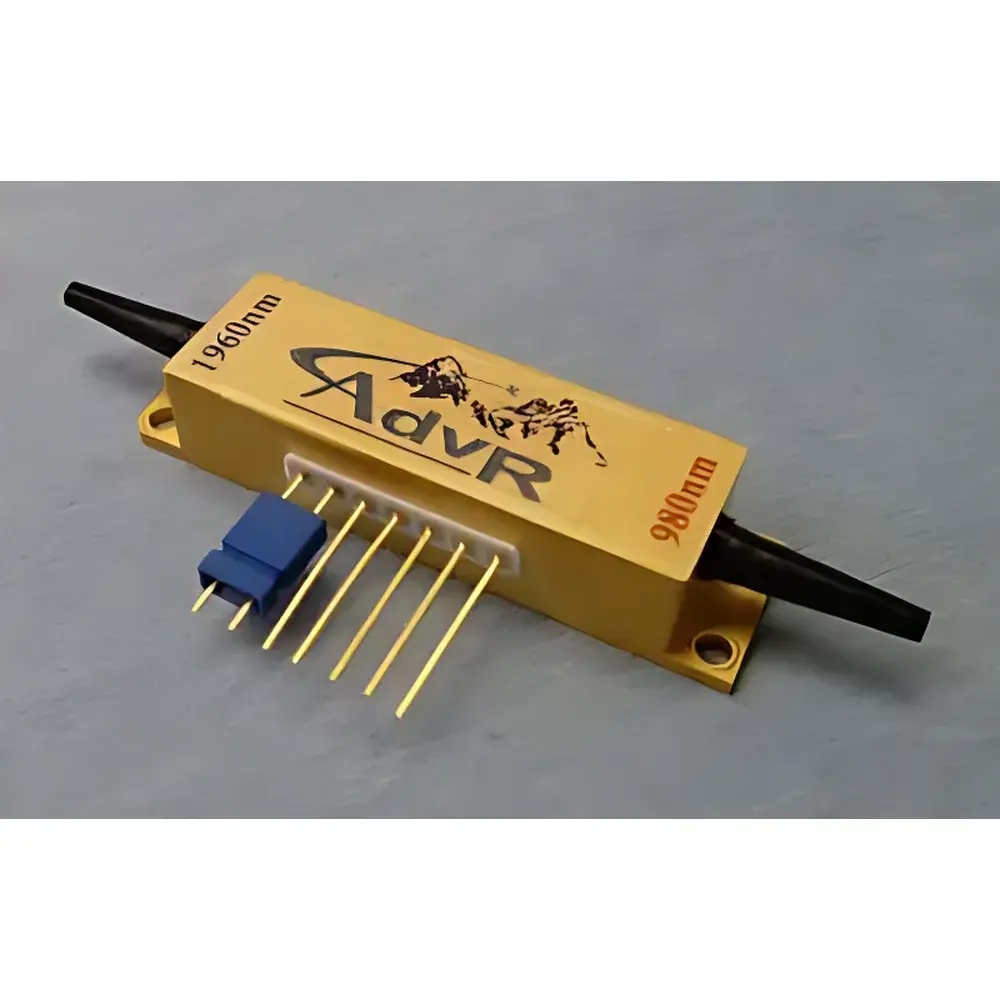
ADVR MgO:LN Ridge Waveguide for Periodically Poled Nonlinear Optical Frequency Conversion
| Brand | ADVR |
|---|---|
| Origin | USA |
| Manufacturer Type | Authorized Distributor (HCP/Longcai Technology) |
| Product Category | Imported Nonlinear Optical Waveguide Device |
| Model | MgO:LN Ridge |
| Pricing | Available Upon Request |
Overview
The ADVR MgO:LN Ridge Waveguide is a monolithic, periodically poled nonlinear optical waveguide engineered for high-efficiency, chip-integrated frequency conversion in quantum optics, atomic physics, and precision spectroscopy applications. Fabricated using robust electric-field poling techniques on stoichiometric or congruent MgO-doped lithium niobate (MgO:LN), this ridge-type waveguide supports quasi-phase-matched (QPM) interactions across a broad transparency range (350 nm – 5 µm). Its design leverages the large nonlinear coefficient (d33 ≈ 27 pm/V) and low propagation loss (< 0.3 dB/cm at 1550 nm) of MgO:LN to enable stable, polarization-maintaining guided-wave nonlinear processes—including second-harmonic generation (SHG), sum-frequency generation (SFG), difference-frequency generation (DFG), spontaneous parametric down-conversion (SPDC), and third-harmonic generation (THG). Unlike bulk crystals, the ridge geometry provides strong optical confinement, enhanced pump intensity, and improved thermal management—critical for maintaining phase-matching stability under continuous-wave or pulsed excitation.
Key Features
- Monolithic MgO:LN ridge waveguide with sub-micron lateral confinement and vertical mode control
- Customizable QPM grating period (Λ = 3.5–30 µm) optimized for target wavelength pairs and interaction type (Type I or Type II)
- High damage threshold (> 100 mW CW input at 780 nm in fiber-pigtailed configuration)
- UV-transmissive operation down to ≥350 nm enabled by MgO doping and optimized waveguide fabrication
- On-chip integrated mode filters for efficient single-mode coupling from standard SMF-28 or PM fibers
- Integrated wavelength division multiplexing structures (on-chip WDMs) enabling independent pump/signal routing in SFG/DFG configurations
- Available in multiple substrate variants: undoped LN (for low-power SPDC), KTP (for high-gain SHG in telecom bands), and RPE-LN (reduced photorefractive effect for long-term stability)
Sample Compatibility & Compliance
The ADVR MgO:LN Ridge Waveguide is compatible with standard fiber-coupled laser sources (e.g., external cavity diodes, fiber lasers, Ti:sapphire oscillators) and integrates seamlessly into OEM modules compliant with industrial and research-grade optical alignment standards. Devices are fabricated under cleanroom conditions (ISO Class 5) and undergo full spectral characterization (phase-matching bandwidth, conversion efficiency, polarization extinction ratio) per batch. While not certified to specific regulatory frameworks (e.g., FDA 21 CFR Part 11), the waveguides support GLP/GMP-aligned experimental workflows when deployed in traceable optical setups. All materials comply with RoHS Directive 2011/65/EU and REACH Annex XIV restrictions. Documentation includes full QPM design files, measured dispersion curves, and thermal tuning coefficients (dΛ/dT ≈ 0.012 nm/K) for end-user calibration.
Software & Data Management
ADVR provides a Python-based configuration toolkit (WaveguideQPM v2.1) for calculating optimal poling periods, effective nonlinear coefficients, and temperature-tuning curves based on user-specified pump/signal wavelengths and crystal orientation. The toolkit interfaces with commercial optical design platforms (e.g., Lumerical MODE, COMSOL Multiphysics) via standardized .mat and .csv exports. For system integration, waveguides are supplied with calibrated spectral response data (wavelength vs. conversion efficiency), enabling direct import into LabVIEW, MATLAB, or Python-based quantum control stacks (e.g., QCoDeS, Qudi). Audit trails for poling process parameters (voltage, dwell time, temperature ramp) are archived per wafer lot for reproducibility and metrological traceability.
Applications
- Quantum information processing: Type-II SPDC sources for polarization-entangled photon pair generation at telecom wavelengths (e.g., 775 nm → 1550 nm signal/idler)
- Atomic trapping and cooling: Narrow-linewidth 369 nm THG source (1108 nm → 369 nm) for Yb+ ion traps; 355 nm output (1064 nm → 355 nm) for Ca+ and Sr+ systems
- Mid-IR generation: DFG-based tunable sources (e.g., 780 nm + 1570 nm → 1550 nm; 852 nm + 1892 nm → 1550 nm) for atmospheric sensing and molecular fingerprinting
- Ultrafast pulse synthesis: SFG mixing of femtosecond pulses (e.g., 515 nm + 1310 nm → 369.5 nm) for attosecond science and UV pump-probe experiments
- Optical clock stabilization: High-efficiency SHG modules (e.g., 1542 nm → 771 nm) for Sr lattice clock interrogation lasers
FAQ
What is the typical conversion efficiency for SHG at 780 nm using the MgO:LN Ridge waveguide?
Conversion efficiencies exceed 25% per watt of fundamental power under optimal phase-matching and mode-matching conditions, with >15% achieved in standard fiber-pigtailed packages.
Can ADVR provide waveguides with non-uniform poling periods for broadband or chirped QPM applications?
Yes—chirped, step-chirped, and fan-out grating designs are available upon request for octave-spanning DFG or group-velocity-matched SPDC.
Is thermal tuning supported, and what is the required temperature range?
All MgO:LN Ridge devices include thermal tuning capability over 20–120 °C, with tuning rates of 0.03–0.05 nm/°C depending on Λ and interaction type.
Are these waveguides compatible with ultrafast (fs/ps) pump sources?
Yes—ridge waveguides maintain dispersion-engineered phase matching for pulses as short as 100 fs, provided group-velocity mismatch is compensated via waveguide dispersion tailoring.
Do you supply full optical packaging, including fiber pigtailing and TEC-controlled mounts?
Standard offerings include FC/APC-pigtailed modules with integrated thermistors and TECs; custom OEM housings (e.g., butterfly, TO-can) are available under NDA.



