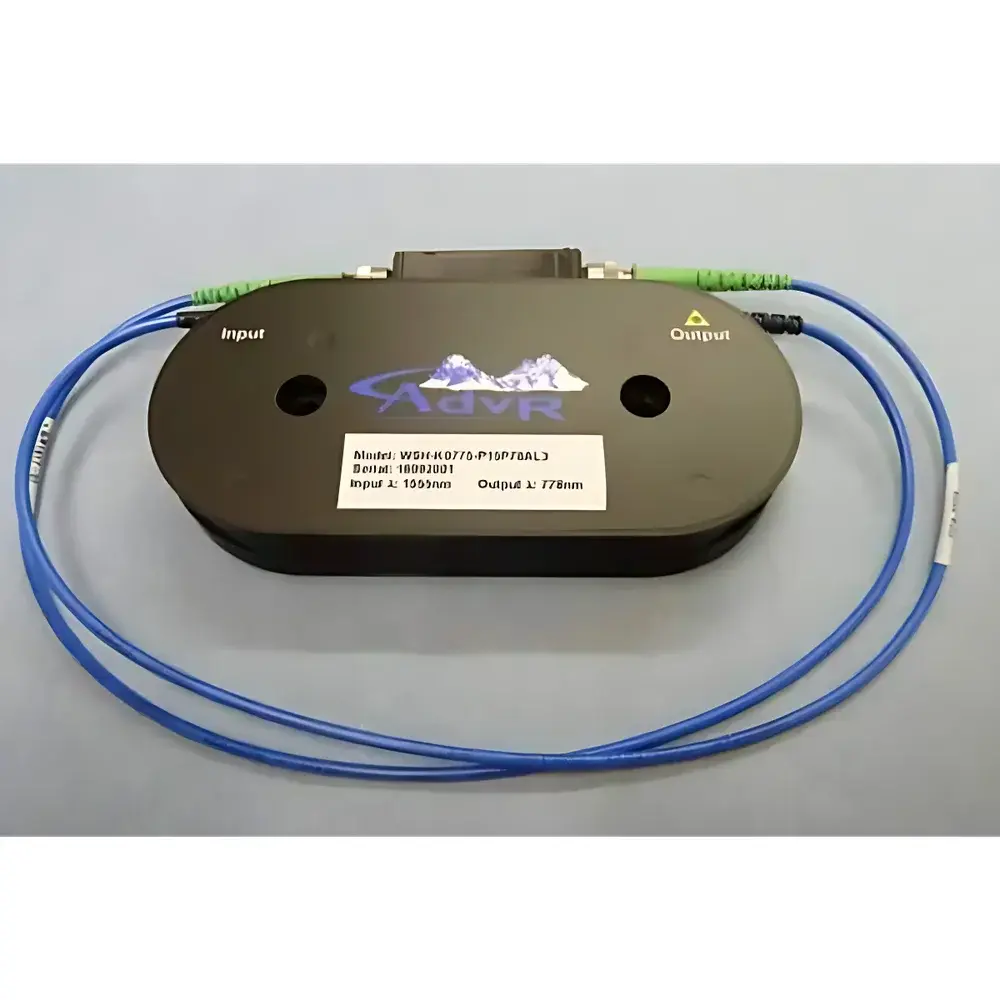
AdvR PPKTP Periodically Poled Potassium Titanyl Phosphate Waveguide
| Brand | AdvR |
|---|---|
| Model | PPKTP |
| Substrate Material | KTP (KTiOPO₄) |
| Poling Period Range | 3.5–22 µm (customizable) |
| Operating Wavelength Range | 350–5000 nm |
| Nonlinear Interaction Types | Type-0, Type-I, Type-II phase matching |
| Primary Applications | SHG, SFG, DFG, SPDC |
| Waveguide Configuration | Ti-indiffused or proton-exchanged ridge/strip waveguides |
| Input/Output Options | Fiber-pigtailed (SMF-28, PM fiber), free-space collimated input/output |
| Max. Continuous Pump Power | ≤500 mW (standard), ≤2 W (high-power variant) |
| Conversion Efficiency | Up to 300 %/W (internal, 1560 nm → 780 nm) |
| Operating Temperature Range | 20–80 °C (thermally stabilized options available) |
| Compliance | RoHS-compliant packaging, ISO 9001-certified manufacturing process |
| Customization | Period, length, AR coating (R < 0.2% @ specified λ), polarization handling, thermal tuning design |
Overview
The AdvR PPKTP Periodically Poled Potassium Titanyl Phosphate Waveguide is a monolithic, engineered nonlinear optical device designed for efficient, stable, and scalable frequency conversion in quantum photonics, atomic physics, and precision metrology systems. Built upon the electro-optic and nonlinear properties of stoichiometric KTiOPO₄ (KTP), the waveguide integrates quasi-phase-matching (QPM) via periodic ferroelectric domain inversion—enabling precise control over phase-matching conditions across ultraviolet to mid-infrared spectral bands (350–5000 nm). Unlike bulk crystals requiring critical angle alignment, the embedded waveguide geometry confines light in a low-loss, single-mode channel, significantly enhancing interaction length and intensity while minimizing walk-off and spatial mode mismatch. This architecture delivers superior conversion efficiency, long-term power stability, and robustness against environmental perturbations—making it ideal for integration into compact, field-deployable, or vacuum-compatible optical systems.
Key Features
- Monolithic titanium-diffused or proton-exchanged ridge waveguide structure on periodically poled KTP substrate
- Customizable poling period (3.5–22 µm) and interaction length (typically 10–50 mm) to target specific wavelength pairs under Type-0, Type-I, or Type-II phase matching
- High internal conversion efficiency: up to 300 %/W for 1560 nm → 780 nm SHG; >250 %/W for 1064 nm → 532 nm under optimized thermal and mode-matching conditions
- Fiber-pigtailed variants with SMF-28 or polarization-maintaining (PM) fiber inputs and AR-coated end-facets (R < 0.2% per surface)
- Free-space collimated input/output configurations with integrated micro-lens arrays or aspheric coupling optics
- Thermally tunable designs supporting ±10 nm wavelength fine-tuning via Peltier-controlled oven (±0.1 °C stability)
- Hermetically sealed, RoHS-compliant housing with optional vacuum-compatible flange mounting
Sample Compatibility & Compliance
The PPKTP waveguide is compatible with standard telecom-band lasers (e.g., DFB, DBR, and fiber amplifiers at 780, 1064, 1310, 1550, and 1960 nm), ultrafast oscillators (fs/ps pulses), and narrow-linewidth CW sources. Its high damage threshold (>500 MW/cm² for nanosecond pulses; >10 kW/cm² for CW at 1064 nm) supports integration into high-repetition-rate quantum light sources and atomic clock interrogation systems. All devices are fabricated under ISO 9001-certified cleanroom processes. Optical coatings meet MIL-C-48497A specifications for environmental durability. For regulated environments, optional documentation packages include traceable calibration reports, material certificates of conformance (CoC), and GLP-aligned test records supporting audit readiness in academic, national lab, and industrial R&D settings.
Software & Data Management
While the waveguide itself is a passive optical component, AdvR provides complementary modeling tools—including a web-accessible QPM calculator and MATLAB-based phase-matching simulation suite—to assist users in selecting optimal poling periods, temperature setpoints, and pump bandwidths. Integration with LabVIEW, Python (via PyVISA), and EPICS enables automated thermal tuning and real-time power monitoring when paired with external temperature controllers and photodiode readouts. Device-specific performance data (e.g., measured SHG efficiency vs. temperature, polarization extinction ratio, insertion loss spectra) are delivered in standardized CSV and HDF5 formats, ensuring compatibility with FAIR (Findable, Accessible, Interoperable, Reusable) data management workflows.
Applications
- Quantum information processing: generation of polarization-entangled photon pairs via SPDC at telecom wavelengths for fiber-based QKD and quantum repeater nodes
- Atomic physics: 780 nm and 775 nm diode laser frequency doubling for rubidium and cesium magneto-optical traps (MOTs)
- Precision interferometry: coherent UV sources (e.g., 397 nm from 794 nm SHG) for calcium ion trapping and optical lattice clocks
- Remote sensing: mid-IR DFG sources (3–5 µm) for differential absorption LIDAR (DIAL) and greenhouse gas detection
- Biophotonics: compact visible-light sources for multiphoton microscopy where space-constrained, low-noise excitation is required
- Optical frequency combs: on-chip f–2f self-referencing using octave-spanning supercontinuum seeding and PPKTP-based difference-frequency detection
FAQ
What is the typical propagation loss for AdvR’s PPKTP waveguides?
Propagation loss is typically ≤0.3 dB/cm at 1550 nm for Ti-indiffused waveguides and ≤0.5 dB/cm for proton-exchanged variants, measured via cut-back method per Telcordia GR-1221-CORE.
Can these waveguides be used with femtosecond pulses?
Yes—group velocity dispersion (GVD) is characterized and compensated in custom designs; pulse broadening remains below 10% for 100-fs input pulses at 1560 nm over 20-mm interaction lengths.
Is thermal stabilization required for stable operation?
For narrow-linewidth CW applications demanding sub-picometer wavelength stability, active temperature control (±0.05 °C) is recommended; for pulsed or coarse-wavelength systems, passive heat-sinking suffices.
Do you provide full optical system integration support?
Yes—AdvR collaborates with昊量光电 (Auniontech) to deliver turnkey modules including pump laser diodes, isolators, coupling optics, thermoelectric controllers, and driver electronics, documented per IEC 61000-6-3 EMC guidelines.
Are there radiation-hardened versions available for space applications?
Radiation-tolerant variants (10⁵ rad(Si) total ionizing dose qualified) are available under custom order with extended life testing and proton irradiation reports.