
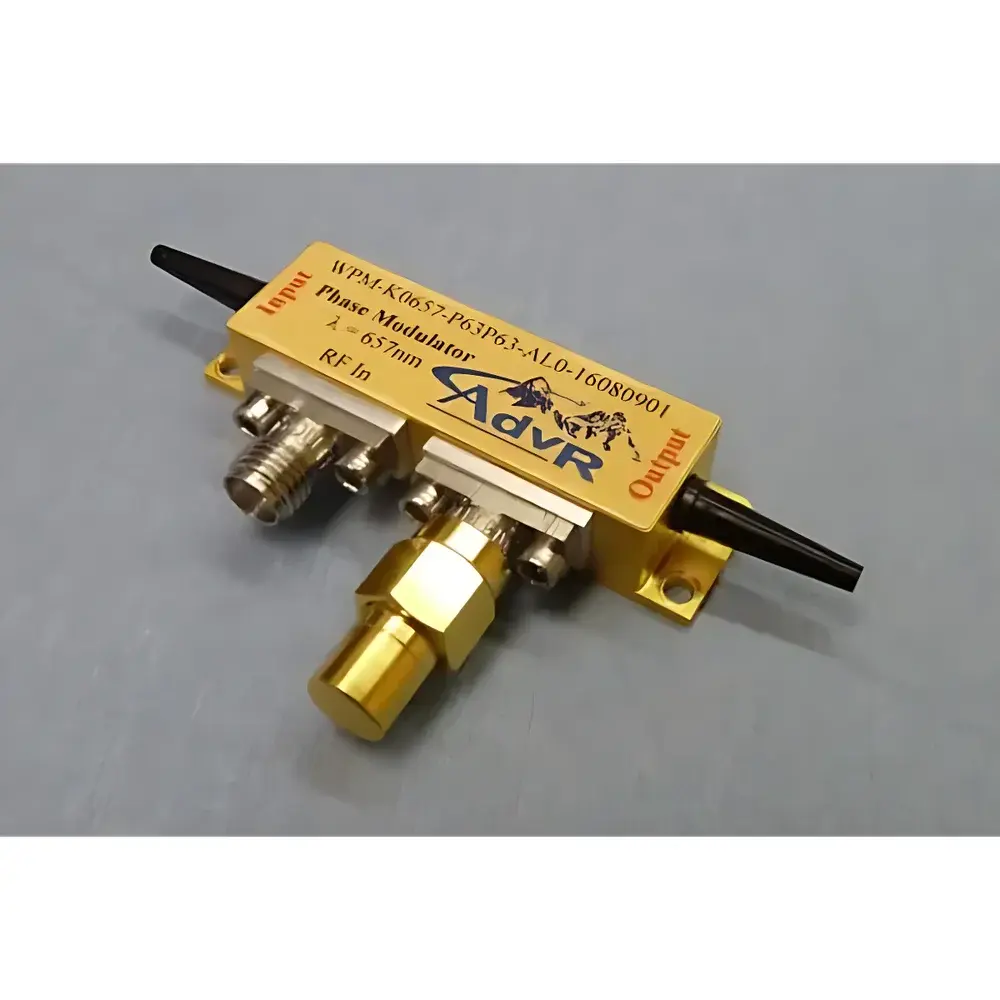
AdvR Visible-Light Phase Modulator
| Brand | AdvR |
|---|---|
| Origin | USA |
| Type | Fiber-Coupled Electro-Optic Phase Modulator |
| Wavelength Range | 397–1064 nm |
| Max. Optical Input Power | 1 W |
| Modulation Bandwidth | Up to 10 GHz |
| Insertion Loss | ≤ 5 dB |
| Half-Wave Voltage (Vπ) | 3–8 V (wavelength-dependent) |
| Polarization-Maintaining Fiber | PM400, PM480, PM630, PM780, PM850, PM980 |
| Compliance | RoHS, CE, ISO 9001-certified manufacturing |
Overview
The AdvR Visible-Light Phase Modulator is a high-performance, fiber-coupled electro-optic phase modulator engineered for precision phase control in visible and near-infrared quantum optical systems. Based on lithium niobate (LiNbO₃) waveguide technology with titanium diffusion and proton exchange fabrication, it operates via the linear electro-optic (Pockels) effect to induce controlled, voltage-driven phase shifts in propagating light without amplitude modulation. Designed specifically for cold atom physics applications—including laser cooling, magneto-optical trapping (MOT), optical lattice loading, and coherent Raman spectroscopy—the device delivers stable, low-noise phase modulation across a broad spectral range from 397 nm to 1064 nm. Its monolithic waveguide architecture ensures high polarization extinction ratio (>20 dB), excellent thermal stability, and long-term operational repeatability under vacuum-compatible and ultra-low-vibration laboratory conditions.
Key Features
- Fiber-pigtailed design with polarization-maintaining (PM) single-mode fibers—compatible with industry-standard PM400 (350–630 nm), PM480 (450–600 nm), PM630 (600–800 nm), PM780 (700–900 nm), PM850 (800–1000 nm), and PM980 (900–1100 nm) fiber types.
- High optical power handling: supports continuous-wave (CW) input up to 1 W at specified wavelengths—enabling integration into high-intensity MOT lasers and repumping beams without thermal lensing or photorefractive damage.
- Wide modulation bandwidth: DC to 10 GHz (3 dB roll-off), facilitating fast phase encoding for sideband generation, frequency shifting, and active stabilization of optical cavities in quantum memory and atomic clock architectures.
- Low insertion loss: ≤ 5 dB across all standard operating wavelengths, minimizing signal attenuation and preserving signal-to-noise ratio in cascaded optical setups.
- Wavelength-specific half-wave voltage (Vπ) ranging from 3 V (at 397 nm) to 8 V (at 657 nm and 780 nm), calibrated and characterized per unit—ensuring predictable, repeatable phase response for closed-loop feedback systems.
- Hermetically sealed, bench-top compatible package with SMA or K-type RF connectors; designed for integration into UHV-compatible optical tables and cryogenic environments (operational down to 4 K with appropriate thermal anchoring).
Sample Compatibility & Compliance
The modulator is optimized for use with atomic and ionic species requiring precise, narrow-linewidth laser addressing—including Ca⁺ (397 nm), Sr (689 nm, 698 nm), Yb (556 nm, 369 nm), Rb (780 nm, 795 nm), Cs (852 nm), Li (671 nm), and molecular transitions such as CaF (606 nm) and I₂ (532 nm). It complies with ISO 9001:2015 quality management standards throughout design, assembly, and test. All units undergo individual spectral characterization, polarization extinction verification, and RF impedance matching validation. The device meets RoHS Directive 2011/65/EU and carries CE marking for electromagnetic compatibility (EMC Directive 2014/30/EU) and low-voltage safety (LVD Directive 2014/35/EU). For regulated research environments, traceable calibration reports and full test data packages are available upon request to support GLP/GMP-aligned documentation workflows.
Software & Data Management
While the modulator itself is analog and driver-agnostic, AdvR provides comprehensive technical documentation—including S-parameter files, Vπ vs. wavelength curves, and thermal drift coefficients—for integration with LabVIEW, MATLAB, Python (via PyVISA or NI-DAQmx), and EPICS-based control systems. Users may pair the device with commercial RF drivers (e.g., Mini-Circuits ZVE-10W+, Analog Devices HMC-C044) supporting 50 Ω impedance and DC-coupled bias-T configurations. Built-in bias voltage ports enable active DC offset control for quadrature point stabilization—a critical requirement in Pound-Drever-Hall (PDH) locking and heterodyne interferometry. Audit-ready configuration logs and modulation waveform metadata can be exported via compatible DAQ hardware, satisfying traceability requirements under FDA 21 CFR Part 11 when deployed in regulated quantum sensor development labs.
Applications
- Laser cooling and trapping of neutral atoms (e.g., Sr, Yb, Mg) and ions (Ca⁺, Ba⁺, Eu⁺, Er⁺) using red- and blue-detuned sidebands generated via phase modulation.
- Coherent population trapping (CPT) and stimulated Raman adiabatic passage (STIRAP) in atomic vapor cells and optical lattices.
- Frequency comb stabilization and optical phase-locked loops (OPLLs) for optical atomic clocks and quantum logic gates.
- Visible-band free-space and fiber-based quantum communication links requiring low-jitter, high-fidelity phase encoding.
- Dynamic wavefront correction in adaptive optics systems interfaced with cold atom interferometers.
- Multi-frequency spectroscopic interrogation of narrow-linewidth transitions (e.g., 87Sr clock transition at 698 nm) with sub-Hz resolution capability.
FAQ
What fiber types are standard for different wavelength bands?
Standard options include PM400 (350–630 nm), PM480 (450–600 nm), PM630 (600–800 nm), PM780 (700–900 nm), PM850 (800–1000 nm), and PM980 (900–1100 nm); custom fiber pigtails are available upon request.
Is the modulator suitable for ultra-high vacuum (UHV) environments?
Yes—the hermetically sealed housing and absence of outgassing adhesives make it compatible with UHV chambers (<10⁻⁹ mbar); bake-out up to 80 °C is supported with proper RF connector selection.
Can multiple modulators be cascaded for higher phase depth?
Yes—low insertion loss and polarization fidelity enable series cascading; however, cumulative Vπ scaling and RF drive synchronization must be accounted for in system-level design.
Does AdvR provide calibration certificates with each unit?
Yes—each modulator ships with a factory calibration report including measured insertion loss, polarization extinction ratio, Vπ, and S21 response up to 10 GHz.
What is the typical lead time for custom wavelength or fiber configuration?
Standard configurations ship within 4–6 weeks; custom wavelengths or non-standard fiber types require 8–12 weeks due to waveguide fabrication and characterization cycles.
Related Products






