
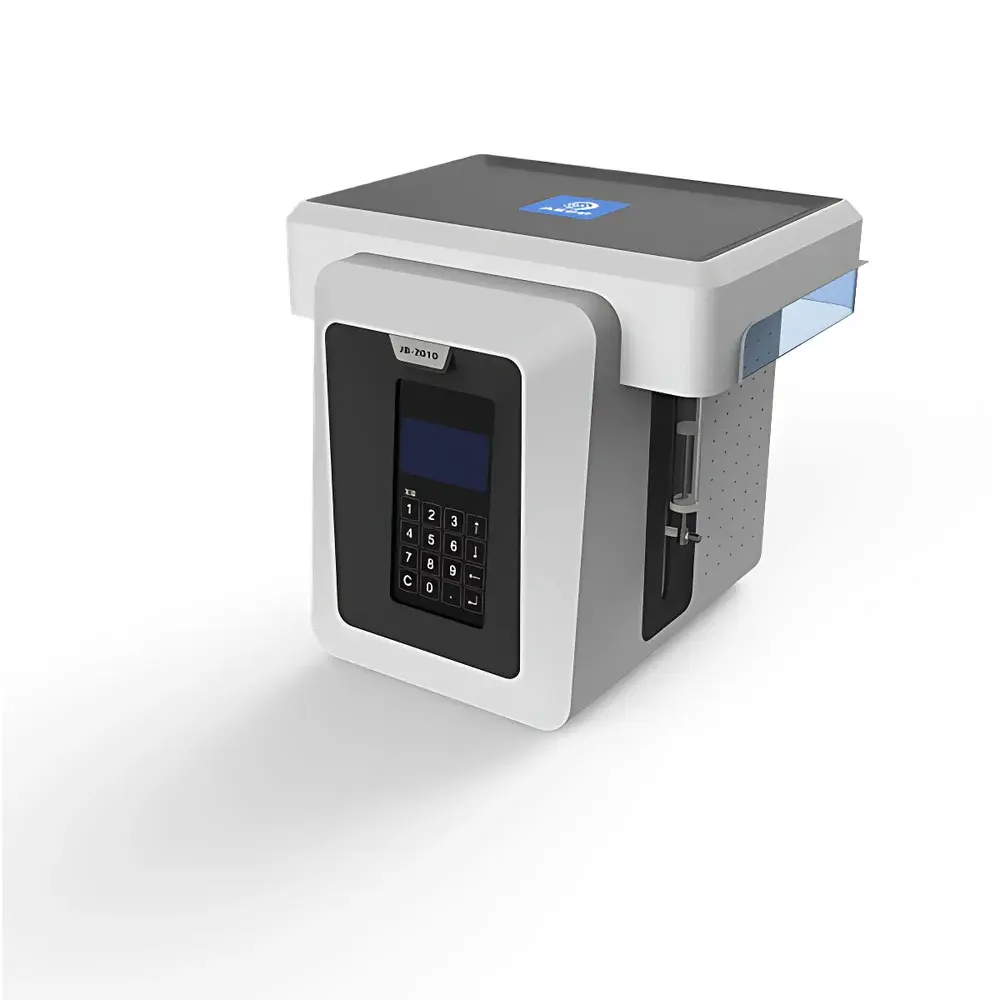
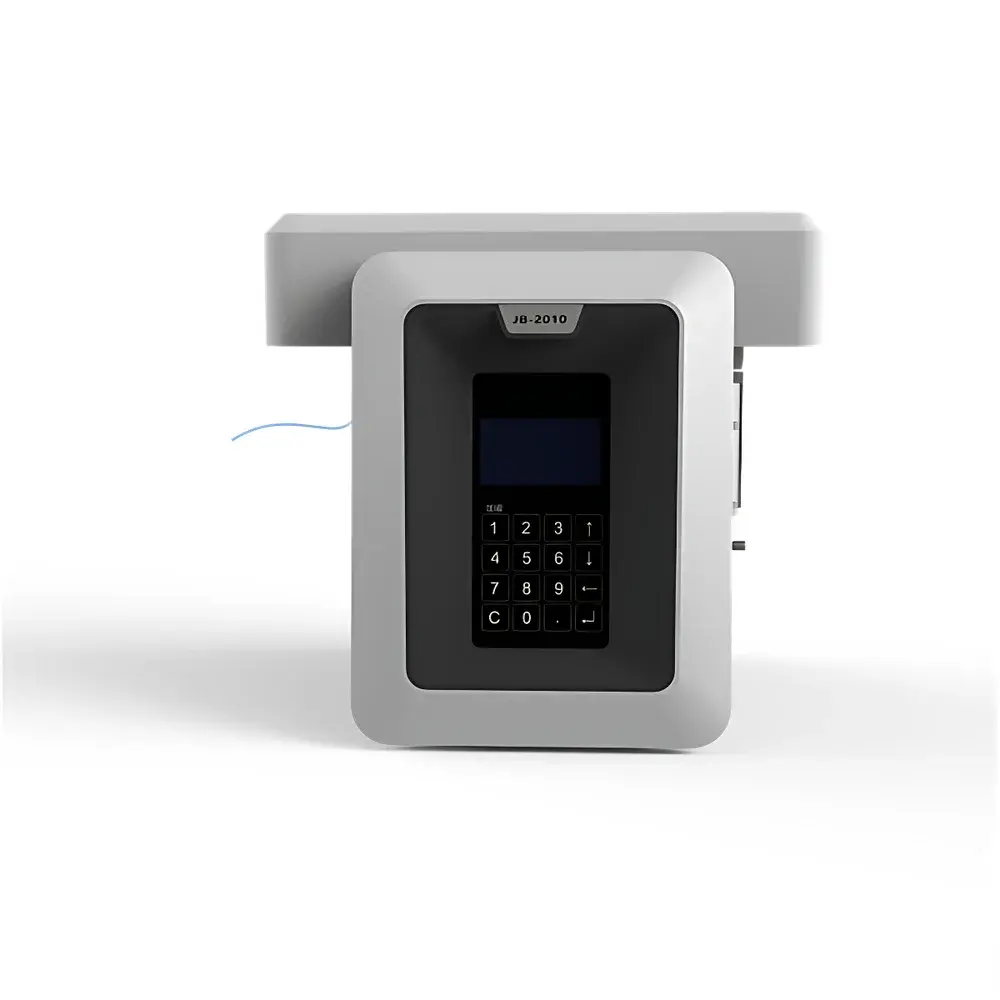
AECC JB-2010 Milliliter-Range Automated Spiking System
| Brand | AECC (Aviation Engine Corporation of China) |
|---|---|
| Origin | Beijing, China |
| Manufacturer Type | Authorized Distributor |
| Country of Origin | China |
| Model | JB-2010 |
| Instrument Type | Single-Channel Electric Pipettor |
| Automation Level | Motorized Piston-Driven |
| Volume Range | Customizable (Standard Configurations: 5 mL, 10 mL, 25 mL) |
| Minimum Dispense Volume | 0.5 mL (at 5 mL total capacity), 1.0 mL (at 10 mL or 25 mL capacity) |
| Accuracy | ±0.01% (relative error, per JJG 646 verification data) |
| Dispense Modes | Full-range aspiration or volume-specific aspiration |
| Cleaning Modes | Multi-cycle standard wash / Low-volume multi-step wash (reagent-saving mode) |
| Syringe Material | Borosilicate glass |
| Fluidic Path Materials | PTFE tubing and fittings |
| Compliance | Fully compliant with JJG 646–2018 “Verification Regulation for Pipettes” (China National Metrology Technical Specification) |
Overview
The AECC JB-2010 Milliliter-Range Automated Spiking System is a precision-engineered motorized piston pipettor designed for high-accuracy, repeatable liquid dispensing in analytical sample preparation workflows. Unlike conventional manual or semi-automated pipetting tools, the JB-2010 employs a closed-loop stepper motor coupled to a high-tolerance glass syringe plunger, enabling deterministic volumetric displacement based on calibrated linear actuation—not air displacement. This direct-displacement architecture eliminates compressibility errors inherent in air-cushion systems and ensures traceable, gravimetrically verifiable performance across its operational range (5–25 mL total capacity). The system is purpose-built for quantitative spiking applications—particularly internal standard addition, calibration curve preparation, and matrix-matched standardization—in regulated environments where metrological integrity, audit readiness, and inter-laboratory reproducibility are critical. Its design aligns with core principles of ISO/IEC 17025:2017 (clause 6.4.3 on equipment verification) and supports GLP/GMP-aligned workflows through deterministic operation and documented performance traceability.
Key Features
- High-precision borosilicate glass syringes with PTFE-sealed plungers and chemically inert PTFE fluidic pathways—ensuring compatibility with organic solvents, strong acids, and bases without adsorption or leaching.
- Dual-mode aspiration logic: full-range draw (for maximum throughput) or volume-specific draw (minimizing dead volume and reagent waste).
- Two programmable cleaning protocols: standard multi-cycle flush (for cross-contamination control) and low-volume multi-step rinse (optimized for precious stock solutions).
- Onboard calibration verification using gravimetric methods per JJG 646–2018; includes built-in reference tables mapping dispense volumes to certified error and RSD limits.
- Motor-driven piston positioning with sub-microliter positional resolution—enabling consistent dispense accuracy even at minimum volumes (e.g., 0.5 mL at 5 mL capacity with measured relative error ≤ ±0.05%).
- Modular mounting interface compatible with standard laboratory automation racks and robotic arms (ISO 8624-compliant footprint).
Sample Compatibility & Compliance
The JB-2010 accommodates aqueous, alcoholic, chlorinated, and polar aprotic solvents without degradation of sealing integrity or dimensional drift. Its glass/PTFE construction meets USP <661.1> requirements for Class VI plastic equivalency in contact materials. All performance claims are validated against JJG 646–2018, which specifies metrological criteria equivalent to ISO 8655–2 (piston-operated volumetric apparatus). While not FDA 21 CFR Part 11–certified out-of-the-box, the device supports integration into Part 11–compliant LIMS or ELN platforms via RS-232/USB serial command protocol (SCPI-compatible), enabling electronic audit trails, user access controls, and electronic signatures when deployed within validated IT infrastructure.
Software & Data Management
The JB-2010 operates via embedded firmware with no external PC dependency for basic spiking sequences. Optional USB-connected configuration software (Windows/Linux/macOS) allows creation and storage of up to 99 predefined spiking protocols—including volume, dwell time, rinse cycles, and aspiration mode. Each execution logs timestamp, operator ID (via optional RFID badge reader), dispense volume, and real-time motor step count. Raw log files export as CSV with ISO 8601 timestamps and UTF-8 encoding—facilitating import into statistical process control (SPC) dashboards or audit documentation systems. Firmware updates retain full backward compatibility with legacy protocol files and calibration records.
Applications
This instrument is routinely deployed in accredited chemical testing laboratories supporting aerospace material certification (e.g., metallic alloy digestion, coating solvent analysis), pharmaceutical QC (residual solvent quantification per ICH Q2(R2)), environmental monitoring (EPA Method 525.3–compatible spiking for LC-MS/MS analysis), and food safety labs (mycotoxin internal standard addition per AOAC 2012.01). Its ability to deliver sub-1% RSD at 1 mL dispense—verified under routine use conditions—makes it suitable for establishing calibration curves requiring ≤2% total uncertainty budgets (per EURACHEM/CITAC Guide CG4). It is also used in method validation studies to isolate operator-induced variability from analytical system noise.
FAQ
What volume ranges are factory-calibrated and verified?
Standard configurations are supplied with full JJG 646–2018 verification reports for 5 mL, 10 mL, and 25 mL syringes. Custom ranges (e.g., 2 mL or 15 mL) are available upon request and subject to individual metrological validation.
Can the JB-2010 be integrated into a robotic liquid handling workstation?
Yes—its mechanical footprint and command-set comply with ISO 8624 and SLAS ANSI standards. OEM integration kits include mounting brackets, I/O trigger lines, and SCPI command documentation.
Is third-party calibration support available outside China?
AECC-authorised service partners in Germany, Singapore, and the USA provide on-site verification against local national standards (e.g., DKD, A2LA-accredited labs), with certificates referencing NIST-traceable mass standards.
How is carryover controlled during sequential spiking of different standards?
The dual-mode cleaning protocol—especially the low-volume multi-step rinse—reduces residual carryover to <50 ppb (validated via blank spike recovery tests with deuterated analogues), meeting ASTM D7097 requirements for trace-level organic analysis.
Does the system support variable dispensing speeds?
Yes—dispense velocity is programmable from 0.1 mL/s to 5 mL/s in 0.1 mL/s increments, allowing optimization for viscous matrices (e.g., glycerol-based standards) or volatile solvents (e.g., dichloromethane) to minimize evaporation or splashing.



