
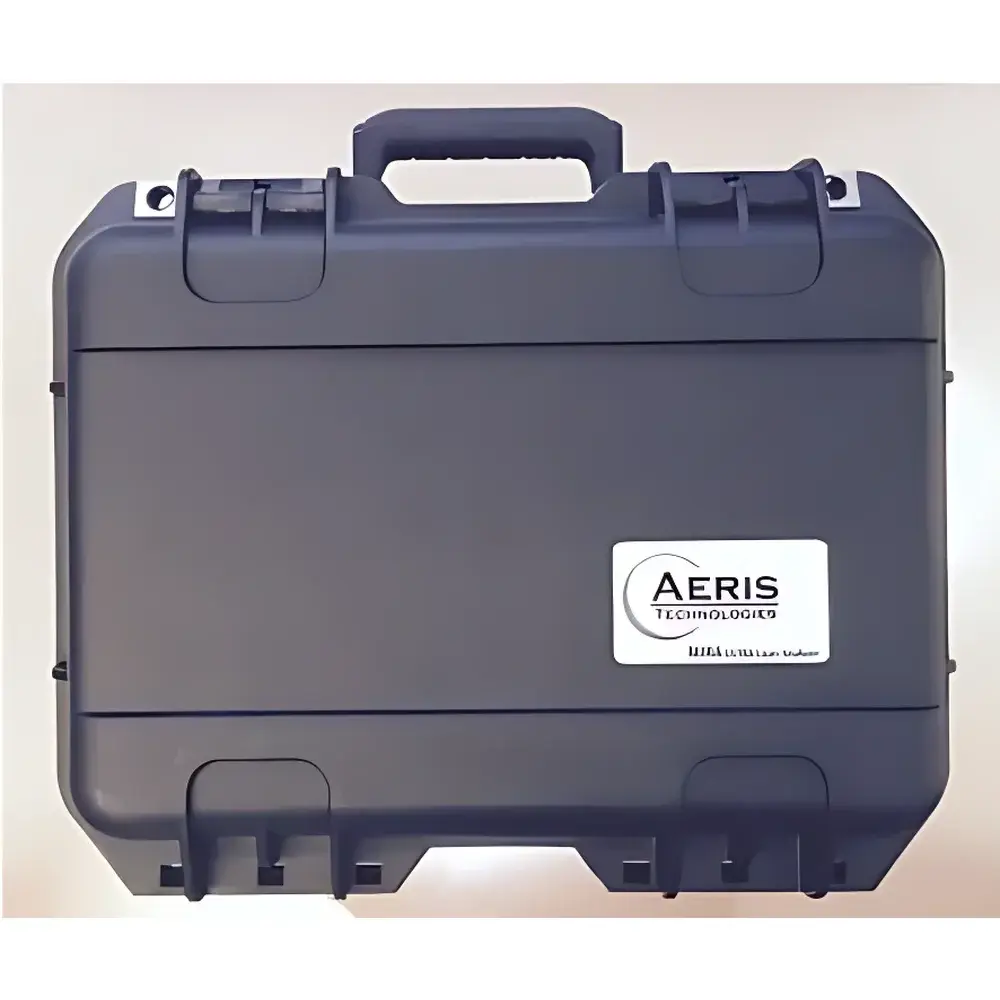
Aeris Technologies MIRA OCS Carbonyl Sulfide Analyzer
| Brand | Aeris Technologies |
|---|---|
| Origin | USA |
| Manufacturer Status | Authorized Distributor |
| Origin Category | Imported |
| Model | MIRA OCS |
| Price | Upon Request |
Overview
The Aeris Technologies MIRA OCS Carbonyl Sulfide Analyzer is a field-deployable, high-precision gas analyzer engineered for quantitative measurement of carbonyl sulfide (OCS) at sub-part-per-trillion (sub-ppt) sensitivity levels. It employs tunable mid-infrared (MIR) laser absorption spectroscopy — a technique leveraging the strong fundamental vibrational–rotational absorption bands of OCS near 4.87 µm — to achieve orders-of-magnitude higher cross-sections than near-infrared (NIR) methods. This physical advantage enables exceptional signal-to-noise ratio and inherent specificity, eliminating spectral interferences common in broadband or UV-based sensors. The optical detection cell is mirrorless, monolithic, and fabricated from chemically inert, thermally stable materials, delivering a 15-meter effective optical path within a compact 60 mL volume. Unlike conventional multipass cells requiring precision-aligned mirrors susceptible to misalignment and contamination, this solid-state architecture ensures long-term mechanical robustness, immunity to vibration, and minimal maintenance. The system simultaneously quantifies OCS and H2O mole fractions in real time, enabling direct dry-air concentration calculation without external drying or post-processing correction. Its operational principle complies with the foundational spectroscopic requirements outlined in ISO 14644-9 (cleanroom air monitoring) and supports trace-gas metrology workflows aligned with WMO GAW (Global Atmosphere Watch) recommendations for atmospheric composition instrumentation.
Key Features
- Sub-ppt detection limit: 35 ppt (1σ, 1-minute integration); <10 ppt (1σ, 15-minute averaging)
- Real-time dual-species measurement: OCS and H2O at 1–2 Hz native output rate (up to 10 Hz via RS-232)
- Mirrorless, monolithic MIR absorption cell: 15 m pathlength in 60 mL volume; no alignment drift or mirror degradation
- Differential temperature-compensated detection algorithm: mitigates thermal baseline drift to <50 ppt (30 s σ)
- Integrated sample pump and flow control: maintains stable pressure and residence time across ambient conditions
- Auto-zero calibration routine: user-definable interval (e.g., hourly, daily), fully automated without consumables or manual intervention
- Ultra-low power consumption: 15 W (MIRA Pico), 17 W (Strato), 25 W (Ultra); compatible with battery, vehicle, or AC operation
- Onboard 32 GB non-volatile memory with optional expansion; timestamped data logging compliant with GLP audit trails
- Multi-interface connectivity: Wi-Fi, USB 2.0, RS-232 (full-duplex, up to 115.2 kbps), and analog voltage outputs (0–5 V or 4–20 mA, optional)
Sample Compatibility & Compliance
The MIRA OCS Analyzer accepts ambient air, soil flux chamber headspace, eddy covariance stack samples, and UAV-borne atmospheric intakes without preconditioning. It operates reliably across 10–40 °C and 10–95% RH (non-condensing), with Ultra-series models incorporating active thermal stabilization of the optical cell at 42 ± 0.005 °C to suppress thermal expansion-induced wavelength drift. All variants meet IEC 61326-1 (EMC for laboratory and industrial use) and are designed to support regulatory-grade data collection under EPA Method TO-15 adjunct protocols for trace sulfur compounds. While not certified as Class I Div 1 hazardous area equipment, its low-power electronics and sealed optical path make it suitable for outdoor deployment per NEMA 4X guidelines when housed in appropriate enclosures. Data integrity features — including immutable timestamps, firmware-signed logs, and configurable audit trail logging — align with FDA 21 CFR Part 11 requirements for electronic records in environmental research applications.
Software & Data Management
Instrument control, real-time visualization, and data export are managed via Aeris’ proprietary MIRA Control Suite (Windows/macOS/Linux), which supports remote configuration over Wi-Fi or Ethernet. The software implements automatic baseline correction using concurrent H2O absorption modeling, exports time-synchronized CSV/NetCDF files with SI-traceable units (mol/mol), and generates KML files when GPS is enabled — enabling georeferenced plume mapping in Google Earth or QGIS. Firmware updates preserve calibration coefficients and user-defined settings. Raw spectral data (interferograms or absorbance spectra) can be exported for third-party spectral fitting (e.g., HITRAN-based line-by-line analysis). Memory management includes circular buffer overwrite protection and SD-card hot-swap capability. All communication protocols adhere to RFC 7231 (HTTP/1.1) and RFC 7644 (SCIM) standards for interoperability with cloud-based environmental data platforms (e.g., ICOS, AmeriFlux).
Applications
- Soil–plant–atmosphere continuum studies: Quantifying OCS uptake as a photosynthetic proxy co-located with CO2 and H2O flux towers
- Wetland and coastal ecosystem monitoring: Resolving diel OCS cycles linked to microbial sulfur metabolism and photochemical oxidation
- UAV-based vertical profiling: Strato variant enables boundary-layer OCS gradient measurements up to 1,200 m AGL
- Mobile ground surveys: Pico and Ultra portable configurations support transect mapping of industrial perimeter emissions or urban background gradients
- Calibration transfer and intercomparison: Serving as a transportable reference standard for validating GC-MS or DNPH-HPLC lab analyses
- Long-term unattended operation: Autonomous deployment in remote sites (e.g., Arctic tundra, alpine meadows) with solar-charged battery systems
FAQ
What is the fundamental measurement principle used by the MIRA OCS Analyzer?
It uses direct absorption spectroscopy with a quantum cascade laser (QCL) operating in the mid-infrared region (4.87 µm), targeting the ν3 fundamental band of OCS.
Does the instrument require consumables or periodic sensor replacement?
No. The solid-state optical path contains no consumable optics, electrochemical cells, or chemical scrubbers. Only routine inlet filter replacement is recommended every 3–6 months depending on particulate load.
How is water vapor interference handled during OCS quantification?
H2O is measured concurrently using a secondary absorption feature within the same spectral scan; dry-mole-fraction OCS is computed in real time using established water vapor dilution corrections.
Can the MIRA OCS meet data quality objectives for WMO GAW or ICOS network compliance?
Yes — when deployed with documented calibration history, environmental metadata logging, and traceable zero/span verification, it satisfies ICOS Level 2 data submission criteria for OCS.
Is factory calibration transferable between units?
Each unit undergoes individual line-strength validation against NIST-traceable OCS standards; calibration coefficients are embedded in firmware and not interchangeable between analyzers.







