
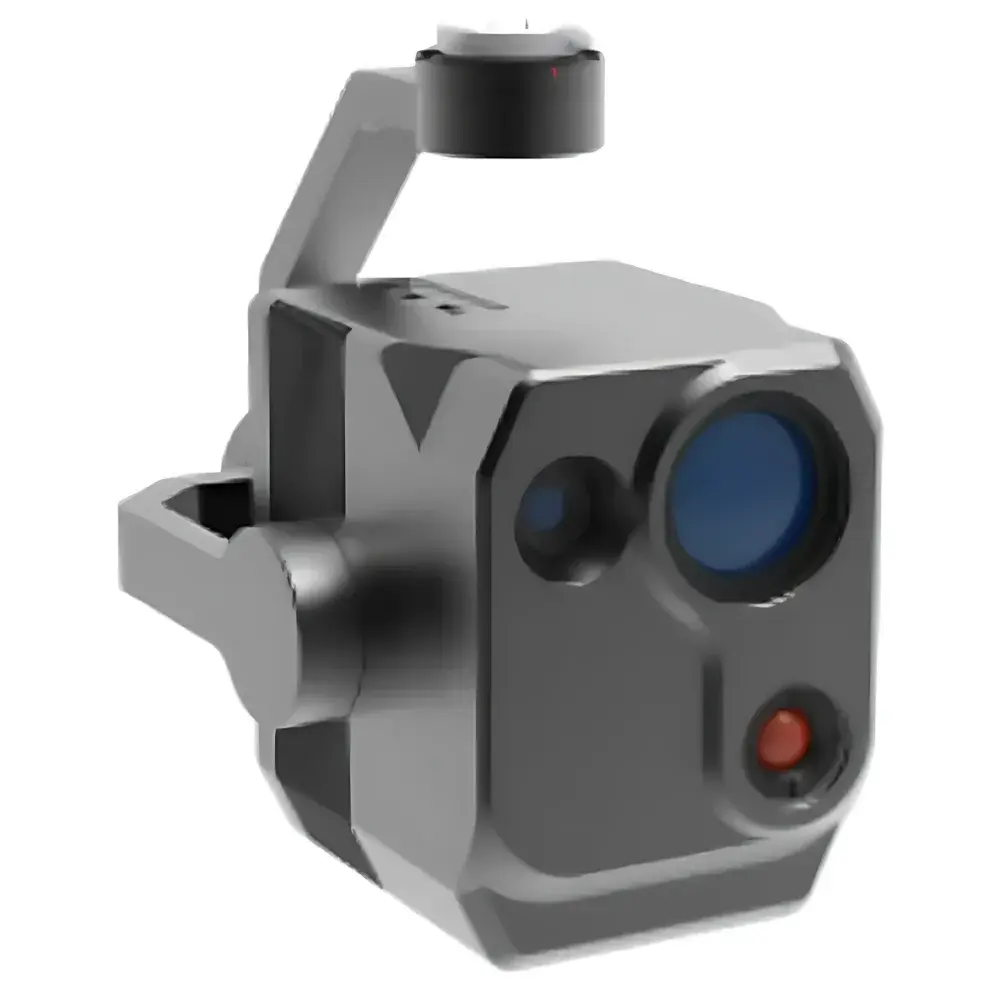
AERO AFX1700-IR Integrated Hyperspectral and Thermal Infrared Imaging System
| Brand | AERO |
|---|---|
| Origin | Beijing, China |
| Manufacturer Type | Authorized Distributor |
| Country of Origin | China |
| Model | AFX1700-IR |
| Operating Principle | Push-broom |
| Imaging Method | Dispersive |
| Platform Compatibility | Ground-based and UAV-mounted |
| Spectral Range | 900–1700 nm (VNIR/SWIR HSI) + 8–14 µm (LWIR thermal) |
| Thermal Spatial Resolution | 640 × 512 pixels (full-frame radiometric temperature mapping) |
| Maximum Data Acquisition Rate | ≥500 Hz across full spectral bands |
| Total Field of View (TFOV) | 35.5° |
| Instantaneous Field of View (IFOV) | 3.5 mrad |
| RGB Camera Resolution | 26 MP |
| System Mass | <2.5 kg |
Overview
The AERO AFX1700-IR is an integrated push-broom hyperspectral and long-wave infrared (LWIR) imaging system engineered for synchronized, multi-modal remote sensing from unmanned aerial vehicles (UAVs) or ground-based platforms. It combines three complementary imaging modalities—visible-near infrared/short-wave infrared (VNIR/SWIR) hyperspectral imaging (900–1700 nm), uncooled microbolometer-based thermal infrared imaging (8–14 µm), and a high-resolution 26-megapixel RGB camera—within a single, compact, and flight-qualified enclosure. The system operates on the principle of spatial scanning: as the platform moves forward, the sensor captures line-by-line spectral data across its full field of view, enabling precise georeferenced spectral cube generation (x, y, λ). Simultaneously, the thermal module delivers calibrated radiometric output at native 640 × 512 pixel resolution, supporting full-frame temperature mapping without interpolation. This architecture ensures temporal synchronization between spectral, thermal, and visual data streams—critical for quantitative analysis in environmental monitoring, precision agriculture, industrial thermography, and defense-related reconnaissance.
Key Features
- Triple-sensor fusion: Co-aligned VNIR/SWIR hyperspectral imager (900–1700 nm), LWIR thermal camera (8–14 µm), and 26 MP RGB imager—all rigidly mounted and factory-calibrated for sub-pixel spatial registration.
- Push-broom acquisition architecture with dispersive prism-grating optics, delivering high spectral fidelity and minimal smile/keystone distortion across the full 35.5° TFOV.
- Real-time onboard control unit integrating GNSS/IMU (high-precision inertial measurement unit) for direct georeferencing and motion compensation—eliminating need for post-flight orthorectification in many operational scenarios.
- Onboard solid-state storage (≥512 GB) with lossless data recording at ≥500 Hz frame rate across all spectral bands; supports external trigger input and time-synchronized metadata logging (UTC timestamp, attitude, position, exposure).
- Lightweight, ruggedized housing (<2.5 kg total mass) compliant with Class I UAV payload constraints; designed for rapid integration onto DJI Matrice, Freefly Alta, or custom VTOL platforms via standardized mechanical and electrical interfaces (MIL-STD-1553, CAN bus, RS-422).
Sample Compatibility & Compliance
The AFX1700-IR is not sample-contacting and requires no consumables or sample preparation—making it suitable for non-invasive, large-area survey applications. Its optical design accommodates variable standoff distances (0.5 m to >500 m), enabling both close-range inspection (e.g., solar panel defect detection, building envelope thermal leakage) and wide-area mapping (e.g., watershed vegetation stress, volcanic surface temperature anomalies). Radiometric calibration is traceable to NIST standards via dual-point blackbody reference sources (−10 °C to +80 °C range) integrated into the thermal subsystem. The system complies with IEC 61000-6-3 (EMC emissions) and IEC 60068-2 environmental stress testing protocols. Data formats adhere to HDF5 and ENVI-compatible BIL/BIP conventions, facilitating interoperability with GIS platforms (ArcGIS, QGIS) and spectral analysis toolkits (Python scikit-image, MATLAB Hypercube Toolbox).
Software & Data Management
The AFX1700-IR ships with AEROView™ — a cross-platform (Windows/Linux) application for mission planning, real-time telemetry monitoring, raw data ingestion, and Level 1 radiometric correction. It supports batch processing of hyperspectral cubes using standard atmospheric correction models (QUAC, FLAASH) and enables pixel-wise emissivity estimation through multi-band thermal-radiative transfer modeling. All calibration parameters, IMU logs, and GPS ephemeris are embedded in metadata headers per IEEE 1278.2-2021 standards. Audit trails—including user login timestamps, processing history, and parameter modifications—are maintained in SQLite-based logs to support GLP-compliant workflows. Export options include GeoTIFF (georeferenced reflectance/emissivity rasters), CSV (spectral profiles), and NetCDF-4 (for climate modeling integration).
Applications
- Agricultural monitoring: Detection of water stress, nitrogen deficiency, and early disease onset via combined SWIR absorption features (e.g., 1450 nm, 1900 nm) and canopy temperature gradients.
- Renewable energy infrastructure: Thermographic identification of hotspots in photovoltaic arrays and wind turbine composite blades under operational load.
- Environmental compliance: Quantitative mapping of methane plumes (via SWIR absorption at 1650 nm) coupled with thermal boundary layer analysis over landfill sites or oil/gas facilities.
- Urban heat island studies: High-resolution surface temperature mapping (±0.5 °C accuracy) correlated with land-use classification derived from VNIR/SWIR spectral unmixing.
- Military and border surveillance: Day/night persistent monitoring leveraging spectral anomaly detection (e.g., camouflage vs. natural vegetation) and thermal contrast enhancement in low-visibility conditions.
FAQ
Is the AFX1700-IR compatible with third-party UAV autopilots such as Pixhawk or ArduPilot?
Yes—the system provides MAVLink-compatible telemetry outputs and accepts mission commands via UART/USB, enabling seamless integration with open-source autopilot ecosystems.
Does the thermal module support radiometric calibration in-flight?
No—radiometric calibration is performed pre-flight using internal blackbody references; however, non-uniformity correction (NUC) is applied automatically before each acquisition sequence.
Can spectral data be processed in real time onboard the UAV?
Basic band math and NDVI calculation are supported in real time; full spectral unmixing or machine learning inference requires post-processing on ground stations due to computational constraints.
What spectral libraries are included for material identification?
The software includes the USGS Digital Spectral Library v7, ECOSTRESS spectral database, and AERO’s proprietary mineral and vegetation signature library (n = 1,247 spectra), all searchable via spectral angle mapper (SAM) and matched filtering algorithms.
Is FDA 21 CFR Part 11 compliance available for regulated industries?
While the base system does not include electronic signature or role-based access controls, optional firmware and software modules can be deployed to meet 21 CFR Part 11 requirements for audit trail integrity and user authentication.
Related Products





