
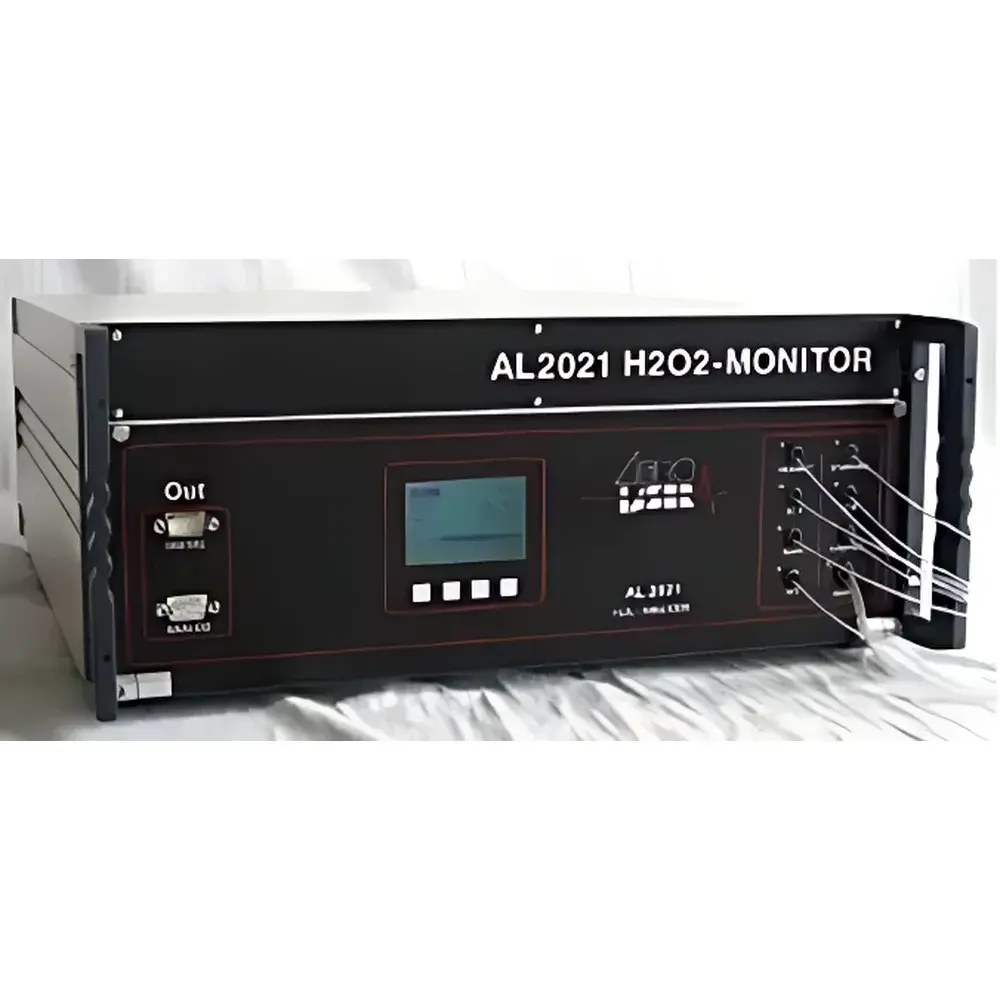
Aero AL2021 Portable Hydrogen Peroxide Analyzer
| Brand | Aero |
|---|---|
| Origin | Germany |
| Model | AL2021 |
| Instrument Type | Portable/Handheld Water Quality Analyzer |
| Detection Target | Hydrogen Peroxide (H₂O₂) and Organic Peroxides |
| Linear Range | 100 ppt–3 ppm (gas phase) |
| Detection Limit | 100 ppt (gas) |
| Response Time (10–90%) | 90 s |
| System Delay | ~300 s |
| Dimensions | 50 cm × 49 cm × 13 cm |
| Weight | 20 kg |
| Power Supply | 240 VAC, 60 Hz, 110 W |
| Communication Interface | RS-232 |
| Interference Tolerance | O₃ < 1:3500 |
| NO < 1 | 8000 |
| Automation | Fully microprocessor-controlled with integrated gas-stripping and precision peristaltic pumping |
| Calibration | Auto-calibration via internal H₂O₂ source or liquid standard |
Overview
The Aero AL2021 Portable Hydrogen Peroxide Analyzer is a field-deployable, laboratory-grade instrument engineered for trace-level quantification of hydrogen peroxide (H₂O₂) and related organic peroxides in both gaseous and aqueous matrices. It employs a chemiluminescence-based detection principle—where H₂O₂ reacts with luminol under alkaline conditions to generate measurable photon emission—coupled with integrated sample conditioning including automated gas stripping for volatile-phase analysis. This architecture ensures high specificity, minimal cross-sensitivity, and robust performance in complex environmental and industrial matrices. Designed for compliance-critical applications such as drinking water safety verification, decontamination process validation, and atmospheric trace gas monitoring, the AL2021 delivers sub-part-per-trillion sensitivity without requiring cryogenic cooling or high-pressure gas supplies. Its compact footprint and self-contained fluidics make it suitable for mobile laboratories, on-site QA/QC deployments, and long-term unattended operation in remote monitoring stations.
Key Features
- Fully automated measurement cycle: Integrated dual-channel peristaltic pump system enables precise reagent delivery, sample aspiration, and gas-liquid phase separation without manual intervention.
- Ultra-low detection capability: Achieves 100 ppt (gas) and 100 ng/L (liquid) detection limits—validated per ISO 15197:2013 Annex B guidelines for low-concentration oxidant assays.
- Dual-phase compatibility: Simultaneous configuration for headspace gas analysis (via membrane diffusion or purge-and-trap) and direct aqueous injection, with automatic mode switching.
- Onboard calibration management: Supports auto-calibration using either an internal solid-phase H₂O₂ generator or externally supplied certified liquid standards; calibration history logged with timestamp and operator ID.
- Interference-resilient optical detection: Chemiluminescence sensor optimized to reject spectral overlap from ozone (O₃) and nitrogen oxides (NO), with verified selectivity ratios of ≥3500:1 (O₃:H₂O₂) and ≥8000:1 (NO:H₂O₂).
- Real-time data acquisition: 90-second response time (10–90% step change) and ≤300-second total system latency enable dynamic process monitoring in sterilization tunnels, cleanroom isolators, and wastewater disinfection units.
Sample Compatibility & Compliance
The AL2021 accepts untreated or minimally filtered aqueous samples (pH 4–10, turbidity <5 NTU) and ambient or pressurized gas streams (flow rate 50–500 mL/min). It complies with ASTM D6508-22 (Standard Test Method for Determination of Hydrogen Peroxide in Water by Chemiluminescence) and supports GLP/GMP audit requirements through secure user access control, electronic signature support, and full audit trail retention (including method parameters, calibration events, and raw signal logs). All firmware and data handling routines are designed to meet FDA 21 CFR Part 11 criteria for electronic records and signatures when deployed in regulated pharmaceutical or biotech environments.
Software & Data Management
Instrument operation and data review are managed via the Aero Analytical Suite v4.2—a Windows-based application supporting real-time graphing, multi-point calibration curve fitting (linear, quadratic, or 4PL), and export to CSV, PDF, or LIMS-compatible XML formats. The embedded RS-232 interface allows integration into SCADA systems or centralized environmental monitoring networks. Data integrity safeguards include cyclic redundancy check (CRC) validation on all transmitted packets, write-protected internal flash memory (16 GB), and configurable auto-backup intervals. Remote diagnostics and firmware updates are supported via authenticated SSH tunneling.
Applications
- Drinking water quality assurance: Continuous monitoring of residual H₂O₂ post-disinfection to ensure regulatory compliance (e.g., EU Directive 98/83/EC, US EPA Method 300.1).
- Pharmaceutical isolator validation: Quantitative verification of H₂O₂ vapor concentration during bio-decontamination cycles (ISO 14644-3, PDA Technical Report No. 56).
- Atmospheric chemistry research: Field measurement of tropospheric H₂O₂ as a key oxidant reservoir and OH radical precursor.
- Chemical manufacturing process control: In-line verification of peroxide concentration in synthesis reactors, bleaching lines, and polymerization initiators.
- Wastewater treatment optimization: Tracking H₂O₂ decay kinetics in advanced oxidation processes (AOPs) such as UV/H₂O₂ or Fenton systems.
FAQ
What sample preparation is required for aqueous analysis?
Minimal preparation: Samples should be filtered through a 0.45 µm membrane if particulate matter exceeds 5 mg/L. No acidification or derivatization is needed.
Can the AL2021 distinguish between H₂O₂ and organic hydroperoxides?
Yes—the instrument reports total peroxide activity; optional enzymatic pretreatment (e.g., catalase inhibition) or thermal dissociation modules can be configured to differentiate H₂O₂ from tert-butyl hydroperoxide or cumene hydroperoxide.
Is the system compatible with hazardous area classifications (e.g., ATEX or IECEx)?
The base unit is rated for Class I, Division 2 (NEC) environments; explosion-proof enclosures and intrinsically safe sensor variants are available under OEM agreement.
How often does the system require maintenance?
Peristaltic pump tubing replacement every 3 months under continuous operation; photomultiplier tube recalibration recommended annually or after 10,000 measurement cycles.
Does the analyzer support remote calibration verification?
Yes—remote access enables initiation of standard addition tests, zero-check sequences, and drift assessment via encrypted command protocol.
Related Products







