
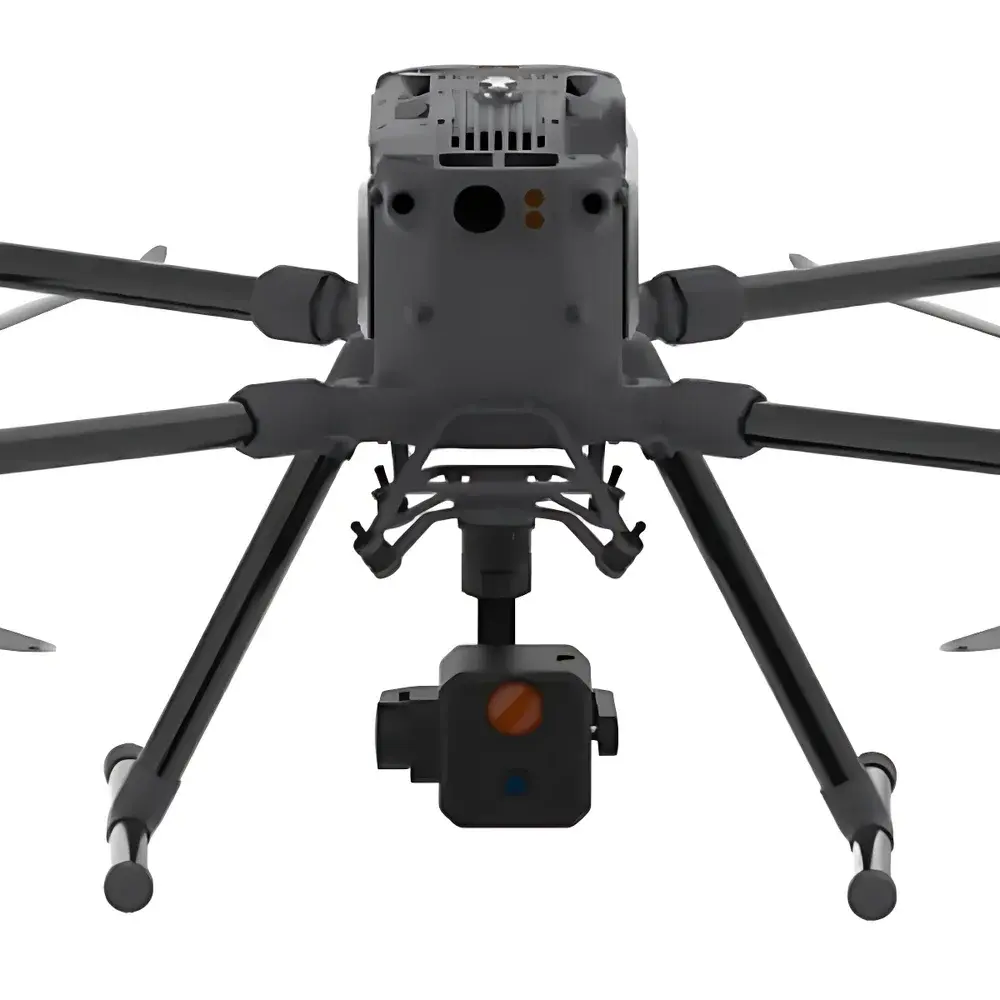
AERO AMIR-640R Airborne Mid-Wave Infrared Imaging Radiometer
| Brand | AERO |
|---|---|
| Origin | Beijing, China |
| Manufacturer Type | Authorized Distributor |
| Origin Category | Domestic (China) |
| Model | AMIR-640R |
| Operating Temperature | Cooled |
| Measurement Method | Non-contact |
| Application Type | Radiometric Thermography |
| Detector Type | Stirling-cooled InSb FPA |
| Spectral Range | 3.7–4.8 µm |
| Thermal Sensitivity (NETD) | ≤22 mK |
| Infrared Resolution | 640 × 512 pixels |
| Temperature Range | −10 °C to +110 °C |
| Accuracy | Not specified per factory datasheet |
| Frame Rate | 25 Hz / 50 Hz |
| Mounting Interface | DJI SkyPort-compatible quick-release gimbal |
| Onboard Storage | 512 GB high-speed UHS-II microSD |
| Weight | <1.2 kg (system with gimbal) |
| Environmental Rating | IP54 (gimbal-integrated) |
Overview
The AERO AMIR-640R is a high-performance, airborne mid-wave infrared (MWIR) imaging radiometer engineered for quantitative thermal mapping from unmanned aerial platforms. It operates on the fundamental principle of calibrated radiometric detection in the 3.7–4.8 µm atmospheric transmission window—where thermal emission from objects near ambient temperature exhibits strong spectral contrast and minimal solar reflectance interference. Unlike uncooled microbolometer-based systems, the AMIR-640R integrates a Stirling-cooled indium antimonide (InSb) focal plane array (FPA), enabling superior thermal resolution (NETD ≤22 mK) and temporal stability essential for scientific-grade thermography and regulatory-compliant thermal surveys. Designed specifically for integration with DJI Matrice 300 RTK and M350 RTK platforms via SkyPort interface, it delivers synchronized georeferenced radiometric video streams and stills without external power or data bridging hardware.
Key Features
- Stirling-cooled InSb detector with 640 × 512 pixel resolution, optimized for MWIR spectral band (3.7–4.8 µm)
- High-fidelity radiometric calibration traceable to NIST-traceable blackbody sources; supports user-defined emissivity input and reflected apparent temperature compensation
- Dual-frame-rate operation (25 Hz / 50 Hz) with full-resolution output and zero-motion blur under dynamic flight conditions
- Integrated precision gimbal with passive/active stabilization—tool-free quick-mount design compliant with DJI SkyPort mechanical and electrical specifications
- Onboard 512 GB UHS-II microSD storage with FAT32/exFAT formatting support; records raw 16-bit radiometric frames with embedded GPS/IMU metadata (UTC timestamp, latitude, longitude, altitude, pitch/roll/yaw)
- Lightweight modular architecture (<1.2 kg total system mass) meeting UAV payload constraints for extended endurance missions
- IP54-rated enclosure for operational reliability in dust-prone and light-rain environments typical of industrial inspection and environmental monitoring
Sample Compatibility & Compliance
The AMIR-640R is suitable for non-contact surface temperature measurement of diverse materials—including composites, metals, asphalt, vegetation, and electrical insulation—provided appropriate emissivity values are assigned during post-processing or real-time analysis. Its spectral response avoids strong CO₂ and H₂O absorption bands, ensuring stable radiometric performance across variable humidity levels. While not certified to IEC 61215 (PV module testing) or ASTM E1934 (quantitative thermography) out-of-the-box, its raw data format (radiance-coded TIFF with embedded calibration coefficients) enables full compliance when processed using validated third-party software (e.g., FLIR Tools+, ThermoAnalytics IRBIS, or custom Python/Matlab pipelines). The system meets electromagnetic compatibility (EMC) requirements per EN 55032 Class B and operates within CE-conformant safety limits for airborne electronic equipment.
Software & Data Management
The AMIR-640R outputs standardized 16-bit radiometric TIFF sequences with embedded EXIF-like metadata, including calibrated radiance values, shutter time, detector temperature, and synchronized GNSS/INS pose data. AERO provides the AMIR Control Suite—a cross-platform application (Windows/macOS/Linux) supporting real-time streaming preview, manual/automatic gain control, region-of-interest (ROI) temperature statistics, and batch export to CSV or HDF5. All stored datasets include audit-trail logs compliant with GLP principles (user ID, session timestamp, parameter settings), though native 21 CFR Part 11 electronic signature functionality requires integration with enterprise LIMS or validated third-party validation packages. Raw data is fully interoperable with open-source tools such as OpenCV, scikit-image, and GDAL for orthorectification, thermal mosaic generation, and AI-driven anomaly detection workflows.
Applications
- Power infrastructure inspection: hotspot detection on transformers, insulators, and transmission lines under load
- Renewable energy asset management: thermal defect identification in photovoltaic arrays (hot spots, cracked cells, bypass diode failure)
- Industrial predictive maintenance: bearing temperature profiling, refractory lining assessment, and steam trap verification
- Environmental science: surface temperature mapping of urban heat islands, wetland evapotranspiration estimation, and wildfire perimeter tracking
- Research-grade UAV-based thermography: validation of CFD models, material emissivity characterization, and boundary-layer thermal analysis
FAQ
Is the AMIR-640R compatible with non-DJI UAV platforms?
Yes—via custom mounting brackets and UART/RS-422 interface; however, full SkyPort-level synchronization (trigger, telemetry, power negotiation) is only guaranteed on DJI Matrice 300/350 RTK series.
Does the system support real-time radiometric video streaming over Wi-Fi or LTE?
No—real-time streaming is limited to low-resolution JPEG previews; full-resolution radiometric data is recorded onboard for post-mission download and processing.
Can the NETD specification be verified in-field?
Yes—using a two-point blackbody calibration source (e.g., CI Systems BB-2000-MW) and ISO 18434-1 methodology; AERO provides test procedures and uncertainty budget templates upon request.
What is the recommended recalibration interval?
Annual recalibration against traceable blackbody standards is advised for metrological continuity; detector cooldown cycle life exceeds 15,000 hours under normal operating conditions.
Is raw radiance data export supported without proprietary software?
Yes—TIFF files contain linear radiance values (W·sr⁻¹·m⁻²) in header tags compliant with TIFF/EP standard; no license key or dongle is required to access pixel-level data.




