
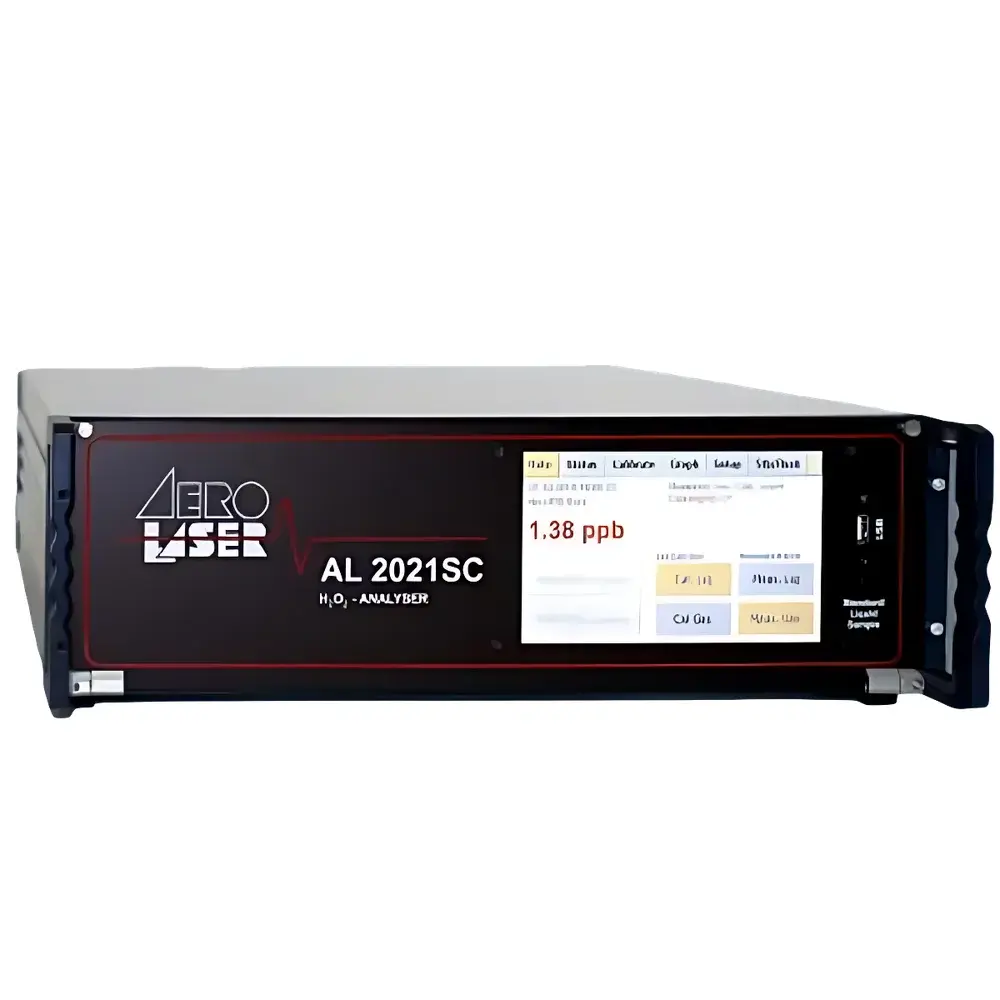
Aero Laser AL2021SC Continuous Hydrogen Peroxide Monitor
| Brand | Aero Laser |
|---|---|
| Origin | Italy |
| Model | AL2021SC |
| Detection Principle | Enzyme-catalyzed fluorometric assay (horseradish peroxidase or catalase-based) |
| Linear Range | 0.1–2000 ppb (gas phase), 150 ng/L–5 mg/L (liquid phase) |
| LOD | <100 ppt (gas), <150 ng/L (liquid), <2×10⁻⁹ mol (liquid) |
| Response Time (10–90%) | 90 s |
| System Delay | ~300 s |
| Noise Level | ≤2% FS |
| Sample Temp. Range | >0 °C to +120 °C |
| Calibration | Auto-zero + semi-automated liquid standard calibration (optional) |
| Interface | Touchscreen GUI + remote operation via Android tablet or PC |
| Connectivity | LAN, RS232 |
| Data Logging | Internal memory + USB export |
| Software | SOL-based graphical data recording & visualization |
| Dimensions | 45 cm × 15 cm × 56 cm (19″ rack-mountable) |
| Weight | 15 kg |
| Power | 110/220 VAC, 110 W |
Overview
The Aero Laser AL2021SC Continuous Hydrogen Peroxide Monitor is a dual-phase (gas and liquid) analytical instrument engineered for real-time, trace-level quantification of hydrogen peroxide (H₂O₂) in critical environmental and process control applications. It employs a highly selective enzymatic fluorometric detection principle—leveraging horseradish peroxidase (HRP) or catalase-mediated oxidation of a fluorogenic substrate—to generate a signal proportional to H₂O₂ concentration. This method ensures exceptional specificity against common interferents (e.g., ozone, chlorine species, organic peroxides) and delivers stable baseline performance under variable matrix conditions. Unlike electrochemical or UV-absorption sensors, the AL2021SC avoids cross-sensitivity issues inherent in multi-oxidant environments and maintains metrological integrity across wide dynamic ranges—from sub-ppt vapor-phase detection in pharmaceutical isolators to sub-ppb aqueous monitoring in ultrapure water (UPW) distribution loops. Its design conforms to the operational rigor required in regulated environments, supporting continuous compliance with ISO 14644 cleanroom classification protocols and EU GMP Annex 1 requirements for residual biocide verification.
Key Features
- Dual-phase capability: Simultaneous or independent monitoring of gaseous (0.1–2000 ppb) and aqueous (150 ng/L–5 mg/L) H₂O₂ without hardware reconfiguration
- Sub-ppt sensitivity in air: Limit of detection <100 ppt (v/v) enables early-stage leak detection and post-decontamination clearance verification
- Liquid-phase optimized variant (AL2021SCL): Eliminates gas sampling lines and ambient air ingress risk; achieves <150 ng/L LOD in UPW, meeting SEMI F63 and ASTM D512-22 trace peroxide specifications
- Automated zeroing and semi-automated calibration: Reduces operator dependency; optional integrated H₂O₂ permeation source enables NIST-traceable gas-phase calibration without external standards
- Rack-mountable 19″ chassis (45 × 15 × 56 cm) with industrial-grade thermal management for sustained operation at sample temperatures up to +120 °C
- Embedded touchscreen interface with configurable alarm thresholds, trend logging, and audit-ready event history
Sample Compatibility & Compliance
The AL2021SC accepts direct gas stream input (e.g., from isolator purge lines, HVAC ducts, or vaporized H₂O₂ chamber exhaust) and unfiltered liquid samples (including UPW, pharmaceutical process water, wastewater effluents, and drinking water). No chemical pretreatment or derivatization is required. For liquid analysis, the AL2021SCL configuration uses a dedicated flow cell with PFA-wetted components and pressure-regulated sample introduction to prevent degassing artifacts. The system complies with IEC 61000-6-2/6-4 for electromagnetic immunity and meets CE marking requirements for measurement instrumentation. Data integrity features—including time-stamped raw signal logs, user-access logs, and electronic signature support—facilitate alignment with FDA 21 CFR Part 11 and EU Annex 11 expectations for computerized systems in GxP environments.
Software & Data Management
Instrument control and data acquisition are managed through the SOL (Smart Online Logger) software suite, accessible locally via the front-panel touchscreen or remotely over Ethernet (LAN) or serial (RS232) interfaces. SOL provides real-time graphical display of concentration trends, customizable report generation (PDF/CSV), and configurable alarm notifications (email/SNMP). All measurements are timestamped with microsecond precision and stored internally (≥30 days at 1-min intervals) or exported to USB mass storage. Audit trails record every parameter change, calibration event, and user login—fully compliant with GLP/GMP data retention mandates. Remote access via Android tablet or Windows PC supports off-site validation oversight and multi-site fleet management.
Applications
- Pharmaceutical aseptic processing: Continuous verification of H₂O₂ residuals (<1 ppm) in isolators and RABS after vaporized hydrogen peroxide (VHP®) decontamination cycles
- Semiconductor manufacturing: In-line monitoring of H₂O₂ breakthrough downstream of UV-oxidation and catalytic recombination units in UPW loops—critical for preventing gate oxide damage on sub-3 nm node wafers
- Chemical process control: Real-time feedback for H₂O₂ dosing in wastewater advanced oxidation processes (AOPs) and bleaching line optimization
- Drinking water safety: Regulatory compliance monitoring for residual peroxide in ozone-peroxide treatment trains
- Antiviral air purification validation: Quantitative assessment of H₂O₂ emission profiles from commercial cold plasma or photocatalytic air sanitizers (e.g., during SARS-CoV-2 mitigation protocols)
FAQ
Can the AL2021SC measure both gas and liquid samples without hardware modification?
Yes—the core optical and fluidic architecture supports interchangeable sampling modules. Gas-phase analysis uses a heated stainless-steel inlet with mass-flow control; liquid analysis employs a pressure-balanced flow cell. Switching modes requires only software selection and module connection.
Is the system suitable for Class A cleanrooms per ISO 14644-1?
Yes—its sealed 19″ enclosure, low particulate shedding materials (316L SS, PFA, fused silica), and absence of internal fans meet ISO 14644-1 Class 5 particle emission limits when installed per manufacturer’s airflow guidelines.
Does the AL2021SCL require reagent replacement or consumables?
No—enzyme immobilization on the optical transducer surface ensures >12 months of stable activity under typical UPW conditions. No liquid reagents, cartridges, or membranes are consumed during operation.
How is trace-level accuracy verified during routine use?
The system supports bracketing with NIST-traceable liquid standards (e.g., Merck CertiRef® H₂O₂ solutions) and optional automated gas-phase calibration using an integrated permeation source calibrated against primary standard generators per ISO 6145-8.
Can historical data be integrated into a LIMS or MES platform?
Yes—SOL software exports time-series data via OPC UA and Modbus TCP protocols, enabling seamless ingestion into LabWare LIMS, Siemens Desigo, or Rockwell FactoryTalk Historian systems.
Related Products







