
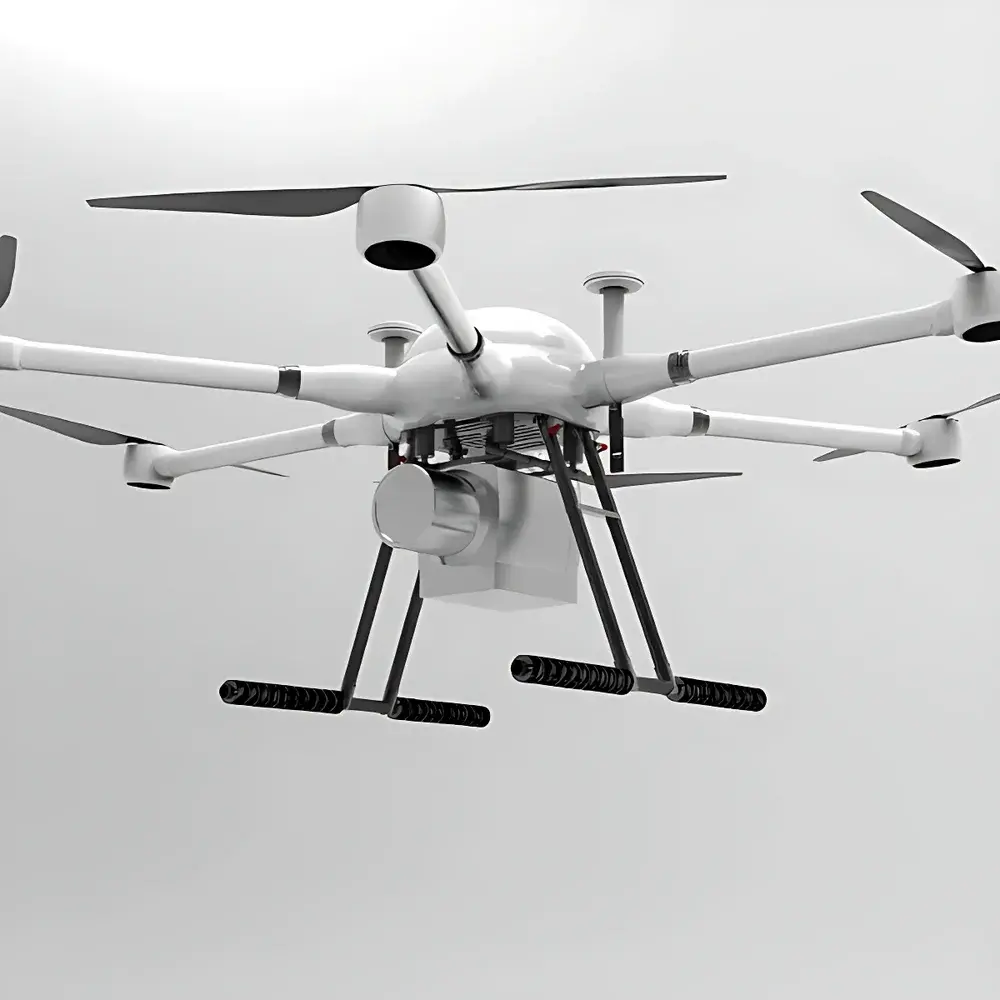
AERO NSpec Airborne HPGe Gamma-Ray Spectrometer
| Brand | AERO |
|---|---|
| Origin | Beijing, China |
| Manufacturer Type | Authorized Distributor |
| Country of Origin | China |
| Model | NSpec |
| Energy Resolution | ≤ 1.85 keV @ 1.33 MeV |
| Relative Efficiency | 20% @ 1.33 MeV (vs. 3"×3" NaI, Co-60, 25 cm) |
| Resolution @ 122 keV | ≤ 875 eV |
| Peak-to-Compton Ratio | ~51:1 |
| FWTM/FWHM | 1.9 |
| FWFM/FWHM | 2.65 |
| Energy Range | 40–3000 keV |
| Cooling Method | Liquid Nitrogen Cryogenic |
| Form Factor | Integrated Miniaturized Unit (Detector + Dewar + MCA + Display) |
Overview
The AERO NSpec Airborne HPGe Gamma-Ray Spectrometer is a compact, cryogenically cooled high-purity germanium (HPGe) detection system engineered for quantitative gamma-ray spectrometry in mobile and aerial survey applications. Operating on the principle of semiconductor-based gamma photon energy deposition and charge carrier collection, the NSpec delivers high-resolution spectral acquisition across a broad energy range (40–3000 keV), enabling precise radionuclide identification and activity quantification without reliance on external X-ray excitation sources. Its design integrates a low-mass HPGe crystal, vacuum-sealed liquid nitrogen dewar, miniature multichannel analyzer (MCA), real-time spectral visualization module, and thermal management subsystem into a single ruggedized unit weighing under 8.5 kg—making it compatible with Class II and III UAV platforms such as the A660 autonomous drone. Unlike scintillation-based systems (e.g., NaI(Tl)), the NSpec leverages the intrinsic energy resolution advantage of HPGe detectors to resolve closely spaced photopeaks (e.g., 134Cs and 137Cs at 604.7 keV and 661.7 keV), critical for regulatory-grade environmental monitoring and nuclear safeguards verification.
Key Features
- World’s smallest commercially available liquid nitrogen–cooled airborne HPGe spectrometer, optimized for UAV integration and rapid deployment
- High-resolution gamma spectroscopy with ≤1.85 keV FWHM at 1.33 MeV (60Co) and ≤875 eV at 122 keV (57Co), meeting IAEA RS-G-1.8 and ASTM D3648-18 spectral fidelity requirements
- 20% relative efficiency referenced to standard 3″×3″ NaI(Tl) detector at 25 cm distance from 60Co source, ensuring robust count-rate performance in low-activity field scenarios
- Integrated real-time MCA firmware with automatic gain stabilization, temperature compensation, and digital pile-up rejection
- Peak-to-Compton ratio of ~51:1 supports reliable discrimination of weak photopeaks above Compton continuum background, essential for uranium/thorium series analysis in soil or debris
- Modular architecture enables seamless transition between airborne survey mode and handheld or vehicle-mounted ground-based operation
Sample Compatibility & Compliance
The NSpec operates in direct detection mode—requiring no sample preparation, irradiation, or collimation—and is inherently compatible with heterogeneous, unsealed, or large-area environmental matrices including soil, sediment, vegetation canopy, building surfaces, and waste containers. It complies with ISO 11929:2019 for evaluation of measurement uncertainty in ionizing radiation detection and supports traceable calibration using NIST-traceable point sources (133Ba, 152Eu, 60Co). Data acquisition workflows align with IAEA Safety Standards Series No. RS-G-1.8 (Guidelines for Airborne Gamma-Ray Spectrometric Surveys) and EPA Method 901.1 for radiological site characterization. The system’s firmware architecture supports audit-ready metadata logging—including GPS timestamped spectra, altitude, pitch/roll orientation, and detector temperature—for GLP-compliant reporting and regulatory submittal.
Software & Data Management
The NSpec ships with AERO SpectrumStudio v3.x—a Windows-based spectral analysis suite supporting real-time display, automated nuclide library matching (IAEA NuDat 3.0 integrated), full-spectrum deconvolution (using least-squares fitting with constrained peak shape models), and dose rate mapping via Monte Carlo–informed efficiency calibration. Raw .CNF and .MCA files are exportable in IEEE 1254-2001 compliant format for third-party interoperability with GammaVision, Genie 2000, or custom Python-based analysis pipelines (e.g., using PyMCA or RadWare). All spectral acquisitions include embedded GPS coordinates, flight path metadata, and hardware health logs. Software modules support 21 CFR Part 11–compliant user access control, electronic signatures, and immutable audit trails for QA/QC documentation in nuclear facility monitoring or emergency response operations.
Applications
- Nuclear facility perimeter monitoring and effluent plume tracking via time-resolved spectral imaging
- Rapid post-incident radiological mapping following transportation accidents or lost source events
- Regulatory compliance surveys for uranium mining tailings, NORM/TENORM waste stockpiles, and decommissioning sites
- Border security and customs interdiction—detection and isotopic identification of shielded special nuclear materials (SNM)
- Environmental baseline studies and long-term trend analysis of 40K, 232Th, 238U, and anthropogenic isotopes (e.g., 137Cs) in agricultural soils and wetlands
- Support for IAEA INPRO and WNA nuclear infrastructure development programs through standardized aerial survey methodology
FAQ
Does the NSpec require on-site liquid nitrogen refilling during flight?
No—the integrated dewar provides ≥6 hours of continuous cryogenic operation at ambient temperatures up to 35°C; refills are only required between missions.
Can spectral data be processed onboard the UAV in real time?
Yes—onboard MCA firmware performs live energy calibration, peak search, and gross count rate estimation; full nuclide identification occurs post-flight in SpectrumStudio.
Is the system certified for use in classified or defense-sensitive environments?
The NSpec meets TEMPEST-level EMI shielding requirements per MIL-STD-461G and supports secure data encryption (AES-256) for transmission and storage.
What calibration standards are included with delivery?
Each unit ships with NIST-traceable 133Ba, 152Eu, and 60Co point sources, plus a comprehensive efficiency calibration certificate valid for 12 months.
How is detector dead time corrected during high-count-rate surveys?
Real-time dead time correction uses hybrid analog-digital methods with live-time gating and pulse pile-up rejection algorithms, validated per ANSI N42.14-2022.
Related Products






