
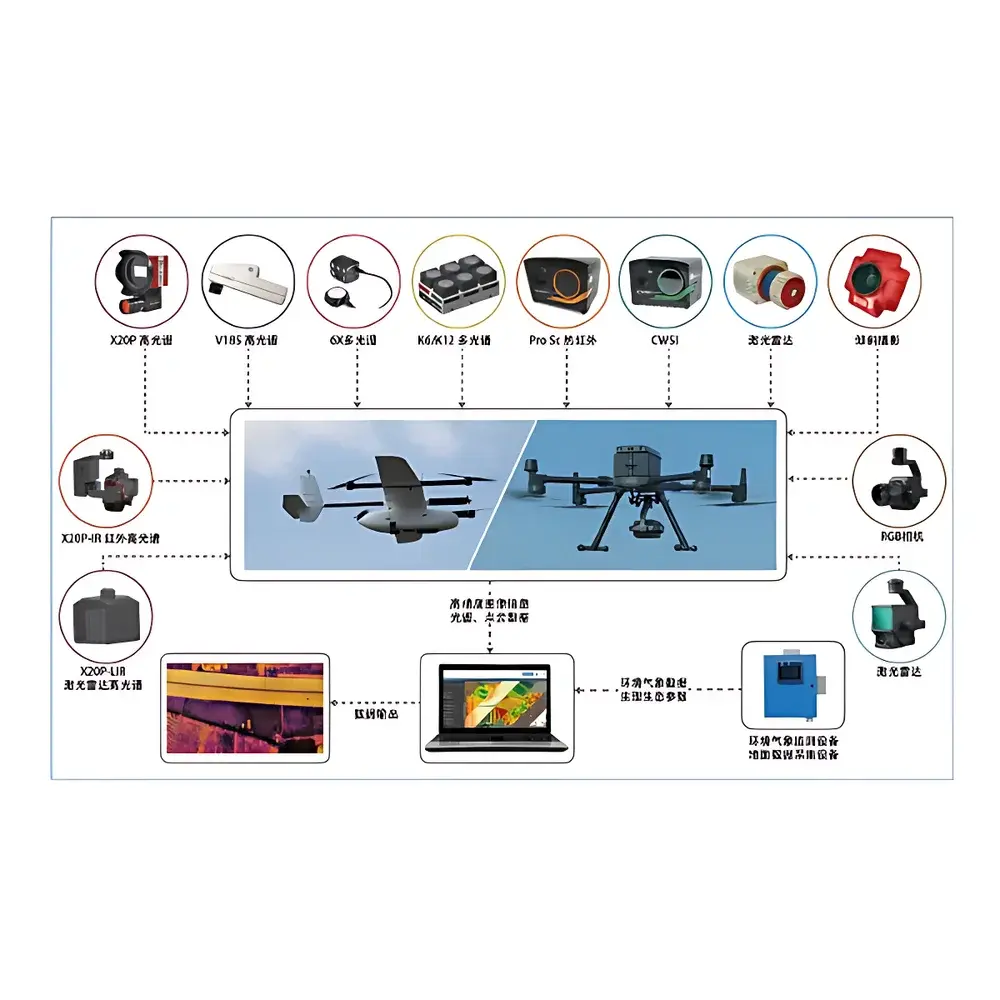
AERO PTA Series Airborne High-Throughput Plant Phenotyping System
| Brand | AERO |
|---|---|
| Platform Type | VTOL UAV (A660 hexacopter or AZCW fixed-wing) |
| Sensor Compatibility | Visible RGB, Snapshot Hyperspectral (V185/X20P), Research-Grade Multispectral (K6), Dual-Camera Thermal IR (Pro Sc), High-Accuracy LiDAR (AZ-LiDAR) |
| Data Output | Radiometrically Calibrated Reflectance & Temperature Cubes, Point Clouds, Canopy Height Models, NDVI/EVI/NDRE/TCI Indices, Biomass & LAI Estimates |
| Compliance | ASTM E2924-22 (Standard Guide for Remote Sensing of Vegetation), ISO 17937:2021 (Spectral Reflectance Measurement of Vegetation), FAO CropWatch Protocols, GLP-aligned Metadata Archiving |
| Software Integration | AERO-PhenoSuite v3.2 (with FDA 21 CFR Part 11–compliant audit trail, ISO/IEC 17025 traceable calibration logs, and USDA-NRCS-compatible georeferencing) |
Overview
The AERO PTA Series Airborne High-Throughput Plant Phenotyping System is an integrated remote sensing platform engineered for field-scale, non-destructive acquisition of quantitative plant phenotypic traits under natural growing conditions. Built upon physically accurate radiometric and geometric measurement principles, the system leverages airborne multispectral, hyperspectral, thermal infrared, and LiDAR modalities to capture structural, biochemical, and physiological parameters—including canopy architecture, chlorophyll content, water status, stomatal conductance proxies, and biomass accumulation—across heterogeneous agricultural landscapes. Unlike ground-based or greenhouse phenotyping systems, the PTA Series operates at operational altitudes (30–120 m AGL), enabling spatially contiguous data collection over hundreds of hectares per flight with sub-decimeter ground sampling distance (GSD). Its core measurement paradigm aligns with established remote sensing biophysical retrieval frameworks: reflectance-derived vegetation indices (e.g., NDVI, NDRE, TCARI/OSAVI) are calibrated against in situ spectroradiometer measurements; thermal emissivity and kinetic temperature maps are corrected using atmospheric transmittance models (MODTRAN-based); and LiDAR-derived canopy height models (CHMs) are co-registered with optical data via RTK-GNSS and IMU fusion for pixel-level trait attribution.
Key Features
- Modular VTOL UAV platform: Selectable A660 heavy-lift hexacopter (max payload 6.5 kg, 45-min endurance) or AZCW vertical-takeoff fixed-wing (120-min endurance, 15 km²/h coverage)
- Radiometrically traceable sensor suite: V185/X20P snapshot hyperspectral imagers (400–1000 nm, 2.5 nm FWHM, push-broom or frame-based acquisition); K6 multispectral camera (6 discrete bands: 450, 530, 550, 660, 720, 840 nm, ±1.5 nm bandpass stability); Pro Sc dual-thermal camera (7.5–13.5 µm, NETD <40 mK, radiometric accuracy ±2°C)
- High-fidelity LiDAR integration: AZ-LiDAR system with 1000 kHz pulse repetition frequency, 15 cm vertical precision (RMSE), and full-waveform digitization for structural trait extraction (e.g., leaf area index, canopy volume, lodging detection)
- Onboard real-time georeferencing: Dual-frequency RTK-GNSS + tactical-grade IMU (0.005° heading accuracy) ensures <5 cm horizontal and <10 cm vertical positional integrity without ground control points
- Automated mission planning & adaptive flight logic: AERO-FlightManager software enables grid, corridor, or ROI-based autonomous navigation with dynamic altitude adjustment based on terrain elevation and crop height models
Sample Compatibility & Compliance
The PTA Series supports phenotypic characterization across diverse agronomic species—including cereals (wheat, rice, maize), legumes (soybean, chickpea), oilseeds (canola), and perennial crops (alfalfa, vineyards)—under variable soil moisture, nitrogen status, and abiotic stress regimes. All optical sensors undergo factory calibration against NIST-traceable standards, with annual recalibration intervals documented per ISO/IEC 17025 requirements. Data acquisition protocols conform to ASTM E2924-22 (remote sensing of vegetation), ISO 17937:2021 (spectral reflectance measurement), and FAO CropWatch metadata schemas. Raw data packages include embedded EXIF and XMP metadata compliant with OGC SensorML and ISO 19115-2 standards, enabling interoperability with AgGateway ADAPT and USDA ARS Cropland Data Layer pipelines. For regulated breeding trials, the system supports GLP-aligned audit trails and 21 CFR Part 11–compliant electronic signatures when operated with AERO-PhenoSuite’s validated configuration.
Software & Data Management
AERO-PhenoSuite v3.2 serves as the unified processing engine, providing end-to-end workflows from raw sensor ingestion to trait quantification. Core modules include: (1) Radiometric correction (dark current subtraction, flat-field normalization, atmospheric compensation via QUAC/DOS); (2) Geometric orthorectification with sub-pixel registration accuracy; (3) Spectral unmixing and pigment concentration estimation (chlorophyll a/b, carotenoids, anthocyanins) using partial least squares regression (PLSR) models trained on reference leaf spectroscopy datasets; (4) Thermal anomaly detection and crop water stress index (CWSI) computation; (5) LiDAR point cloud classification (ground/non-ground) and CHM generation; (6) Multi-modal trait fusion (e.g., combining NDVI with canopy height to estimate biomass). All processing steps are scriptable via Python API, and output formats include GeoTIFF, Cloud Optimized GeoTIFF (COG), LAS/LAZ, and NetCDF4 with CF-1.8 conventions. Data provenance—including sensor gain settings, GPS timestamps, and calibration certificate IDs—is immutably logged in SQLite-backed audit databases.
Applications
- Field-scale QTL mapping and genomic selection: Correlating spectral-temporal trait trajectories (e.g., greenness decay rate during senescence) with SNP markers across breeding populations
- Abiotic stress phenotyping: Quantifying drought-induced stomatal closure via thermal heterogeneity metrics and salinity response through red-edge inflection point shifts
- Precision irrigation management: Generating high-resolution evapotranspiration (ETa) maps using two-source energy balance models constrained by PTA-derived surface temperature and albedo
- Crop health monitoring: Early detection of fungal infection (e.g., Fusarium head blight in wheat) via hyperspectral anomalies in 700–750 nm region prior to visible symptom onset
- Yield prediction modeling: Integrating time-series LAI, canopy cover fraction, and thermal stress accumulation into machine learning ensembles (XGBoost, Random Forest) validated against combine harvester yield monitors
FAQ
What UAV platforms are certified for PTA Series integration?
The A660 hexacopter and AZCW VTOL fixed-wing are fully integrated and factory-tested; third-party UAVs require mechanical, electrical, and firmware compatibility validation through AERO’s Engineering Support Program.
Can the system operate in regulatory-controlled airspace (e.g., EU U-space, FAA Part 107)?
Yes—both platforms comply with EASA STS-01/02 and FAA Part 107 remote ID requirements; operation in controlled airspace requires LAANC authorization or direct coordination with local ANSP.
How is radiometric accuracy maintained across seasonal temperature variations?
All optical sensors incorporate onboard blackbody references and temperature-stabilized detector housings; pre-flight and in-flight dark frame acquisition corrects for thermal drift, with calibration coefficients updated automatically via AERO-PhenoSuite’s QC module.
Is raw LiDAR point cloud data exportable for third-party analysis?
Yes—LAS/LAZ files with classified returns (ground, vegetation, noise) and full waveform metadata are provided alongside georeferenced intensity rasters and digital surface models.
Does AERO provide validation services against ground-truth phenotyping protocols?
Yes—AERO offers turnkey validation campaigns including in-field spectral library development, destructive sampling coordination, and statistical concordance reporting per ISO 5725-2 repeatability/reproducibility guidelines.
Related Products







