
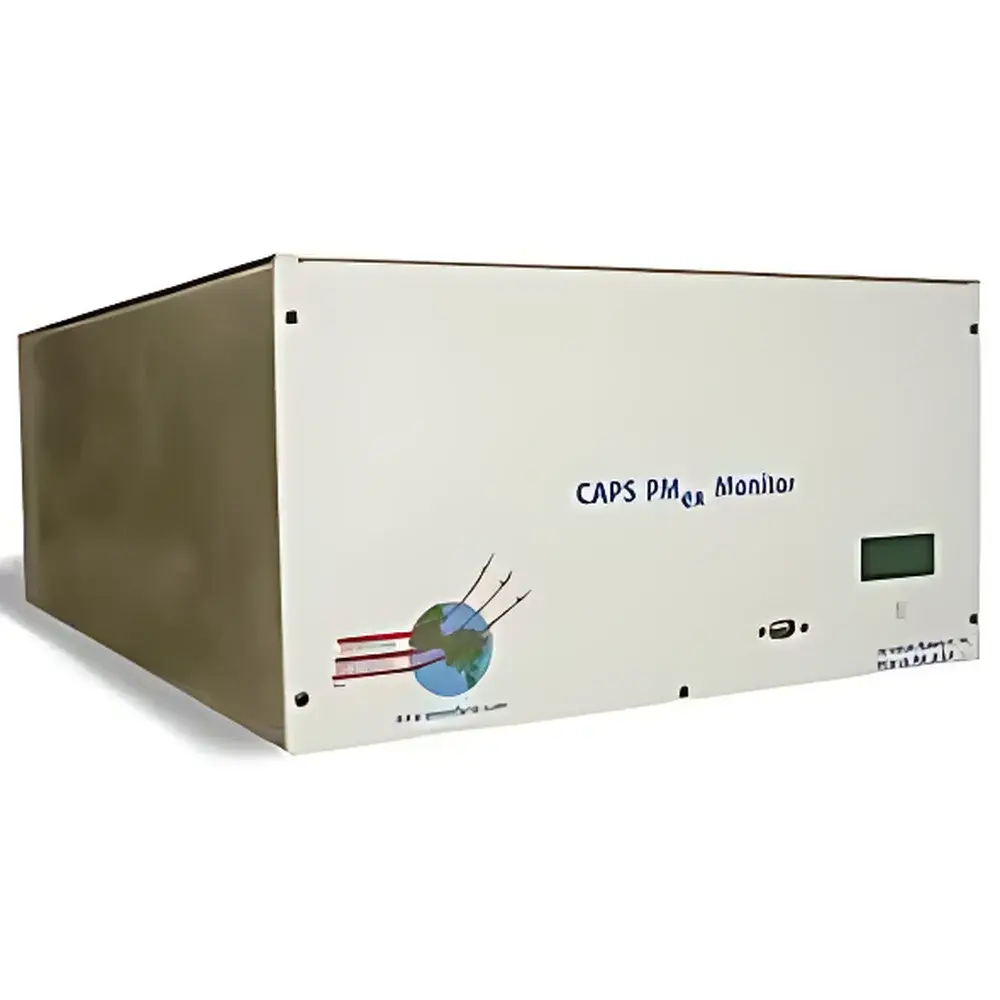
Aerodyne CAPS PMex Multi-Chamber Particle Extinction Coefficient Measurement System
| Brand | Aerodyne |
|---|---|
| Origin | USA |
| Manufacturer Type | Authorized Distributor |
| Origin Category | Imported |
| Model | CAPS PMex |
| Instrument Principle | Cavity Attenuated Phase Shift Spectroscopy (CAPS) |
| Product Type | Online Continuous Monitor |
| Response Time | <2 s |
| Repeatability | CO, CO₂, CH₄, C₂H₄, HCHO, CHOOH, COS, SO₂, NO, N₂O, NO₂, NH₃, HONO, HNO₃, ¹³C-CO₂, ¹⁸O-CO₂, ¹⁷O-CO₂, HOD, ¹⁵N¹⁴N¹⁶O (δ¹⁵Nα), ¹⁴N¹⁵N¹⁶O (δ¹⁵Nβ) |
| Wavelength Options | 405 nm, 450 nm, 525 nm, 630 nm, 660 nm, 780 nm (up to 4 simultaneously selectable) |
| Linear Range | 0–4000 Mm⁻¹ |
| Sensitivity | 2.5 Mm⁻¹ (1 s), 0.25 Mm⁻¹ (60 s) |
| Sample Flow Rate | 0.85 L/min per cavity |
| Operating Pressure | Ambient |
| Materials in Contact with Sample | Conductive polyurethane, stainless steel, conductive silicone, aluminum |
| Data Output | RS-232, USB, Ethernet |
| Onboard Storage | 5 years of data |
| Dimensions | 61 cm × 43 cm × 31 cm |
| Weight | 15 kg |
| Power | <100 W, 100–250 VAC (50–60 Hz) |
Overview
The Aerodyne CAPS PMex Multi-Chamber Particle Extinction Coefficient Measurement System is an online, continuous-monitoring instrument engineered for high-fidelity, real-time quantification of aerosol light extinction coefficients across multiple optical wavelengths. It employs Cavity Attenuated Phase Shift Spectroscopy (CAPS)—a well-established, physics-based optical technique that measures the phase shift of intensity-modulated light resonating within a high-finesse optical cavity containing ambient aerosol. Unlike traditional integrating nephelometers or filter-based absorption photometers, CAPS provides direct, calibration-free extinction measurement with traceable SI-unit traceability. The system’s dual-cavity architecture enables simultaneous multi-wavelength operation—up to four independent wavelengths selected from six available options (405, 450, 525, 630, 660, and 780 nm)—making it uniquely suited for spectral extinction analysis, Ångström exponent derivation, and source apportionment studies in atmospheric science and combustion diagnostics.
Key Features
- Multi-chamber design supports up to four parallel, independently controlled optical cavities—each configurable at discrete wavelengths for concurrent spectral extinction profiling.
- Zero-gas-free operation with automatic background subtraction via real-time cavity ring-down phase tracking—eliminating drift associated with periodic zeroing cycles.
- High sensitivity: detection limit of 2.5 Mm⁻¹ at 1-second integration time; sub-0.3 Mm⁻¹ at 60-second averaging—enabling resolution of fine-mode urban aerosols and low-concentration plumes.
- Linear dynamic range spanning 0–4000 Mm⁻¹—validated across laboratory and field conditions without saturation or nonlinearity correction.
- Robust mechanical architecture: all wetted surfaces constructed from conductive polyurethane, electropolished stainless steel, conductive silicone gaskets, and anodized aluminum—ensuring electrostatic dissipation, corrosion resistance, and compatibility with humid or chemically reactive sampling environments.
- Low power consumption (<100 W) and universal AC input (100–250 VAC, 50–60 Hz) support unattended deployment in remote sites, mobile platforms (e.g., aircraft, ground vehicles), and fixed monitoring stations.
- Integrated onboard data logging with five-year storage capacity—retaining timestamped extinction values, cavity pressure, temperature, flow rate, and diagnostic telemetry.
Sample Compatibility & Compliance
The CAPS PMex is designed for direct sampling of ambient air, stack emissions, combustion exhaust, and chamber-generated aerosols without dilution or conditioning—provided particulate mass concentration remains below coagulation-limited thresholds (~10⁶ cm⁻³). Its pressure-agnostic cavity design maintains measurement fidelity across altitudes up to 3000 m ASL and relative humidity up to 95% RH (non-condensing). All firmware and data handling protocols comply with EPA Compendium Method TO-15 and ISO 21501-4 for aerosol optical property instrumentation. While not a regulated compliance analyzer per se, its traceable extinction measurements serve as primary input for PM₂.₅ and PM₁₀ mass reconstruction models validated under US EPA AP-42 and EU Directive 2008/50/EC. The system supports audit-ready data export with embedded timestamps, instrument ID, and metadata—facilitating GLP-aligned reporting and QA/QC documentation.
Software & Data Management
Instrument control, real-time visualization, and data export are managed via Aerodyne’s cross-platform CAPS Control Suite (v4.2+), compatible with Windows, Linux, and macOS. The software provides live cavity phase-lock diagnostics, wavelength-specific extinction time series, spectral ratio plots (e.g., 405/660 nm), and automated calculation of extinction Ångström exponent (EAE). Raw data streams via Ethernet or USB adhere to IEEE 1451.2-compliant TEDS templates, enabling plug-and-play integration into SCADA, CR1000X, or EPICS-based environmental monitoring networks. All stored datasets include full provenance: acquisition time (UTC), cavity temperature/pressure, sample flow verification flags, and firmware revision hash—meeting FDA 21 CFR Part 11 requirements for electronic records when deployed in regulated research settings (e.g., clinical exposure chambers, pharmaceutical cleanroom validation).
Applications
- Long-term ambient aerosol monitoring networks (e.g., IMPROVE, EMEP, ACTRIS)
- In situ characterization of aircraft engine exhaust plumes during takeoff, cruise, and landing phases
- Mobile lab deployments along transportation corridors for roadside black carbon and secondary organic aerosol (SOA) source attribution
- Real-time feedback control in combustion optimization experiments (e.g., gas turbine, biomass furnace)
- Validation of satellite-derived aerosol optical depth (AOD) products through ground-truth extinction profiles
- Chemical aging studies in smog chambers using time-resolved multi-wavelength extinction kinetics
- Calibration transfer reference for filter-based absorption instruments (e.g., MAAP, AE33) and nephelometers (e.g., TSI 3563)
FAQ
How does CAPS differ from cavity ring-down spectroscopy (CRDS)?
CAPS measures the phase shift of amplitude-modulated light rather than exponential decay time—enabling higher signal-to-noise at low extinction levels and eliminating the need for ultra-stable lasers or high-bandwidth detectors.
Can the CAPS PMex measure both extinction and absorption simultaneously?
No—it measures total extinction only. However, when paired with a co-located nephelometer (e.g., TSI 3563), scattering can be subtracted to derive absorption coefficient with uncertainty propagation formalism per ASTM D6245.
Is calibration required before field deployment?
The system is factory-calibrated using NIST-traceable cavity length standards and certified reference gases. Field verification requires only zero-air check (via internal bypass) and span verification using calibrated neutral density filters—no user-performed optical alignment.
What maintenance intervals are recommended?
Optical windows require cleaning every 3–6 months depending on site particulate loading; pump filters every 6 months; no laser or detector replacement needed within 5 years of operation.
Does the system support remote firmware updates?
Yes—via secure SSH-enabled Ethernet connection; updates preserve all historical calibration coefficients and user-defined configuration profiles.
Related Products







