
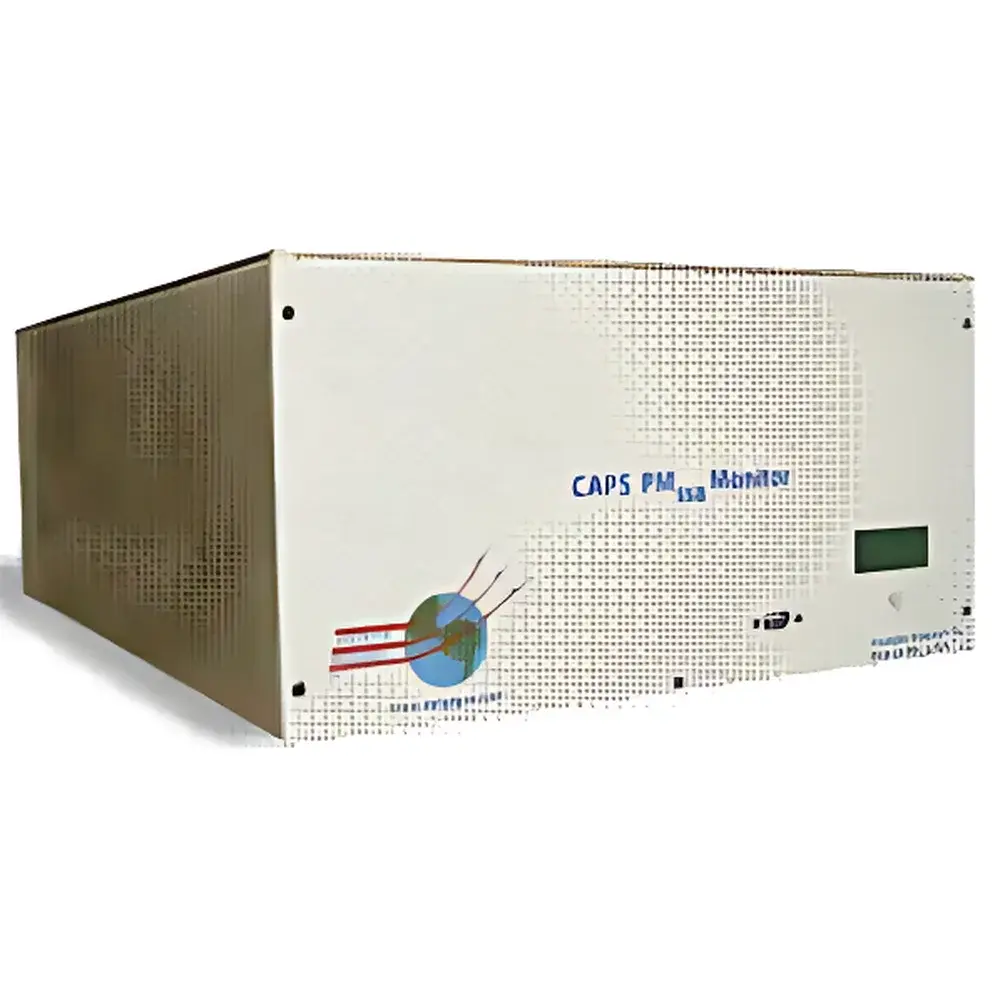
Aerodyne CAPS PMssa Cavity Attenuated Phase Shift Spectrometer for Aerosol Single Scattering Albedo and Extinction Coefficient Measurement
| Brand | Aerodyne |
|---|---|
| Origin | USA |
| Model | CAPS PMssa |
| Principle | Cavity Attenuated Phase Shift (CAPS) Spectroscopy |
| Form Factor | Continuous Online Monitor |
| Response Time | 1 s |
| Sensitivity | 3.0 Mm⁻¹ (1 s), 0.5 Mm⁻¹ (60 s) |
| SSA Uncertainty | ±0.03 (30 s integration) |
| Wavelength Options | 405 nm, 450 nm, 525 nm, 630 nm, 660 nm, 780 nm |
| Sample Flow Rate | 0.85 L/min |
| Operating Pressure | Ambient |
| Housing Dimensions | 61 cm × 43 cm × 23 cm |
| Weight | 16 kg |
| Power | 200–250 V AC, 50–60 Hz, 50–100 W |
| Data Interfaces | RS-232, USB, Ethernet |
| Onboard Storage | ≥5 years of high-resolution time-series data |
| Wetted Materials | Conductive polyurethane, stainless steel, conductive silicone, aluminum |
| Display | Integrated real-time LCD interface |
Overview
The Aerodyne CAPS PMssa is a field-deployable, continuous online aerosol monitor engineered to quantify two fundamental optical properties of atmospheric particulate matter: the particle extinction coefficient (bext) and the single scattering albedo (SSA, ω0). It employs Cavity Attenuated Phase Shift (CAPS) spectroscopy—a highly sensitive, absolute optical technique that measures the phase delay of modulated light propagating through a high-finesse optical cavity containing sampled ambient air. Unlike integrating sphere or filter-based methods, CAPS delivers direct, calibration-free extinction measurements with sub-second temporal resolution and exceptional long-term stability. The instrument’s core optical architecture features a temperature-stabilized, low-loss cavity with internal walls coated in Avian-D white diffuse reflector—ensuring near-Lambertian scattering characteristics critical for accurate angular-integrated signal interpretation. A photomultiplier tube (PMT) positioned orthogonally to the incident beam detects scattered photons, enabling concurrent retrieval of scattering-derived parameters essential for SSA computation (ω0 = bscat / bext). Designed for unattended operation in diverse environmental regimes—from urban street canyons to aircraft-mounted platforms—the CAPS PMssa meets the rigorous demands of atmospheric science, climate modeling validation, and regulatory air quality monitoring programs.
Key Features
- Sub-second response time (≤1 s) enables capture of rapid aerosol dynamics during plume events, combustion transients, or boundary layer evolution.
- High sensitivity: detection limit of 3.0 Mm⁻¹ at 1 s integration; improves to 0.5 Mm⁻¹ with 60 s averaging—suitable for clean background and polluted urban environments alike.
- Multi-wavelength capability: six discrete laser diode options (405, 450, 525, 630, 660, and 780 nm) support spectral dependence analysis of extinction and SSA—critical for aerosol typing (e.g., distinguishing black carbon from dust or sulfate).
- Robust mechanical design: sealed optical cavity, conductive wetted materials (stainless steel, conductive polyurethane, conductive silicone, aluminum), and integrated thermal management ensure operational reliability across −20 °C to +40 °C ambient conditions.
- Autonomous data handling: onboard flash memory stores >5 years of timestamped, high-resolution (1 Hz) bext, SSA, and auxiliary sensor outputs; accessible via Ethernet, USB, or RS-232.
- Minimal maintenance footprint: no consumables, no optical alignment required post-installation, and no zero-gas calibration needed—reducing lifecycle operational cost and downtime.
Sample Compatibility & Compliance
The CAPS PMssa draws ambient air at a controlled flow rate of 0.85 L/min using an integrated diaphragm pump. Its sample path is optimized for particles ≤10 µm aerodynamic diameter (PM10), with optional inlet conditioning (e.g., PM2.5 cyclones, Nafion dryers, or thermodenuders) compatible via standard 1/4″ Swagelok fittings. All wetted surfaces are chemically inert and electrically conductive, minimizing electrostatic particle loss and surface adsorption artifacts—particularly important for volatile organic compounds (VOCs) and semi-volatile aerosols. The system conforms to EPA reference method principles for aerosol optical property measurement and supports compliance with ISO 21507 (aerosol instrumentation) and ASTM D6245 (ambient air quality—particulate matter sampling). While not a certified regulatory monitor per se, its traceable, physics-based measurement principle and documented uncertainty budget (±0.03 for SSA over 30 s) make it suitable for GLP-aligned field studies and model evaluation frameworks requiring metrologically defensible optical closure.
Software & Data Management
Data acquisition and instrument control are managed by Aerodyne’s proprietary CAPS Control Suite, a cross-platform application supporting real-time visualization, remote configuration, and automated QA/QC flagging. Raw phase shift and cavity ring-down signals are processed using factory-characterized transfer functions to compute bext and ω0 with full error propagation. Export formats include netCDF-4 (CF-compliant), CSV, and HDF5—facilitating seamless ingestion into atmospheric modeling tools (e.g., GEOS-Chem, WRF-Chem) and statistical analysis pipelines. Audit trails record all parameter changes, firmware updates, and calibration events in accordance with FDA 21 CFR Part 11 requirements when operated under validated SOPs. Optional integration with Aerodyne’s CloudLink service enables encrypted telemetry, over-the-air diagnostics, and centralized fleet monitoring for multi-site deployments.
Applications
- Airborne and ground-based campaigns targeting aerosol–radiation interaction quantification (e.g., DOE ARM, NASA ATom, EMeRGe).
- Urban air quality networks assessing spatial gradients in black carbon dominance and secondary organic aerosol formation.
- Mobile monitoring on research vehicles or drones for traffic emission characterization and hotspot identification.
- Aviation emissions testing—including engine exhaust plume analysis at airports and test stands per ICAO Annex 16 guidance.
- Combustion research laboratories evaluating fuel formulation impacts on soot optical properties.
- Long-term trend analysis in background stations (e.g., NOAA GML, EMEP) where SSA serves as a key indicator of aerosol aging and mixing state.
FAQ
How does CAPS differ from traditional cavity ring-down spectroscopy (CRDS)?
CAPS measures the phase shift of amplitude-modulated light rather than exponential decay time—yielding higher signal-to-noise for extinction at low concentrations and eliminating mirror reflectivity dependence.
Can the CAPS PMssa operate unattended for extended periods?
Yes—designed for continuous operation up to 12 months between routine checks; onboard storage and power management support solar/battery configurations.
Is external calibration required?
No—CAPS provides absolute extinction based on first-principles cavity geometry and modulation frequency; only periodic verification against reference standards (e.g., CO2-doped air) is recommended for QA.
What aerosol size ranges does it measure?
The instrument responds to total light extinction from all airborne particles in the sampled airstream; size-resolved interpretation requires co-location with SMPS or APS systems.
Does it require gas scrubbers or drying for humid environments?
While capable of operating in ambient humidity, optimal SSA accuracy is achieved with relative humidity <40 %; integration with Nafion dryers or chilled mirrors is supported and commonly deployed.
Related Products







