
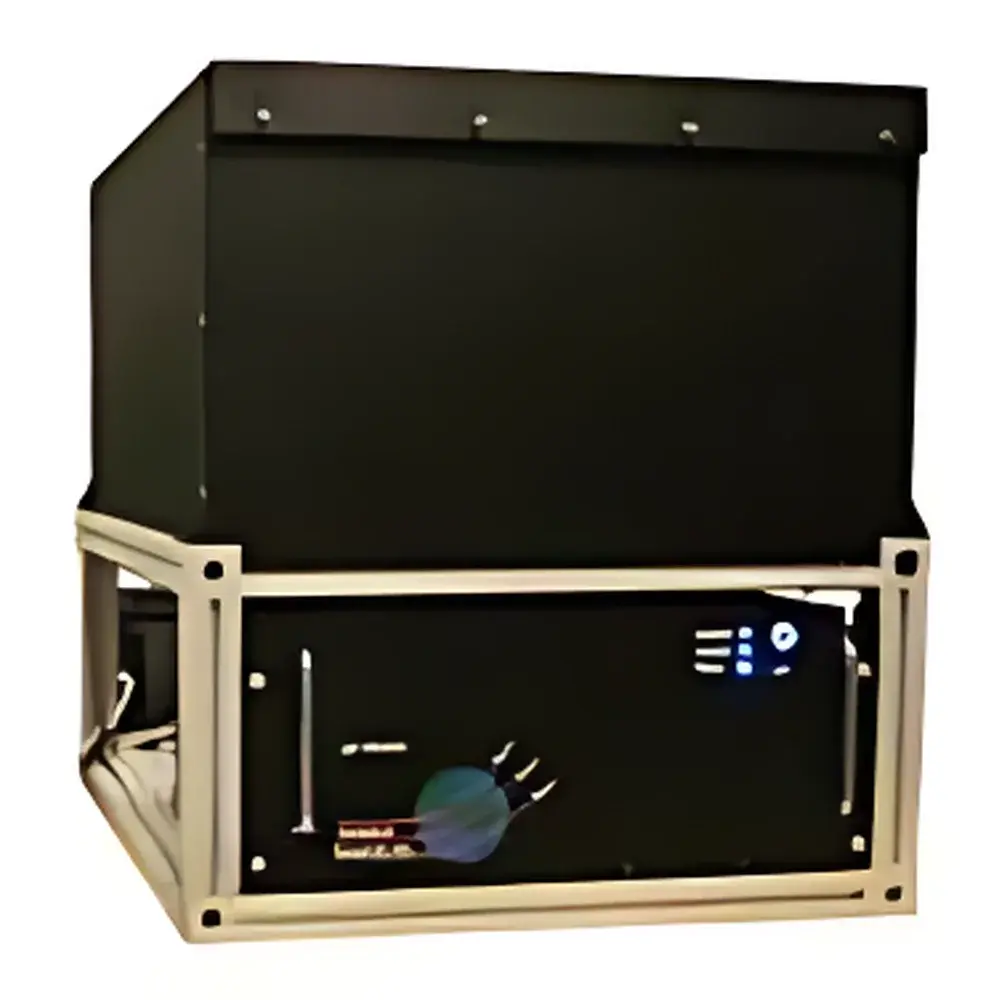
Aerodyne SIX Dual-Laser Tunable Infrared Laser Direct Absorption Spectrometer (TILDAS) for High-Frequency, Simultaneous Multi-Species Trace Gas Monitoring
| Brand | Aerodyne |
|---|---|
| Origin | USA |
| Model | SIX |
| Detection Principle | Tunable Infrared Laser Direct Absorption Spectroscopy (TILDAS) |
| Configuration | Online, Real-Time |
| Response Time | <1 s (10 Hz data acquisition) |
| Measurement Species | NH₃, O₃, CO₂, CH₄, N₂O, H₂O |
| Isotopic Capability | ¹³C-CO₂, ¹⁸O-CO₂, ¹⁷O-CO₂, HOD, ¹⁵N¹⁴N¹⁶O (δ¹⁵Nα), ¹⁴N¹⁵N¹⁶O (δ¹⁵Nβ) |
| Path Length | Up to 210 m (Patented Astigmatic Multipass Cell) |
| Detection Limits (1σ) | NH₃: 50 ppt (1 s), 15 ppt (100 s) |
| O₃ | 400 ppt (1 s), 100 ppt (100 s) |
| CO₂ | 0.25 ppm (1 s), 0.06 ppm (100 s) |
| N₂O | 80 ppt (1 s), 20 ppt (100 s) |
| CH₄ | 400 ppt (1 s), 100 ppt (100 s) |
| H₂O | 10 ppm (1 s), 5 ppm (100 s) |
| Operating Temperature | 10–35 °C |
| Relative Humidity | 5–95 % RH |
| Sample Flow Rate | 0–20 slpm |
| Data Interfaces | RS232, USB, Ethernet |
| Dimensions (W×D×H) | 560 × 770 × 640 mm |
| Weight | 75 kg |
| Power | 250–500 W, 120/240 VAC, 50/60 Hz |
Overview
The Aerodyne SIX is a high-precision, dual-laser tunable infrared laser direct absorption spectrometer (TILDAS) engineered for continuous, simultaneous quantification of six key atmospheric trace gases—NH₃, O₃, CO₂, CH₄, N₂O, and H₂O—at 10 Hz temporal resolution. It operates on the physical principle of mid-infrared (MIR) molecular absorption spectroscopy, targeting fundamental vibrational-rotational transitions in the 1046 cm⁻¹ (L1) and 1275 cm⁻¹ (L2) spectral regions—where each gas exhibits strong, spectrally isolated “fingerprint” absorption lines. This ensures unambiguous identification and quantification without chemical conversion or cross-interference. The instrument integrates a patented astigmatic multipass absorption cell, enabling optical path lengths up to 210 meters within a compact footprint—significantly enhancing sensitivity while maintaining robustness for field deployment. Unlike chemiluminescence, electrochemical, or nondispersive infrared (NDIR) methods, TILDAS delivers absolute concentration measurements traceable to HITRAN line parameters, eliminating reliance on frequent calibration standards and minimizing drift over extended unattended operation.
Key Features
- Dual quantum cascade laser (QCL) architecture with independent wavelength tuning for orthogonal detection of two gas groups: L1 (NH₃, O₃, CO₂) and L2 (CH₄, N₂O, H₂O)
- Real-time 10 Hz data acquisition with sub-second response time (<1 s), optimized for eddy covariance (EC) flux measurements
- Ppt-level detection limits achieved via long-path absorption (76–210 m) and shot-noise-limited laser detection
- Patented surface passivation and anti-adsorption treatment for reactive, sticky species—including NH₃ and HONO—minimizing memory effects and ensuring quantitative sampling efficiency
- Integrated isotopic ratio capability for ¹³C-CO₂, ¹⁸O-CO₂, ¹⁷O-CO₂, HOD, and position-specific δ¹⁵N in N₂O (δ¹⁵Nα and δ¹⁵Nβ), supporting biogeochemical source attribution
- Factory-characterized measurement ranges covering ambient to elevated concentrations: NH₃ (0–30 ppm), CH₄ (0–200 ppm), CO₂ (0–30 %), N₂O (0–30 ppm), O₃ (0–30 ppm), H₂O (0–30 %)
- Environmental resilience: operational across 10–35 °C and 5–95 % RH without condensation control hardware
Sample Compatibility & Compliance
The Aerodyne SIX is designed for direct, unmodified sampling of ambient air, stack effluents, soil chamber headspace, and ecosystem boundary layer air. Its inert, passivated sample inlet and heated optical cell prevent catalytic decomposition or adsorption losses—particularly critical for NH₃, HONO, and other polar, reactive species. The system meets requirements for GLP-compliant environmental monitoring and supports audit-ready data provenance under ISO 17025 frameworks. While not certified for industrial safety (e.g., ATEX), its measurement methodology aligns with EPA Method TO-11A (for formaldehyde) and ASTM D6348 (for gaseous emissions) in spectral specificity and detection performance. For regulatory reporting, raw absorbance spectra and fitted line intensities are retained alongside concentration time series—enabling full traceability and reprocessing per evolving analytical protocols.
Software & Data Management
Instrument control, spectral fitting, and real-time concentration calculation are executed via Aerodyne’s proprietary TILDAS Data Acquisition and Analysis Software (TDAS). TDAS implements nonlinear least-squares fitting against high-resolution HITRAN-based line lists, applying pressure-broadening corrections, temperature-dependent partition functions, and baseline polynomial removal. All raw interferograms and fitted residuals are archived at full 10 Hz resolution. Export formats include ASCII time-series (.csv), NetCDF-4 (CF-compliant), and HDF5—facilitating integration with flux processing toolchains such as EddyPro®, TK3, or custom Python/Matlab pipelines. Audit trails record operator actions, laser parameter changes, and calibration events in accordance with FDA 21 CFR Part 11 principles (electronic signatures optional upon configuration). Remote diagnostics and firmware updates are supported via secure SSH or HTTPS interfaces.
Applications
- Eddy covariance flux measurements of NH₃, N₂O, CH₄, and CO₂ across agricultural soils, peatlands, forests, and urban-rural gradients
- Process-level studies of nitrogen cycling—e.g., quantifying NH₃ volatilization from manure application or δ¹⁵N-N₂O signatures distinguishing nitrification vs. denitrification pathways
- Urban air quality networks tracking ozone precursors (NH₃ + NOₓ), secondary aerosol formation potential, and methane leakage from infrastructure
- Long-term atmospheric observatories requiring stable, calibration-free operation for trend analysis of greenhouse gas growth rates (e.g., ΔCH₄ ≈ 14 ppt yr⁻¹; ΔN₂O ≈ 0.8 ppt yr⁻¹)
- Laboratory chamber experiments investigating photochemical kinetics of HONO, NO₂, and O₃ under controlled irradiation and humidity
- Isotope-enabled ecosystem studies—e.g., ¹³C-CO₂ discrimination during photosynthesis or ¹⁸O-CO₂ exchange in soil respiration
FAQ
How does the SIX achieve ppt-level sensitivity without frequent calibration?
It relies on absolute absorption spectroscopy: concentration is derived directly from Beer-Lambert law using precisely known line strengths from HITRAN, high-finesse multipass optics, and low-noise QCL detection—eliminating empirical calibration drift.
Can the system measure isotopologues simultaneously with bulk species?
Yes. Isotopic ratios (e.g., δ¹³C-CO₂, δ¹⁵N-N₂O) are extracted from the same high-resolution spectra used for concentration retrieval—no hardware modification or time multiplexing is required.
What makes the SIX suitable for eddy covariance applications?
Its 10 Hz native acquisition rate, <1 s latency, and intrinsic time synchronization across all six species ensure phase-coherent flux computation—critical for accurate covariance estimation of turbulent scalar transport.
How is NH₃ adsorption mitigated in the sampling train?
Through dual surface engineering: (1) vapor-phase passivation agents pre-saturate active sites in stainless-steel and quartz surfaces; (2) thermally stabilized, electropolished components minimize sticking coefficients—validated by co-measured HONO/NO₂ response synchrony.
Is remote operation and data streaming supported?
Yes. TDAS provides configurable network streaming (TCP/IP, MQTT), encrypted cloud backup options, and RESTful API access for integration into centralized environmental data platforms.
Related Products







