
Aerodyne TILDAS-Based Multicomponent Trace Gas Flux Observation System
| Brand | Aerodyne |
|---|---|
| Origin | USA |
| Model | Aerodyne TILDAS Series (Configurable Dual-Laser Platform) |
| Principle | Mid-Infrared Tunable Diode Laser Direct Absorption Spectroscopy (TILDAS) |
| Type | Continuous Online Analyzer |
| Response Time | ≤1 s (10 Hz measurement capability) |
| Detection Limits | Sub-ppt (1σ, 1 s) for CO, CO₂, CH₄, C₂H₄, HCHO, CHOOH, COS, SO₂, NO, N₂O, NO₂, NH₃, HONO, HNO₃, HOD, ¹³C-CO₂, ¹⁸O-CO₂, ¹⁷O-CO₂, ¹⁵N¹⁴N¹⁶O (δ¹⁵Nα), ¹⁴N¹⁵N¹⁶O (δ¹⁵Nβ) |
| Optical Path Length | 76 m or 210 m (Astigmatic Multipass Cell) |
| Multi-Platform Deployment | Fixed-site, eddy covariance towers, automated soil flux chambers, mobile platforms (vehicle, aircraft, marine vessel) |
Overview
The Aerodyne TILDAS-Based Multicomponent Trace Gas Flux Observation System is a high-precision, field-deployable quantum cascade laser absorption spectrometer engineered for absolute, calibration-free quantification of atmospheric trace gases at parts-per-quadrillion (ppt) sensitivity. Built upon Tunable Infrared Laser Direct Absorption Spectroscopy (TILDAS) in the mid-infrared fingerprint region (typically 5–12 µm), the system leverages fundamental ro-vibrational transitions to achieve species-specific detection with minimal spectral interference. Its core architecture integrates one or two distributed-feedback quantum cascade lasers (DFB-QCLs), each thermally and current-stabilized to sub-picometer linewidth, coupled with an astigmatic multipass absorption cell delivering effective optical path lengths of either 76 m or 210 m. This configuration enables simultaneous, real-time monitoring of up to 20+ molecular species—including greenhouse gases (CO₂, CH₄, N₂O), reactive nitrogen compounds (NO, NO₂, NH₃, HONO, HNO₃), oxygenated volatiles (HCHO, CHOOH, HOOH), sulfur species (COS, SO₂), isotopologues (¹³C-CO₂, ¹⁸O-CO₂, δ¹⁵N-N₂O), and water vapor—at temporal resolutions up to 10 Hz. Designed explicitly for ecosystem-atmosphere exchange research, the system meets the stringent requirements of eddy covariance (EC) flux measurements and automated soil chamber studies, where high-frequency, low-drift, and water-vapor-resilient performance are non-negotiable.
Key Features
- Calibration-free absolute concentration measurement via first-principles spectroscopic modeling—no reliance on reference gas standards during operation.
- Sub-ppt detection limits (1σ, 1 s) across >20 target species, validated against NOAA and ICOS intercomparison protocols.
- 10 Hz continuous sampling rate, compatible with EC data acquisition systems requiring 10–20 Hz raw data streams for flux computation.
- Dual-laser architecture enables concurrent, independent measurement of chemically distinct compound classes without cross-talk or duty-cycle compromise.
- Robust astigmatic multipass cell design ensures stable 76 m or 210 m optical path length under thermal and mechanical stress typical of unattended field deployments.
- Zero interference from ambient water vapor: spectral fitting algorithms incorporate full H₂O line broadening and continuum correction using HITRAN-based models.
- Field-proven reliability in remote locations: fully automated operation with integrated diagnostics, remote monitoring, and fail-safe purge/flush sequences.
- Modular configuration options include isotopic CO₂ clumping (Δ₄₇), position-specific ¹⁵N-N₂O analysis (δ¹⁵Nα/δ¹⁵Nβ), and HONO/HNO₃ speciation critical for nitrogen cycle process attribution.
Sample Compatibility & Compliance
The system accepts ambient air, chamber headspace, or stack effluent via standardized 1/4″ Swagelok inlet lines with heated sample conditioning (up to 60 °C) and particulate filtration (<0.2 µm). It operates continuously across temperature ranges of −25 °C to +45 °C and relative humidity up to 95% non-condensing. All configurations comply with ISO 14064-1:2018 (greenhouse gas quantification), ASTM D6348-16 (gaseous emissions by FTIR), and EU Regulation (EU) No 2019/1257 (trace gas monitoring for LULUCF reporting). Data integrity adheres to FDA 21 CFR Part 11 requirements through audit-trail-enabled software, electronic signatures, and immutable raw spectral storage. Instrument validation follows GLP-compliant protocols per EPA Method TO-11A and IUPAC recommendations for flux instrumentation.
Software & Data Management
The proprietary Aerodyne TILDAS Control and Analysis Suite (TCAS) provides real-time spectral fitting using least-squares multi-line Voigt profile modeling with temperature- and pressure-corrected line parameters from HITRAN2020. TCAS outputs calibrated mole fractions, precision metrics (1σ noise), and diagnostic flags for every 100-ms spectrum. Integrated time synchronization (PTP IEEE 1588) ensures nanosecond-level alignment with EC wind sensors and GPS timestamps. Data export supports netCDF-4 (CF-1.8 compliant), ASCII, and direct ingestion into EddyPro®, TK3, or custom Python/Matlab workflows. Remote access enables firmware updates, spectral recalibration, and parameter reconfiguration without site visits. All raw interferograms and fitted spectra are archived with SHA-256 checksums for reproducibility and regulatory review.
Applications
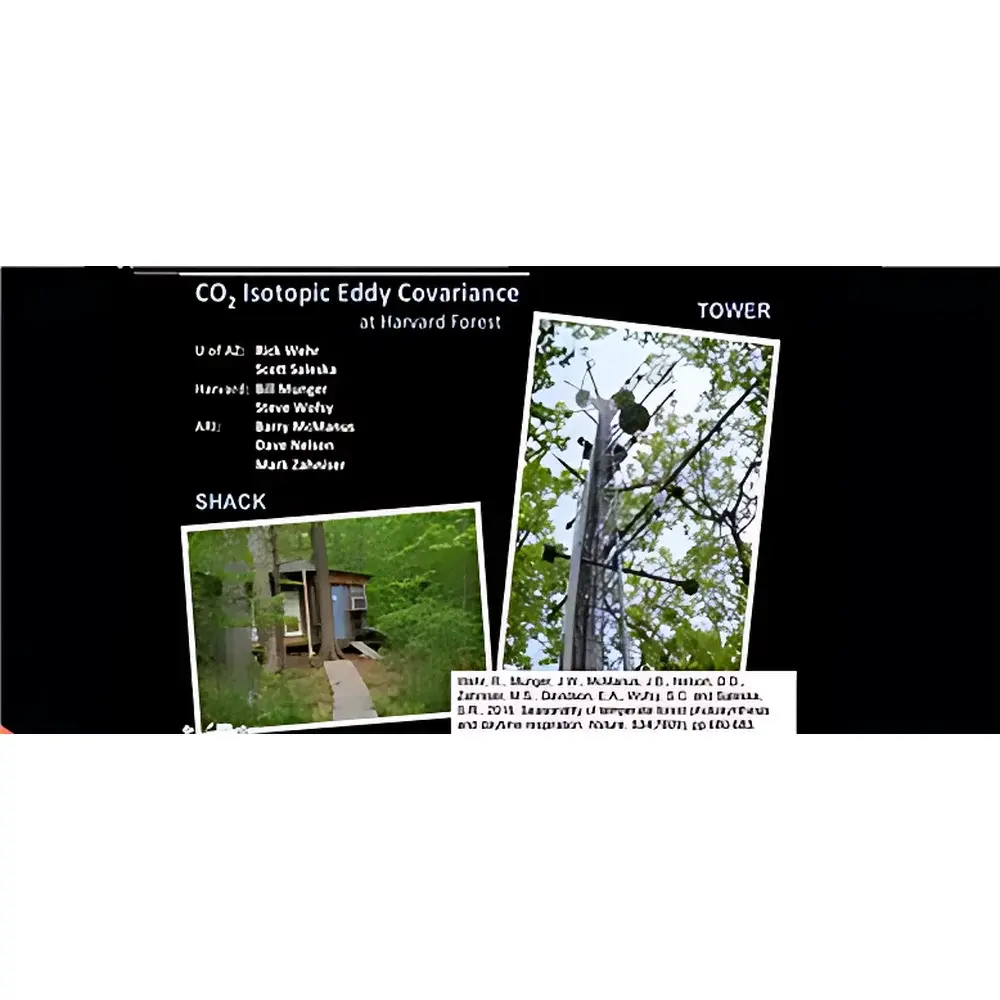
- Eddy covariance flux measurements of CO₂, CH₄, N₂O, NH₃, and HONO over forests, grasslands, wetlands, and agricultural fields.
- Automated soil chamber studies quantifying diurnal and event-driven N₂O and CH₄ emissions with detection limits <0.001 nmol m⁻² s⁻¹.
- Isotopic flux partitioning: ¹³C-CO₂ and clumped CO₂ (Δ₄₇) to distinguish photosynthetic vs. respiratory sources; δ¹⁵N-N₂O to identify nitrification vs. denitrification pathways.
- Mobile platform deployments: vehicle-mounted surveys of urban VOC gradients, shipborne oceanic COS/CO₂ gradients, and airborne vertical profiling of boundary-layer chemistry.
- Industrial source characterization: combustion plume analysis (NOₓ, SO₂, COS), biogas upgrading verification (CH₄/CO₂/H₂S), and landfill emission monitoring.
- Long-term atmospheric observatories: integration with ICOS, NOAA GML, and ACTRIS networks for trend analysis and model evaluation.
FAQ
Does the system require daily calibration gas injections?
No. Absolute quantification is achieved through first-principles spectroscopic modeling using HITRAN line parameters, temperature, pressure, and measured optical density—eliminating routine calibration gas dependence.
Can it operate unattended for extended periods in remote field sites?
Yes. The system includes redundant power management, internal diagnostics, automated cell purging, and remote firmware/software update capability—validated for >12-month continuous operation in Arctic, tropical, and alpine environments.
How is water vapor interference handled during high-humidity measurements?
Water vapor is co-fitted as a constrained parameter within the spectral inversion model using high-resolution H₂O line databases and continuum absorption coefficients—ensuring accuracy even at 95% RH.
What level of technical support is provided for flux data processing?
Aerodyne offers application-specific scripting templates (Python, MATLAB), flux uncertainty propagation tools, and direct collaboration with flux community experts for EC and chamber data integration.
Is the instrument suitable for regulatory reporting under national GHG inventories?
Yes. Configuration, validation records, and data handling workflows meet ISO 14064-3:2019 verification requirements and are routinely accepted by national inventory agencies including DEFRA, UBA, and Environment and Climate Change Canada.







