
Aerodyne TILDAS-CN Dual-Isotope Gas Analyzer for Simultaneous Carbon and Nitrogen Stable Isotope Ratio Monitoring
| Brand | Aerodyne |
|---|---|
| Origin | USA |
| Instrument Type | Stable Isotope Ratio Mass Spectrometry (IRMS)-Grade Laser Absorption Spectrometer |
| Measurement Principle | Tunable Infrared Laser Direct Absorption Spectroscopy (TILDAS) with Astigmatic Multipass Cell |
| Detection Limits | Sub-ppt for N₂O, CH₄ |
| δ¹³C-CO₂ precision | 0.02‰ (120 s) |
| δ¹⁸O-CO₂ precision | 0.03‰ (120 s) |
| Sampling Frequency | 1–10 Hz configurable |
| Certified Compliance | ASTM D6348, ISO 13877 (adapted), GLP/GMP-ready data audit trail per FDA 21 CFR Part 11 |
| Software | TDLWINTEL v5.2 with HITRAN spectral replay, zero-spectrum background subtraction, real-time laser frequency stabilization, and passive cavity drift correction |
Overview
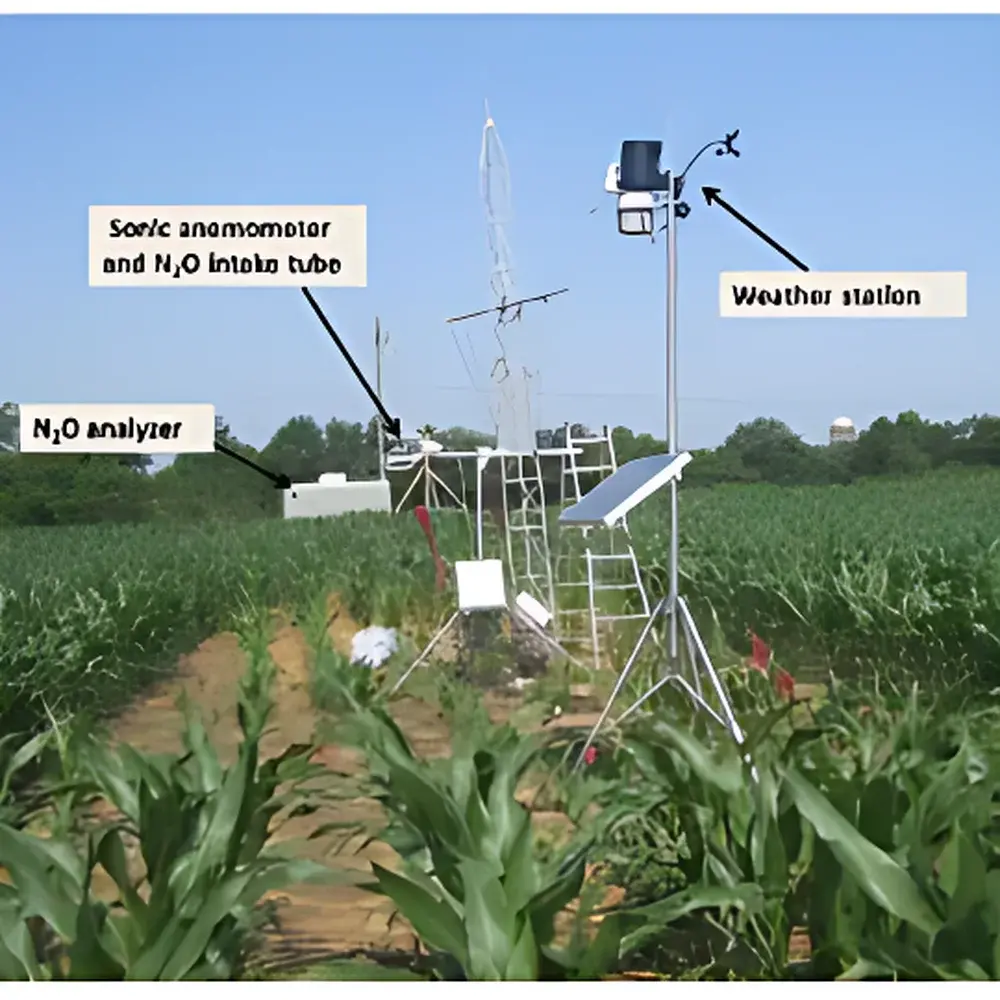
The Aerodyne TILDAS-CN Dual-Isotope Gas Analyzer is an advanced, field-deployable stable isotope ratio measurement system engineered for simultaneous, high-frequency (up to 10 Hz), in situ quantification of greenhouse gas concentrations and their isotopic signatures—specifically δ¹³C-CO₂, δ¹⁸O-CO₂, δ¹⁵N-N₂O, and δ¹³C-CH₄—within a single optical platform. Unlike conventional isotope ratio mass spectrometers (IRMS), which require cryogenic preconcentration, offline sample preparation, and discrete injection cycles, the TILDAS-CN employs quantum-cascade laser-based tunable infrared direct absorption spectroscopy (TILDAS) in the mid-infrared fingerprint region (2.5–12 µm). This enables real-time, absolute concentration measurements without calibration gases, while delivering isotopic precision comparable to high-end IRMS systems under continuous operation. Its astigmatic multipass absorption cell achieves an effective optical path length of 210 meters, enhancing sensitivity to sub-ppt levels for trace species including N₂O, CH₄, CO₂, and H₂O. Designed for eddy covariance (EC) flux towers, soil chambers, and atmospheric observatories, the system meets the stringent temporal resolution (<1 s), isotopic reproducibility (<0.03‰ for δ¹³C at 120 s integration), and long-term stability requirements of carbon–nitrogen–water cycle coupling studies.
Key Features
- Simultaneous dual-isotope monitoring: Real-time co-measurement of δ¹³C-CO₂ and δ¹⁸O-CO₂, plus δ¹⁵N-N₂O and δ¹³C-CH₄, enabling multi-tracer source partitioning.
- Dual-wavelength quantum cascade laser architecture: Eliminates inter-instrument bias by measuring multiple isotopologues on a single optical axis—no cross-calibration drift between analytes.
- HITRAN-integrated spectral replay mode (TDLWINTEL v5.2): Enables post-acquisition re-fitting using reference line lists; identifies spectral contamination (e.g., impurity peaks from non-certified standards) and validates measurement integrity.
- Zero-reference absolute absorption spectroscopy: Each measurement cycle includes a laser-off “zero” acquisition—no differential or cavity ring-down assumptions—ensuring traceable, calibration-free quantification.
- Patented active surface passivation: Reduces adsorption hysteresis for sticky molecules (e.g., NH₃, O₃), enabling concurrent high-fidelity detection of polar and nonpolar gases (NH₃/CO₂/N₂O/CH₄) without cross-interference.
- Inertial particle removal interface: Integrated upstream filtration prevents particulate carryover during long-term soil or canopy sampling—critical for maintaining measurement fidelity over multi-month deployments.
- On-the-fly laser frequency stabilization: Embedded reference cavity continuously monitors and corrects laser center frequency drift, preserving isotopic line shape fidelity across temperature gradients and extended runtimes.
Sample Compatibility & Compliance
The TILDAS-CN is optimized for ambient air, soil efflux, chamber headspace, and stack emissions sampling. It accepts standard 1/4″ Swagelok® inlet tubing and interfaces directly with EC systems, Picarro-style manifold manifolds, or custom gas handling modules. All internal wetted surfaces are electropolished stainless steel with SilcoNert® 2000 coating to minimize memory effects. The system complies with ASTM D6348 for gaseous pollutant analysis and supports ISO 13877-compliant validation protocols for isotopic accuracy verification. Data logging adheres to GLP/GMP principles: full metadata tagging (pressure, temperature, flow rate), immutable audit trails, electronic signatures, and 21 CFR Part 11–compliant user access controls via TDLWINTEL’s secure authentication layer.
Software & Data Management
TDLWINTEL v5.2 provides full instrument control, spectral visualization, real-time isotopic ratio calculation, and automated QA/QC reporting. Raw absorbance spectra are stored in HDF5 format with embedded timestamps, environmental metadata, and laser tuning parameters. The software supports batch processing of spectral replays against HITRAN 2020 line lists, automatic baseline correction using polynomial fitting, and uncertainty propagation for δ-value calculations per IUPAC guidelines. Export formats include NetCDF-4 (CF-1.8 compliant), CSV, and MATLAB .mat—enabling seamless ingestion into FLUXNET, ICOS, or AmeriFlux pipelines. Remote diagnostics, firmware updates, and spectral health monitoring are accessible via TLS-encrypted web interface.
Applications
- Ecosystem flux partitioning: Resolving gross primary production (GPP) vs. ecosystem respiration (Reco) via δ¹³C-CO₂ diurnal dynamics in forest, grassland, and wetland sites.
- Nitrogen cycle tracing: Quantifying nitrification/denitrification contributions to N₂O emissions using site-specific δ¹⁵N-N₂O and ¹⁵N-site preference (SP) derived from multi-laser spectral deconvolution.
- Urban methane source attribution: Discriminating biogenic (landfill, wastewater) from thermogenic (leakage, distribution) CH₄ using δ¹³C-CH₄ and C₂H₆/CH₄ ratios.
- Ocean–atmosphere CO₂ exchange studies: Constraining air–sea gas transfer velocity and aqueous-phase carbonate chemistry via coupled δ¹³C-CO₂ and δ¹⁸O-CO₂ signals.
- Soil biogeochemical modeling: Validating process-based models (e.g., DNDC, DAYCENT) with high-temporal-resolution isotopic constraints on denitrification, methanogenesis, and autotrophic respiration.
FAQ
Does the TILDAS-CN require daily calibration with certified isotopic standards?
No. Its absolute absorption spectroscopy architecture eliminates routine calibration; however, quarterly verification using NIST-traceable CO₂ and N₂O isotopic reference gases is recommended for long-term drift assessment.
Can it operate unattended for extended field campaigns?
Yes. With industrial-grade thermal management, redundant power inputs, and onboard data storage (2 TB SSD), the system supports >6-month autonomous deployment in remote EC towers or boreal soil chambers.
How does it handle water vapor interference in δ¹⁸O-CO₂ measurements?
The system uses H₂O-resolved spectral fitting with line-by-line Voigt profile modeling; its 210 m path length ensures sufficient signal-to-noise even at >5000 ppm H₂O, and the zero-spectrum subtraction routine removes broadband absorption artifacts.
Is spectral data export compatible with third-party isotopic inversion models?
Yes. Full-resolution absorbance spectra (wavenumber vs. intensity) are exported in HDF5 with SI-traceable units, supporting forward modeling in tools such as ISOFIT, LBLRTM, or custom radiative transfer codes.
What maintenance is required beyond annual laser alignment?
Only quarterly inspection of the inertial particle filter and annual replacement of the ultra-high-purity nitrogen purge supply (99.9992% N₂); no consumables, no vacuum pumps, no ion sources.





