
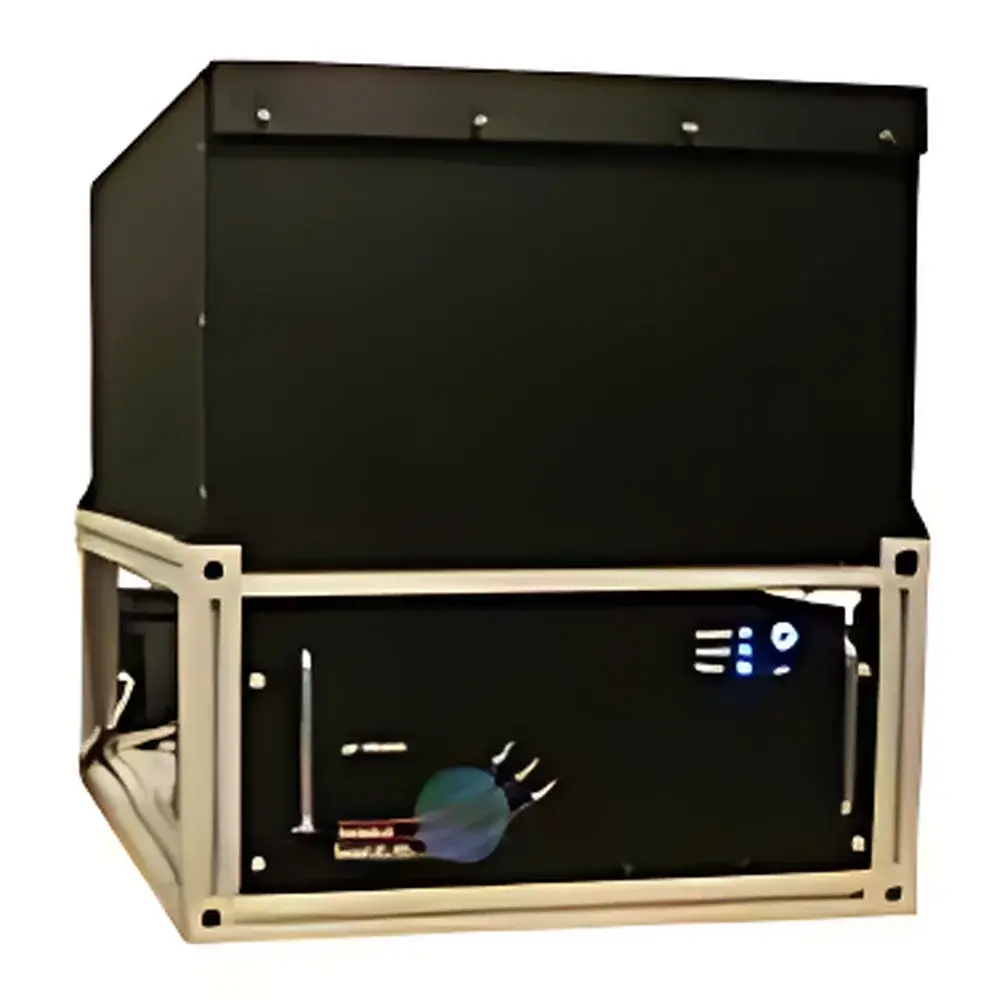
Aerodyne TILDAS-CNW Dual-Isotope Gas Analyzer for Simultaneous Carbon, Nitrogen, and Water Isotope Monitoring
| Brand | Aerodyne |
|---|---|
| Origin | USA |
| Model | Aerodyne TILDAS-CNW |
| Detection Principle | Tunable Infrared Laser Direct Absorption Spectroscopy (TILDAS) |
| Configuration | Online Continuous Analyzer |
| Response Time | <1 s (up to 10 Hz measurement frequency) |
| Repeatability | CH₄, δ¹³C(CH₄), N₂O, δ¹⁵N¹⁴N¹⁶O, δ¹⁴N¹⁵N¹⁶O, δ¹⁸O(N₂O), CO₂, δ¹³C(CO₂), δ¹⁸O(CO₂), H₂O, δ¹⁸O(H₂O), δHDO |
| Measurement Range | CH₄: 2–20 ppm |
| N₂O | 0.3–100 ppm |
| CO₂ | 300–1000 ppm or 0.1–0.3 µmol/mol |
| H₂O | 0–4% |
| Precision (1 s / 100 s) | CH₄: 0.2 / 0.05 ppb |
| δ¹³C(CH₄) | 1.0 / 0.2 ‰ |
| N₂O | 0.03 / 0.01 ppb |
| δ¹⁴N¹⁵N¹⁶O | 6.0 / 1.5 ‰ |
| δ¹⁵N¹⁴N¹⁶O | 9.0 / 2.3 ‰ |
| δ¹⁸O(N₂O) | 12.0 / 3.0 ‰ |
| CO₂ | 0.1 / 0.03 ppm |
| δ¹³C(CO₂) | 0.1 / 0.03 ‰ |
| δ¹⁸O(CO₂) | 0.1 / 0.03 ‰ |
| H₂O | 10 / 5 ppm |
| δ¹⁸O(H₂O) | 0.1 / 0.03 ‰ |
| δHDO | 0.3 / 0.1 ‰ |
| Operating Temperature | 10–35 °C |
| Humidity Range | 5–95 % RH (non-condensing) |
| Sampling Flow Rate | 0–20 SLPM |
| Data Interfaces | RS232, USB, Ethernet |
| Dimensions | 530 × 660 × 710 mm (W×D×H) |
| Weight | 72 kg |
| Power | 500 W, 120/240 VAC, 50/60 Hz |
Overview
The Aerodyne TILDAS-CNW Dual-Isotope Gas Analyzer is an advanced online environmental monitoring instrument engineered for high-temporal-resolution, simultaneous quantification of carbon-, nitrogen-, and water-related trace gases and their stable isotopologues in ambient air, eddy covariance towers, soil chambers, and atmospheric profiling systems. It employs Tunable Infrared Laser Direct Absorption Spectroscopy (TILDAS) in the mid-infrared spectral region (2.5–5 µm), where fundamental vibrational-rotational transitions of target molecules exhibit maximal absorption cross-sections and minimal spectral interference. Unlike isotope-ratio mass spectrometry (IRMS) or cavity-enhanced techniques requiring cryogenic preconcentration or complex calibration gas standards, the TILDAS-CNW delivers real-time, absolute concentration and isotopic ratio measurements via direct, physics-based spectral fitting—eliminating drift-induced calibration dependencies and enabling robust field deployment with minimal operator intervention.
Key Features
- Simultaneous detection of 12+ isotopic species across three biogeochemical cycles: CH4, δ13C(CH4), N2O, δ15N14N16O, δ14N15N16O, δ18O(N2O), CO2, δ13C(CO2), δ18O(CO2), H2O, δ18O(H2O), and δHDO.
- Patented astigmatic multipass absorption cell with optical path lengths up to 210 m—optimized for absorbance depth between 0.1 and 1.0—ensuring sub-ppt detection limits and exceptional signal-to-noise ratio.
- High-speed laser scanning (1–3 kHz) synchronized with precision current modulation enables full spectral acquisition and baseline correction within each 100-ms cycle, supporting true 10 Hz data output with validated precision.
- Integrated 16-port rotary sampling valve controlled by TDLWintel software, supporting automated switching among inlet lines for vertical profiling, chamber flux studies, and multi-point calibration without manual reconfiguration.
- Active thermal stabilization: sealed, insulated enclosure maintained at 30 °C ± 0.1 °C over ambient range –20 to +40 °C—minimizing thermo-optic drift and ensuring long-term measurement stability.
- GPS-synchronized timekeeping via NTP-compatible interface ensures traceable timestamping for eddy covariance flux partitioning and inter-site data harmonization under FLUXNET or ICOS protocols.
Sample Compatibility & Compliance
The TILDAS-CNW is designed for continuous unattended operation in diverse environmental settings—including remote field stations, forest canopies, agricultural soils, and urban boundary layers. Its robust sample handling architecture accommodates flow rates from 0 to 20 SLPM, with programmable switching between high-flow eddy covariance mode (10 SLPM) and low-flow concentration monitoring (<1 SLPM). The system meets ASTM D6348–22 and ISO 14644-1 Class 8 cleanroom compatibility requirements for optical alignment integrity. All isotopic delta values are reported relative to internationally accepted reference scales (VPDB for carbon, AIR-N2 for nitrogen, VSMOW for oxygen and hydrogen), with internal standardization traceable to NIST SRM 1666b (CH4), NIST SRM 610 (CO2), and IAEA reference waters (VSMOW2, GISP). Data logging and audit trails comply with GLP/GMP principles; raw spectra and fitted parameters are archived with metadata sufficient for third-party validation per US EPA Method TO-15 and ISO 17025 accreditation frameworks.
Software & Data Management
Operation and real-time analysis are managed through the proprietary TDLWintel software platform, which provides integrated instrument control, spectral acquisition, nonlinear least-squares fitting (using HITRAN-based line lists), and on-the-fly δ-value calculation. Each scan captures both the target absorption feature and adjacent baseline regions, enabling dynamic background subtraction and eliminating zero-offset drift. The software supports configurable averaging windows (1–100 s), automatic outlier rejection based on χ² residuals, and export of fully annotated ASCII or NetCDF files compliant with CF-1.8 metadata conventions. Remote diagnostics, firmware updates, and configuration backup are accessible via secure Ethernet connection. All raw interferograms and fit reports are stored locally with SHA-256 checksums, satisfying FDA 21 CFR Part 11 requirements for electronic records and signatures when deployed in regulated research environments.
Applications
- Quantifying microbial source partitioning of CH4 emissions (e.g., acetoclastic vs. hydrogenotrophic methanogenesis) using dual δ13C–δD constraints.
- Resolving N2O production pathways (nitrification vs. denitrification) via site-specific δ15N and δ18O signatures, including intramolecular 15N site preference (SP).
- Partitioning ecosystem-scale CO2 fluxes into photosynthetic assimilation and respiratory release using δ13C(CO2) diurnal dynamics.
- Tracing hydrological connectivity and evapotranspiration sources using δ18O(H2O) and δHDO in atmospheric vapor profiles.
- Validating Earth system models (e.g., CESM, CLM) by providing high-frequency isotopic constraints on land–atmosphere exchange processes.
- Supporting Tier 3 greenhouse gas inventories under IPCC 2006 Guidelines and subsequent refinements (e.g., 2019 Refinement).
FAQ
What isotopic species does the TILDAS-CNW measure simultaneously?
It measures CH4, δ13C(CH4), N2O, δ15N14N16O, δ14N15N16O, δ18O(N2O), CO2, δ13C(CO2), δ18O(CO2), H2O, δ18O(H2O), and δHDO—all in a single, uninterrupted acquisition stream.
Does the system require external calibration gases during operation?
No. The TILDAS-CNW performs absolute concentration and isotopic ratio determination via first-principles spectral fitting. While periodic verification with certified standards is recommended for QA/QC, routine calibration gas injections are not required for stable long-term operation.
How is temperature stability maintained in variable field environments?
The analyzer resides in a thermally isolated, actively heated enclosure regulated to 30 °C ± 0.1 °C using PID-controlled resistive heating and high-efficiency insulation—ensuring optical alignment and detector responsivity remain invariant across –20 to +40 °C ambient conditions.
Can the system be integrated into existing eddy covariance infrastructure?
Yes. With native support for 10-Hz data streaming, GPS-synchronized timestamps, and RS232/Ethernet output, the TILDAS-CNW interfaces directly with standard EC data loggers (e.g., Campbell Scientific CR6, LI-COR EddyPro) and complies with AmeriFlux and ICOS metadata standards.
What maintenance is required for sustained field deployment?
Routine maintenance is limited to quarterly inspection of inlet filters, annual verification of laser wavelength calibration using built-in reference cells, and biannual cleaning of optical windows using spectroscopic-grade solvents—no consumables or vacuum pumps are involved.







