
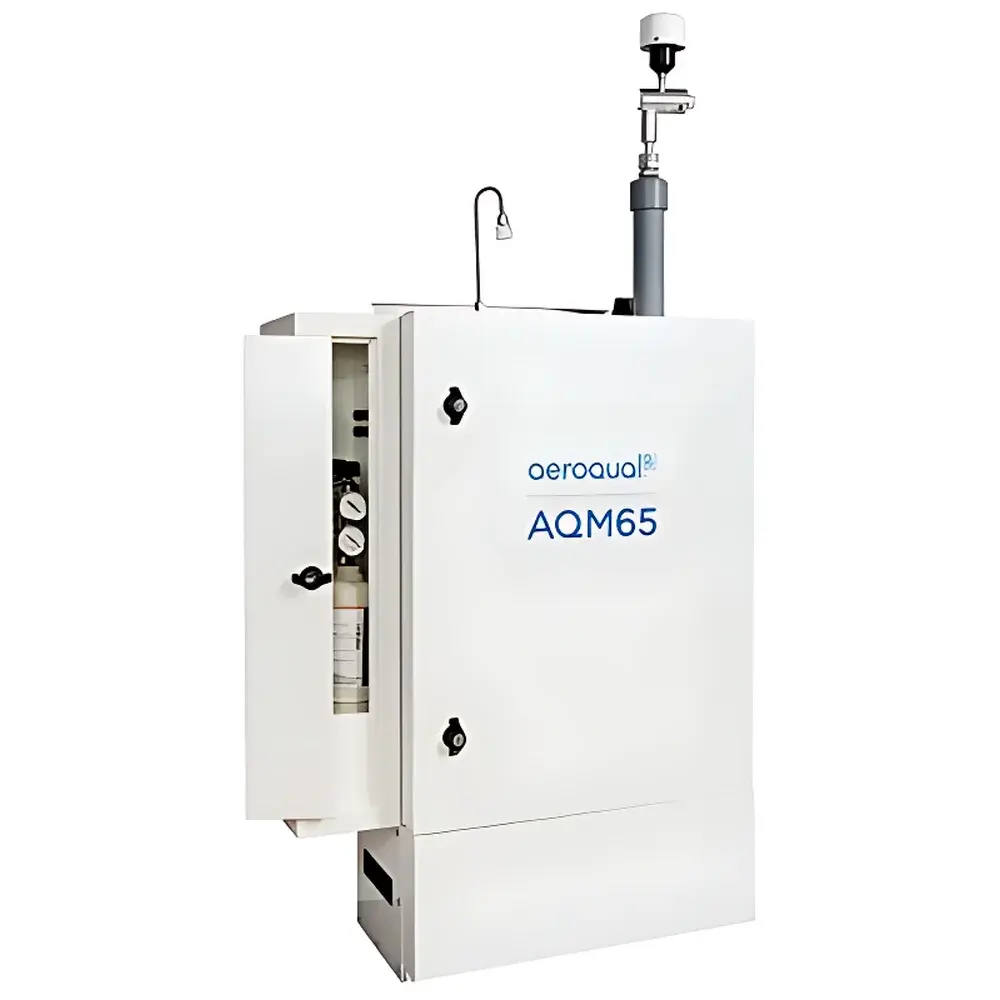
Aeroqual AQM 65 Portable Air Quality Monitoring Station
| Brand | Aeroqual |
|---|---|
| Origin | New Zealand |
| Model | AQM 65 |
| Power Supply | 90–264 VAC, 47–63 Hz |
| Operating Temperature | −35 °C to +50 °C |
| Enclosure Rating | IP65 |
| Dimensions (standard) | 1310 × 510 × 290 mm (H×W×D) |
| Weight | ~25 kg |
| Core Computing Platform | Intel Atom N2600, 1.6 GHz, 2 GB RAM, 32 GB SSD, Ubuntu Linux |
| Communication | Wi-Fi, Ethernet (LAN), optional cellular GPRS modem |
| Gas Sampling | 12 V brushless diaphragm pump, PTFE-lined stainless steel inlet |
| Thermal Management | DC compressor (R134a), 12–24 V, 60 W resistive heater |
| Data Transmission | Aeroqual Cloud (encrypted), FTP/email export (optional), SMS/email alerts (optional) |
| Calibration Options | AirCal 1000 (portable), AirCal 8000 (integrated) |
| Certified Sensor Modules | Gill WindSonic (ultrasonic wind), Vaisala WXT536 (weather), Cirrus MK427 Class 1 (noise), Novalynx pyranometer (solar radiation) |
| Measured Gases | O₃ (0–0.5 ppm), NO₂ (0–0.2 ppm), NOₓ (0–0.5 ppm), CO (0–25 ppm), SO₂ (0–10 ppm), H₂S (0–10 ppm), CO₂ (0–2000 ppm), VOC (0–20 ppm) |
| Particulate Matter | PM₁/PM₂.₅/PM₁₀/TSP via optical particle counter (±5 µg/m³ + 15% of reading) and turbidimeter (±2 µg/m³ + 5% of reading) |
| Meteorological Parameters | Wind speed/direction, temperature, relative humidity, barometric pressure, rainfall, solar irradiance |
| Noise Monitoring | 30–100 dB(A), Class 1 accuracy per IEC 61672-1 |
Overview
The Aeroqual AQM 65 Portable Air Quality Monitoring Station is a field-deployable, modular environmental monitoring platform engineered for high-fidelity, simultaneous measurement of up to 20 regulated air pollutants and meteorological parameters. Built upon electrochemical, metal oxide semiconductor (MOS), non-dispersive infrared (NDIR), and optical scattering detection principles, the AQM 65 delivers trace-level gas quantification and gravimetric-equivalent particulate mass concentration data compliant with international reference methods. Unlike legacy fixed-site stations, the AQM 65 integrates sensor-level thermal stabilization, active zero-point compensation, and traceable calibration architecture—enabling deployment in urban canyons, industrial perimeters, roadside corridors, and remote field sites without infrastructure dependency. Its design adheres to ISO 12039 (SO₂), ISO 10498 (NO₂), EN 14625 (O₃), and US EPA EQOA-0123-120 (PM₂.₅) performance expectations for indicative monitoring systems. The station operates continuously under ambient conditions ranging from −35 °C to +50 °C and maintains measurement integrity across variable humidity (10–95% RH) and solar loading due to its passive solar-reflective enclosure and active thermal management system.
Key Features
- Modular sensor architecture enabling user-defined configuration of gas, particulate, meteorological, and noise modules without hardware rework
- Onboard embedded industrial computer (Intel Atom N2600, Ubuntu Linux) supporting local data processing, diagnostics, and firmware updates
- Active thermal regulation using R134a-based compression cooling and resistive heating to stabilize sensor operating temperature within ±0.5 °C
- Zero-drift compensation algorithm with automated baseline correction during idle cycles, reducing manual intervention frequency by >70%
- IP65-rated anodized aluminum enclosure with solar-reflective coating and 40–50 mm cross-linked polyethylene internal insulation for thermal inertia
- Low-power consumption (<100 W typical) compatible with off-grid operation via solar-charged battery banks or uninterruptible power supplies
- Integrated dual-path particulate measurement: optical particle counter (OPC) for size-resolved counts and turbidimetric nephelometer for mass concentration validation
- Gas sensor calibration traceability to NIST-traceable standards via optional AirCal 1000 (field-portable) or AirCal 8000 (integrated dilution + zero-air generation)
Sample Compatibility & Compliance
The AQM 65 is validated for continuous ambient air sampling in accordance with ISO 14644-1 (cleanroom classification), ASTM D6284 (ambient VOC measurement), and EU Directive 2008/50/EC (ambient air quality assessment). All electrochemical gas sensors undergo factory calibration against certified standard gases (e.g., O₃ at 0.1 ppm, NO₂ at 0.05 ppm) with documented uncertainty budgets per ISO/IEC 17025. Particulate modules meet EN 12341:2014 equivalence criteria for PM₁₀ and PM₂.₅ measurement, with optical alignment verified using NIST-traceable polystyrene latex (PSL) microspheres. Meteorological sensors comply with WMO Guide to Instruments and Methods of Observation (CIMO) requirements. Noise measurement conforms to IEC 61672-1:2013 Class 1 specifications. Full audit trails—including calibration logs, sensor diagnostics, and environmental metadata—are retained locally and synchronized to encrypted cloud storage, supporting GLP/GMP-aligned data governance frameworks.
Software & Data Management
Aeroqual Connect is a browser-based interface hosted on the onboard Linux system, accessible via Chrome, Safari, or Edge without plugin dependencies. It provides real-time visualization of all sensor outputs, configurable alarm thresholds (email/SMS), diagnostic dashboards, and over-the-air firmware updates. Aeroqual Cloud serves as the central repository for time-series data with TLS 1.2 encryption, role-based access control, and immutable audit logging. Raw data exports support CSV, JSON, and NetCDF formats; automated FTP push and scheduled email delivery are configurable. The platform implements timestamped digital signatures for each data packet and supports 21 CFR Part 11-compliant electronic records when paired with organizational identity management policies. Historical datasets are indexed by geotag, sensor ID, and calibration epoch, enabling retrospective QA/QC analysis across multi-year deployments.
Applications
- Urban air quality surveillance networks—supporting hyperlocal pollution mapping, hotspot identification, and source apportionment modeling
- Industrial fence-line monitoring for compliance with EPA 40 CFR Part 63 and EU Industrial Emissions Directive (2010/75/EU)
- Roadside and tunnel air quality assessment aligned with WHO Global Air Quality Guidelines and CEN/TS 16451
- Short-term campaign monitoring for environmental impact assessments, construction site compliance, and public health studies
- Mobile monitoring on vehicle-mounted platforms for rapid-response emergency assessment and regulatory inspection workflows
- Cultural heritage site preservation—tracking acid gas deposition (SO₂, NO₂) and particulate soiling rates on historic facades
- Educational deployment in university environmental science programs, providing students hands-on experience with calibrated, networked sensor systems
FAQ
What calibration standards does the AQM 65 follow?
The AQM 65 uses NIST-traceable standard gases for initial factory calibration, and field recalibration is performed using AirCal 1000 or AirCal 8000 systems that generate certified zero air and precise diluted span gases per ISO 6145-7.
Can the AQM 65 operate unattended for extended periods?
Yes—it is rated for continuous operation up to 12 months between maintenance intervals, with automatic self-diagnostics, battery-backed clock, and watchdog timer recovery.
Is particulate measurement compliant with regulatory reference methods?
While not a federal equivalent method (FEM) device, its OPC and turbidimeter outputs demonstrate strong correlation (R² > 0.92) with FRM/FEM beta attenuation monitors (BAM) and tapered element oscillating microbalances (TEOM) under controlled intercomparison studies.
How is data security ensured during transmission?
All communications use TLS 1.2 encryption; cloud-stored data resides in ISO 27001-certified infrastructure with AES-256 encryption at rest and strict RBAC policies.
What meteorological sensors are certified for regulatory use?
The Vaisala WXT536 meets WMO Class II specifications for temperature, humidity, pressure, and precipitation; Gill WindSonic satisfies IEC 61400-12-1 Annex J for wind resource assessment.







