
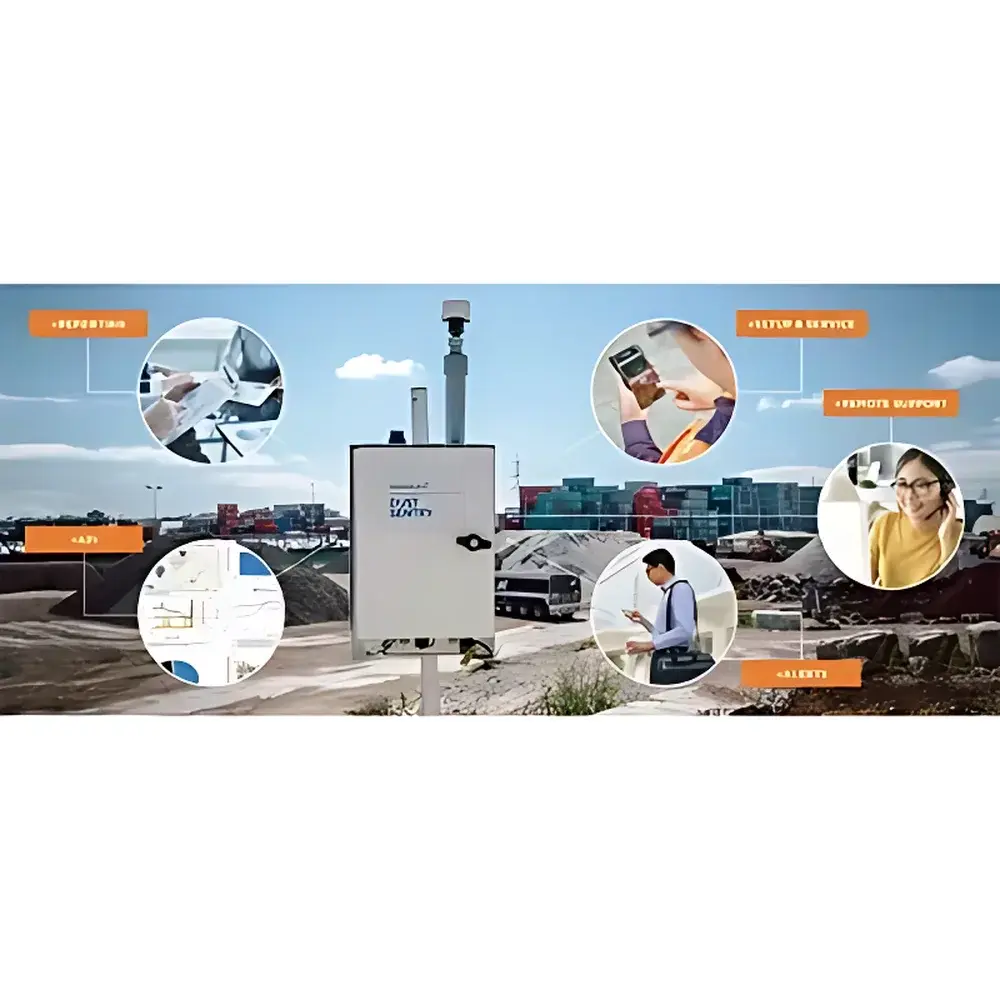
Aeroqual DusT Sentry Atmospheric Particulate Matter Monitoring Station
| Brand | Aeroqual |
|---|---|
| Origin | New Zealand |
| Model | DusT Sentry |
| Particle Measurement Principle | Optical Particle Counting (OPC) via Right-Angle Laser Scattering |
| Measured Parameters | TSP, PM₁₀, PM₂.₅, PM₁ |
| Optional Integrated Gases | VOCs, NO₂, O₃ |
| Sampling Flow Rate | 1.0 LPM |
| Detection Limit | <1 µg/m³ |
| Accuracy | ±(5 µg/m³ + 15% of reading) |
| Resolution | 0.1 µg/m³ |
| Data Logging Interval | 1 min to 24 h |
| Operating Temperature | −10 °C to +45 °C |
| Power Supply | 100–260 VAC (24.7 W) or 12 VDC (27.2 W) |
| Enclosure | IP65-rated GRP cabinet with aluminum solar radiation shield |
| Weight | <13 kg |
| Dimensions | 483 H × 330 W × 187 D mm (incl. shield & mounting hardware) |
| Data Storage | 32 GB SSD (≥5 years at 1-min intervals) |
| Certified | MCERTS-approved for precision and repeatability |
| Comms | Wi-Fi, Ethernet, optional HSPA 3G cellular modem |
| Software | Aeroqual Connect (browser-based local configuration), Aeroqual Cloud (secure encrypted remote data access, diagnostics, calibration logging, alarm management) |
Overview
The Aeroqual DusT Sentry Atmospheric Particulate Matter Monitoring Station is a field-deployable, reference-grade environmental monitoring platform engineered for high-temporal-resolution quantification of airborne particulate mass concentrations. It employs a calibrated optical particle counter (OPC) based on right-angle laser scattering—principled on Mie theory—to detect and size individual particles across four discrete aerodynamic diameter channels (PM₁, PM₂.₅, PM₁₀, and TSP). Unlike gravimetric or beta-attenuation methods requiring lengthy integration periods, the DusT Sentry delivers real-time mass concentration outputs (µg/m³) derived from particle count-to-mass conversion algorithms validated against ISO 10993-12 and EN 12341 reference methodologies. Its design targets continuous operation in unattended outdoor environments—including urban networks, industrial perimeters, construction sites, and mobile monitoring campaigns—where regulatory compliance, long-term data integrity, and low logistical overhead are critical. The system meets MCERTS requirements for precision (±5 µg/m³ + 15% of reading) and inter-unit repeatability, positioning it as a cost-optimized alternative to BAM (Beta Attenuation Monitor) and TEOM (Tapered Element Oscillating Microbalance) systems without compromising metrological traceability.
Key Features
- High-frequency particulate monitoring: configurable logging interval from 1 minute to 24 hours, enabling detection of transient emission events and diurnal trends.
- Modular sensor architecture: native support for co-located gas sensing (VOCs, NO₂, O₃) and meteorological parameters (wind speed/direction, temperature, humidity, rainfall, barometric pressure, noise, solar irradiance) via standardized analog/digital interfaces.
- Robust embedded control system: fanless Intel Atom N3350 dual-core processor (1.1 GHz), 4 GB RAM, 32 GB SSD running Ubuntu Linux—optimized for deterministic I/O timing and firmware stability.
- Low-power operation: nominal 24.7 W AC draw; compatible with off-grid deployment using photovoltaic panels and 12 V DC input.
- Field-serviceable enclosure: IP65-rated glass-reinforced polyester (GRP) housing with integrated aluminum solar radiation shield, rated for continuous operation between −10 °C and +45 °C ambient.
- MCERTS-certified performance: independently verified accuracy, linearity, and long-term drift characteristics suitable for regulatory reporting under EU Directive 2008/50/EC and US EPA PM2.5 monitoring guidance.
- Rapid deployment: full mechanical and software setup achievable within 10 minutes using browser-based Aeroqual Connect interface—no local installation or version management required.
Sample Compatibility & Compliance
The DusT Sentry is designed for ambient air sampling in accordance with ISO 24243:2021 (air quality — performance criteria for instruments measuring particulate matter) and aligned with the measurement principles outlined in EN 12341:2014 (ambient air — standardization of measurement methods for PM₁₀ and PM₂.₅). Its OPC-based detection satisfies the “equivalent method” classification under U.S. EPA’s Federal Reference Method (FRM) and Federal Equivalent Method (FEM) frameworks when deployed with appropriate collocation and calibration protocols. The system supports GLP-compliant data handling through time-stamped audit logs, user-access controls, and secure firmware update signing. All data transmissions to Aeroqual Cloud utilize TLS 1.2+ encryption and adhere to GDPR-compliant storage policies. Optional SMS/email alerting and FTP push functionality enable automated notification of exceedances against user-defined thresholds—critical for early warning applications in occupational health and community exposure assessment.
Software & Data Management
Data acquisition, configuration, and diagnostics are managed through two interoperable software layers. Aeroqual Connect is a zero-install, responsive web application accessible via any modern browser—providing real-time instrument status, live sensor readings, calibration history, and diagnostic logs without dependency on proprietary desktop clients. Aeroqual Cloud serves as the central, ISO 27001-aligned data repository, offering role-based access, multi-site dashboarding, automated report generation (PDF/CSV), and API-driven integration with third-party SCADA, GIS, or LIMS platforms. The onboard 32 GB SSD retains ≥5 years of 1-minute resolution data locally, while synchronized cloud backups preserve raw and processed datasets for >20 years. Remote firmware updates, parameter reconfiguration, and alarm threshold adjustments can be executed without physical site visits—reducing operational costs and improving network uptime reliability.
Applications
- National and municipal air quality monitoring networks requiring high-density, cost-effective node deployment.
- Roadside and tunnel PM monitoring to assess traffic-related emissions and evaluate mitigation strategies.
- Mobile source characterization: integration onto light-duty vehicles, drones, or portable trailers for hotspot mapping and fugitive dust tracking.
- Industrial hygiene and boundary monitoring at mining, quarrying, cement production, and demolition sites.
- Indoor-outdoor exposure studies in schools, hospitals, residential neighborhoods, and commercial buildings.
- Environmental impact assessments (EIA) and baseline surveys prior to infrastructure development or land-use change.
- Research-grade time-series analysis of aerosol dynamics, including nucleation events, regional transport, and secondary organic aerosol formation.
FAQ
What particulate size fractions does the DusT Sentry measure?
It simultaneously reports mass concentrations for PM₁, PM₂.₅, PM₁₀, and total suspended particulates (TSP) using an optically calibrated multi-channel OPC.
Is the system compliant with international air quality standards?
Yes—the instrument is MCERTS certified for precision and repeatability and aligns with ISO 24243, EN 12341, and U.S. EPA FEM equivalency criteria when operated per manufacturer-specified calibration and maintenance schedules.
Can meteorological sensors be added post-deployment?
Yes—modular analog and digital I/O ports support plug-and-play integration of third-party sensors including Gill WindSonic, Vaisala WXT536, Cirrus MK427, and Novalynx pyranometers.
How is data security ensured during transmission and storage?
All communications use TLS 1.2+ encryption; cloud-hosted data resides in geographically redundant, SOC 2 Type II audited infrastructure with RBAC, immutable audit trails, and optional 2FA.
What power options are available for remote installations?
Standard operation uses 100–260 VAC; optional 12 VDC input enables solar/battery-powered configurations with ultra-low standby consumption.
Does the system support automated reporting and alarm notifications?
Yes—configurable email/SMS alerts, scheduled PDF/CSV report delivery, and FTP data push are available via Aeroqual Cloud with customizable trigger logic and escalation rules.







