
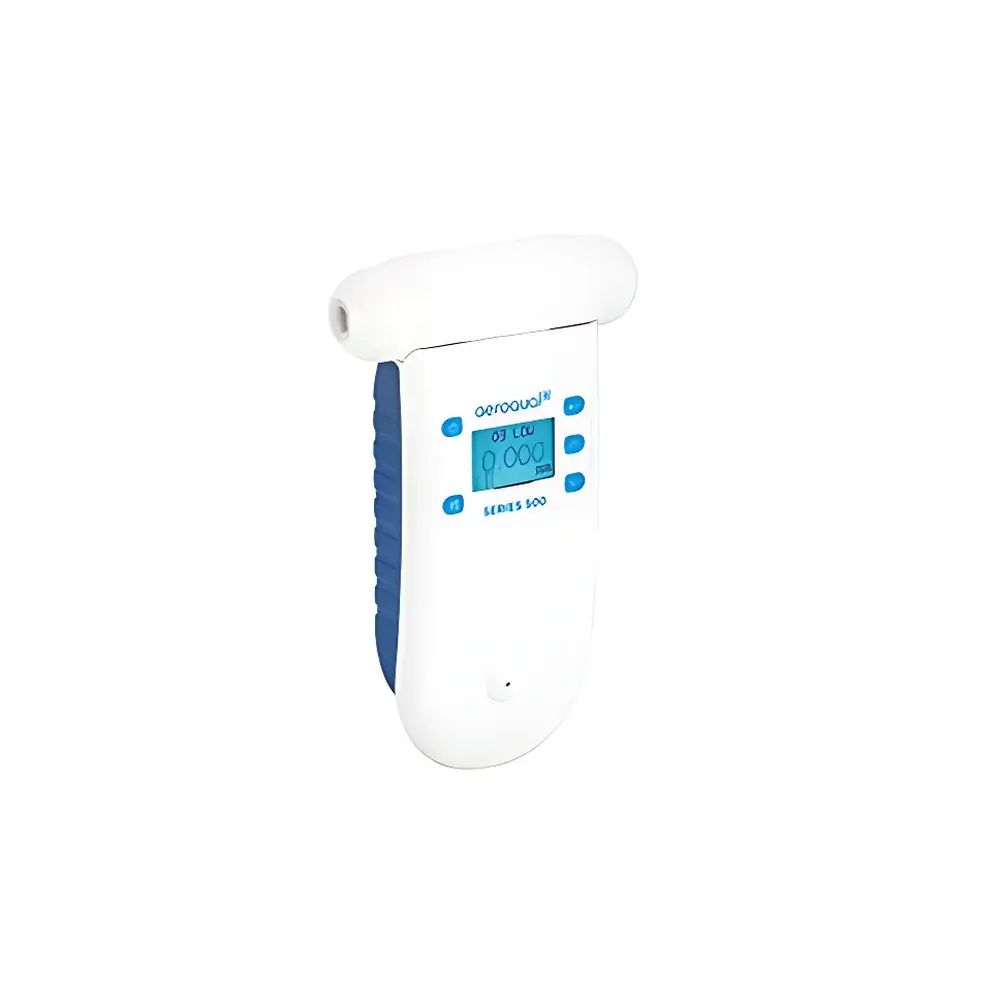
AEROQUAL Series 500 Portable Ambient Air Quality Monitor
| Brand | Aeroqual |
|---|---|
| Origin | New Zealand |
| Model | Series 500 |
| Instrument Type | Portable |
| Detectable Gases | CO, CO₂, NO, H₂S, O₃ |
| Response Time | ≤120 s (T90, gas-dependent) |
| Measurement Accuracy | ±0.5–10% of reading + offset (gas- and sensor-specific) |
| Measurement Range | 0.001–10,000 ppm (gas-dependent) |
| Data Logging Capacity | 8,188 records (including 2,706 temperature/humidity entries) |
| Power | Rechargeable 12 V DC Li-ion battery (2.7 Ah), ~8 h operation |
| Dimensions (with sensor head) | 195 × 122 × 54 mm |
| Weight (with battery & sensor head) | <460 g |
| IP Rating | IP20 / NEMA 1 |
| Operating Environment | 5–45 °C, 0–95% RH (non-condensing) |
| Compliance | FCC Part 15, EN 50082-1:1997, EN 50081-1:1992 |
Overview
The AEROQUAL Series 500 Portable Ambient Air Quality Monitor is an engineered field-deployable instrument designed for real-time, quantitative measurement of gaseous pollutants and particulate matter in ambient, indoor, and occupational environments. It operates on a modular sensor-cartridge architecture—where each analyte-specific sensing module (referred to as a “sensor head”) integrates a calibrated transducer (electrochemical, NDIR, PID, or metal oxide semiconductor), active sampling fan, temperature/humidity compensation circuitry, and digital signal conditioning. The system employs diffusion- and forced-flow sampling principles depending on the sensor head configuration, ensuring representative air intake and minimizing boundary-layer effects. Its core measurement methodology adheres to established electrochemical oxidation kinetics (for CO, H₂S, NO₂, SO₂), non-dispersive infrared absorption (for CO₂), photoionization (for VOCs), and UV absorption (for O₃), all traceable to NIST-certified reference standards via factory calibration protocols. Designed for regulatory-grade screening—not laboratory-grade certification—the Series 500 delivers repeatable, field-validated data suitable for trend analysis, exposure assessment, and compliance pre-screening under ISO 8573-1, EPA Method TO-15 adjunct applications, and WHO air quality guideline monitoring.
Key Features
- Modular sensor-head architecture supporting up to 16 interchangeable analyte-specific cartridges—including CO, CO₂, NO, NO₂, O₃, H₂S, NH₃, SO₂, CH₄, VOCs (PID & MOS), PM₂.₅/PM₁₀, and formaldehyde—enabling rapid reconfiguration without hardware modification.
- Active fan-assisted sampling ensures consistent volumetric flow across sensor heads, improving measurement reproducibility and reducing response lag under variable wind or static conditions.
- Onboard data logging stores up to 8,188 timestamped readings (including concurrent temperature and relative humidity), with dedicated storage allocation for 2,706 combined environmental parameter records.
- Real-time statistical display: simultaneous presentation of instantaneous, minimum, maximum, and rolling average values for all active channels.
- User-accessible zero and span calibration functions, configurable high/low alarm thresholds with audible alert, and analog output (0–5 V DC) for integration into SCADA or datalogger systems.
- Field-replaceable 12 V DC lithium-ion battery (2.7 Ah) providing ≥8 hours of continuous operation; hot-swap capable without instrument shutdown.
- Ruggedized enclosure constructed from PC/ABS blend with IP20/NEMA 1 ingress protection; operational within 5–45 °C and 0–95% RH (non-condensing).
Sample Compatibility & Compliance
The Series 500 is validated for use with ambient air matrices containing typical background oxygen concentrations (~20.9%). Sensor performance specifications assume operation within defined thermal and humidity envelopes (e.g., 0–40 °C and 10–90% RH for most electrochemical cells); deviations require optional environmental enclosures (e.g., HH ENC) to mitigate condensation-induced drift or cross-sensitivity artifacts. It complies with electromagnetic compatibility standards EN 50082-1:1997 and EN 50081-1:1992, and meets radiated emission requirements per FCC Part 15 Subpart B. While not certified for Class I Div 1 hazardous locations, select sensor heads (e.g., CH₄, H₂) are rated for industrial hygiene use under OSHA 1910.120 and ACGIH TLV®-guided exposure assessments. Data integrity aligns with GLP-aligned workflows—audit trails, user authentication, and calibration history are preserved in exported CSV files, though native 21 CFR Part 11 compliance requires third-party validation of the desktop software environment.
Software & Data Management
The included AEROQUAL Desktop Software (v5.x, Windows-compatible) enables full configuration, real-time streaming visualization, post-hoc calibration adjustment, and batch export to CSV or Excel formats. All logged datasets embed UTC timestamps, sensor serial identifiers, firmware revision, and environmental metadata (T/RH). The software supports multi-channel overlay plots, custom averaging intervals (1-min to 24-h), and alarm event flagging. Raw sensor voltage outputs and compensated concentration values are separately accessible for method validation. USB 2.0 interface (RS-232 over FTDI chip) ensures deterministic communication; no proprietary drivers required. Firmware updates are delivered via signed binary packages with checksum verification to maintain traceability.
Applications
- Ambient air quality surveys: roadside NO₂/O₃ mapping, landfill perimeter H₂S monitoring, urban CO gradient studies.
- Indoor environmental quality (IEQ) audits: HVAC performance verification, CO₂ demand-controlled ventilation validation, ozone leakage detection near printers/copiers.
- Occupational health & safety: confined-space entry pre-screening (O₂ depletion, H₂S, CO), fugitive VOC emissions tracking during maintenance, ammonia leak response in refrigeration facilities.
- Educational and citizen science deployments: curriculum-integrated air monitoring projects, community-led pollution hotspot identification.
- Short-term regulatory monitoring: supplemental data collection for EPA Region-specific SIPs, WHO AQG benchmarking, or ISO 16000-22-compliant material emission testing support.
FAQ
What gases can the Series 500 measure simultaneously?
Up to four gases plus temperature and relative humidity can be measured concurrently, limited by the number of installed sensor heads and physical port availability on the base unit.
Are sensor heads calibrated before shipment?
Yes—each sensor head undergoes individual two-point (zero and span) calibration using NIST-traceable gas standards; calibration certificates are supplied with each unit.
Can the instrument operate unattended for extended periods?
Yes—when powered via 12 V DC external supply (100–250 V AC adapter included), it supports continuous logging for >30 days at 1-minute intervals.
Is particulate matter measurement integrated or add-on?
PM₂.₅ and PM₁₀ are measured via an optional optical particle counter (OPC) sensor head (PML series), which uses laser scattering and size binning algorithms compliant with ISO 2591-1.
How is data traceability maintained during field use?
Each measurement record includes embedded firmware version, sensor head serial number, calibration date, and user-defined site ID—enabling full chain-of-custody reconstruction in audit scenarios.







