
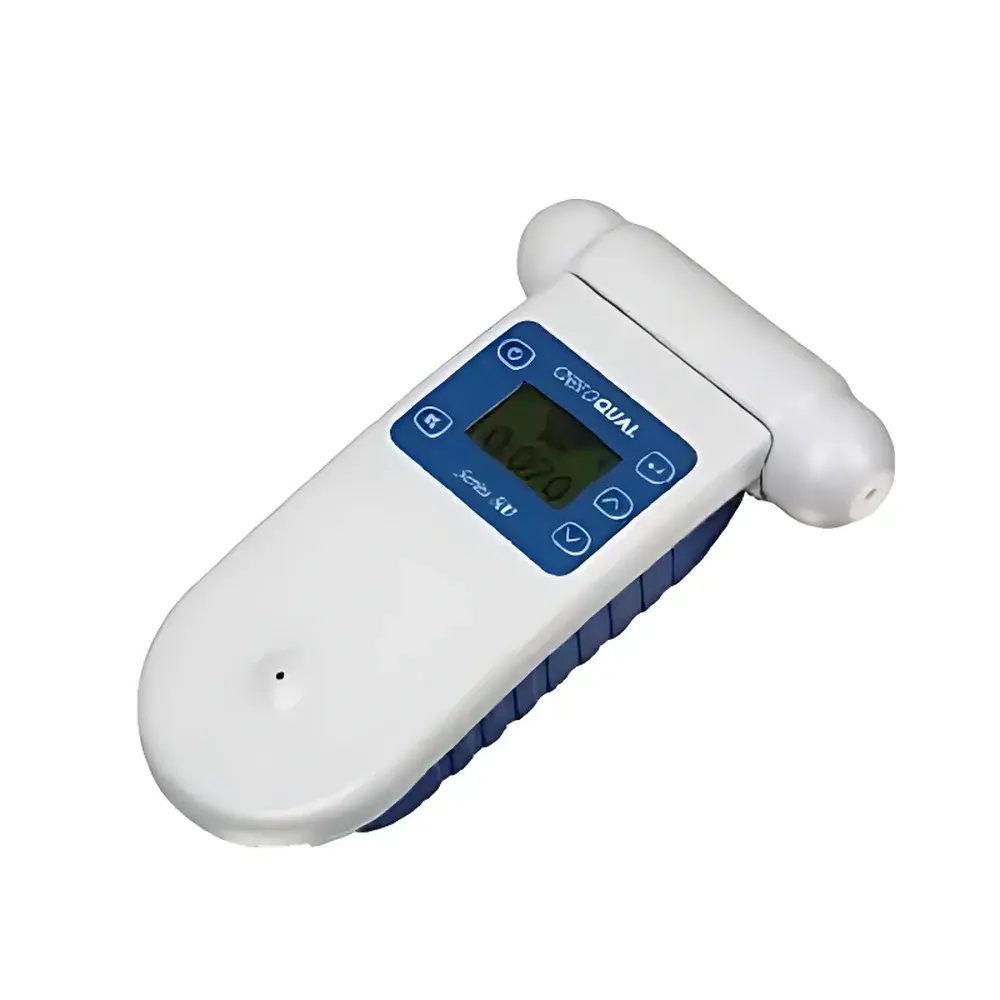
AEROQUAL Series 500 Portable Multi-Gas & Particulate Monitor
| Brand | Aeroqual |
|---|---|
| Origin | New Zealand |
| Model | AEROQUAL Series 500 |
| Sensor Compatibility | Interchangeable modular sensor heads (sold separately) |
| Power | Rechargeable 12 V DC Li-ion battery (2700 mAh, ~8 h runtime) |
| Data Logging | 8,188 total readings (including up to 2,706 temperature/humidity records) |
| Communication | USB (RS-232 via adapter), 0–5 V analog output |
| Environmental Rating | IP20 / NEMA 1 |
| Dimensions | 195 × 122 × 54 mm (with sensor head) |
| Weight | <460 g (<16 oz) |
| Operating Range | 5–45 °C, 0–95 %RH (non-condensing) |
| Certifications | FCC Part 15, EN 50082-1:1997, EN 50081-1:1992 |
Overview
The AEROQUAL Series 500 is a field-deployable, multi-parameter air quality monitoring platform engineered for precision, flexibility, and operational robustness in real-world environmental, occupational, and indoor air quality (IAQ) applications. Unlike fixed-station analyzers or single-gas handhelds, the Series 500 employs a modular architecture centered on interchangeable sensor heads—each housing a calibrated, application-optimized sensing element (electrochemical, metal oxide semiconductor, NDIR, PID, or optical particle counter). This design enables rapid reconfiguration for up to 16 distinct target analytes without instrument replacement. Measurement principles vary by sensor type: electrochemical cells provide selective redox-based quantification of toxic gases (e.g., CO, H2S, NO2); NDIR detectors deliver stable, drift-resistant CO2 measurement; PID sensors enable broad-spectrum volatile organic compound (VOC) detection; and laser scattering particle counters (PML series) report PM2.5 and PM10 mass concentrations per ISO 16000-26 and EPA EQOA-1 guidance. Active sampling via integrated axial fan ensures representative air draw across variable ambient conditions, mitigating boundary layer effects and enhancing data fidelity.
Key Features
- Modular sensor head system—swap in seconds for immediate adaptation to new monitoring objectives (e.g., switching from O3/NO2 urban profiling to NH3/H2S industrial fence-line surveillance)
- On-board data logging with timestamped records for concentration (ppm, mg/m³), temperature (°C), and relative humidity (%RH)—8,188 total entries, with dedicated allocation for environmental metadata
- Real-time display of instantaneous, minimum, maximum, and rolling average values—critical for exposure assessment per ACGIH TLV® and OSHA PEL compliance workflows
- Configurable audible and visual high/low alarms with user-defined thresholds—supports hazard response protocols under ANSI Z241.1 and IEC 60079-29-1
- Zero and span calibration capability using certified gas standards—traceable to NIST SRMs where applicable; supports field verification prior to critical sampling campaigns
- Dual power operation: rechargeable 12 V Li-ion battery (2700 mAh, ~8 h continuous use) and universal 100–250 V AC adapter—enables unattended deployment in remote locations
- Ruggedized polycarbonate/ABS enclosure rated IP20/NEMA 1—designed for laboratory, vehicle-mounted, and short-term outdoor deployment (not for permanent weather exposure)
Sample Compatibility & Compliance
The Series 500 accommodates sensor heads validated for gaseous and particulate targets across three primary domains: ambient air (O3, NO2, SO2, NMHC, PM2.5/PM10), indoor environments (CO, CO2, O3, VOCs), and occupational health (H2S, Cl2, NH3, CH4, C2Cl4). All electrochemical and semiconductor sensors are factory-calibrated against traceable reference standards and exhibit performance within manufacturer-specified accuracy envelopes under defined temperature (0–40 °C) and humidity (10–90 %RH) constraints. While not certified to ISO/IEC 17025 for accredited testing, the platform supports GLP-aligned data integrity when used with documented calibration logs, audit trails (via desktop software), and controlled handling procedures. Sensor interchangeability does not compromise metrological traceability—each head carries individual calibration coefficients stored in onboard memory.
Software & Data Management
AEROQUAL provides free Windows-compatible desktop software for configuration, real-time telemetry, and post-processing. The application enables full control over logging intervals (1 s to 24 h), alarm thresholds, display units (ppm vs. mg/m³), and time synchronization. Export formats include CSV and Excel-compatible XLSX, facilitating integration into LIMS, GIS mapping tools, or statistical analysis platforms (e.g., R, Python pandas). Raw data files embed sensor serial numbers, calibration dates, and firmware versions—supporting 21 CFR Part 11-compliant audit trails when paired with organizational electronic signature policies. No cloud dependency: all processing occurs locally, preserving data sovereignty and enabling offline analysis in resource-constrained field settings.
Applications
- Short-term ambient air quality surveys—compliance screening near construction sites, landfills, or traffic corridors per EU Directive 2008/50/EC
- Personal exposure monitoring for epidemiological studies—time-weighted average (TWA) and short-term exposure limit (STEL) calculations aligned with ISO 8549 and NIOSH Method 0500
- Indoor air quality diagnostics—CO2-driven ventilation assessment, formaldehyde off-gassing evaluation in building materials, and ozone intrusion detection
- Industrial hygiene audits—confined space entry pre-screening, fugitive emission verification, and process leak detection using multi-sensor sweep protocols
- Educational field labs—hands-on atmospheric chemistry instruction with real-time spectral response visualization and comparative sensor performance analysis
FAQ
Can the Series 500 be used for regulatory compliance reporting?
It is suitable for indicative monitoring and preliminary assessment but not certified as a reference method per EPA, ISO, or EN standards. For legally defensible compliance data, pairing with certified reference analyzers and third-party validation is recommended.
Are sensor heads cross-compatible across AEROQUAL product lines?
Series 500 sensor heads are mechanically and electrically compatible with Series 200 and 300 instruments, though firmware and calibration file structures may require version-matched software updates.
How often must sensors be recalibrated?
Electrochemical and semiconductor sensors typically require zero and span calibration every 3–6 months under routine use; frequency increases with exposure to extreme humidity, high contaminant loads, or temperature cycling—per manufacturer’s maintenance schedule and ISO 17025 Clause 6.4 recommendations.
Does the device support simultaneous multi-gas measurement?
Yes—up to four sensor heads can be operated concurrently (e.g., CO + NO2 + O3 + PM2.5) depending on physical head configuration and power budget; sequential measurement is used for >4 parameters.
Is GPS geotagging available?
No native GPS module is integrated; however, external Bluetooth GPS receivers can synchronize timestamps and coordinates via third-party logging software for spatial data correlation.
Related Products







