
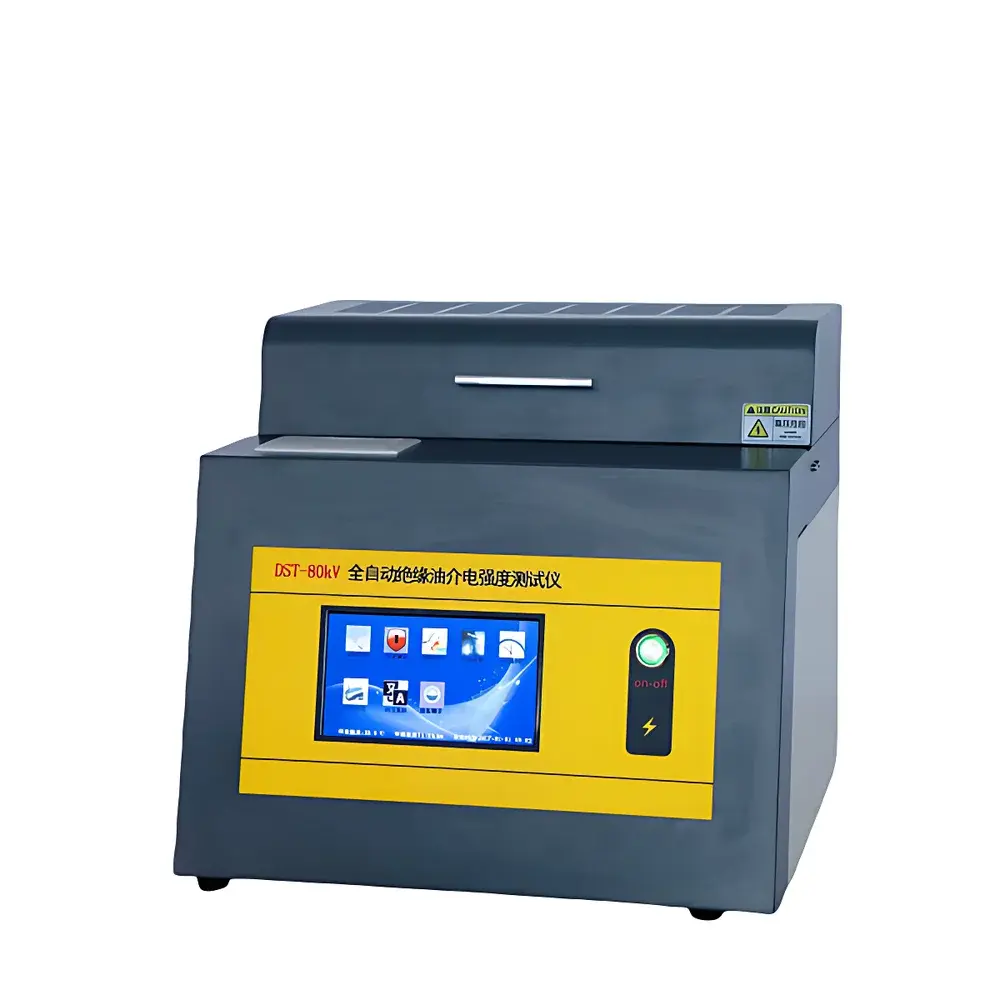
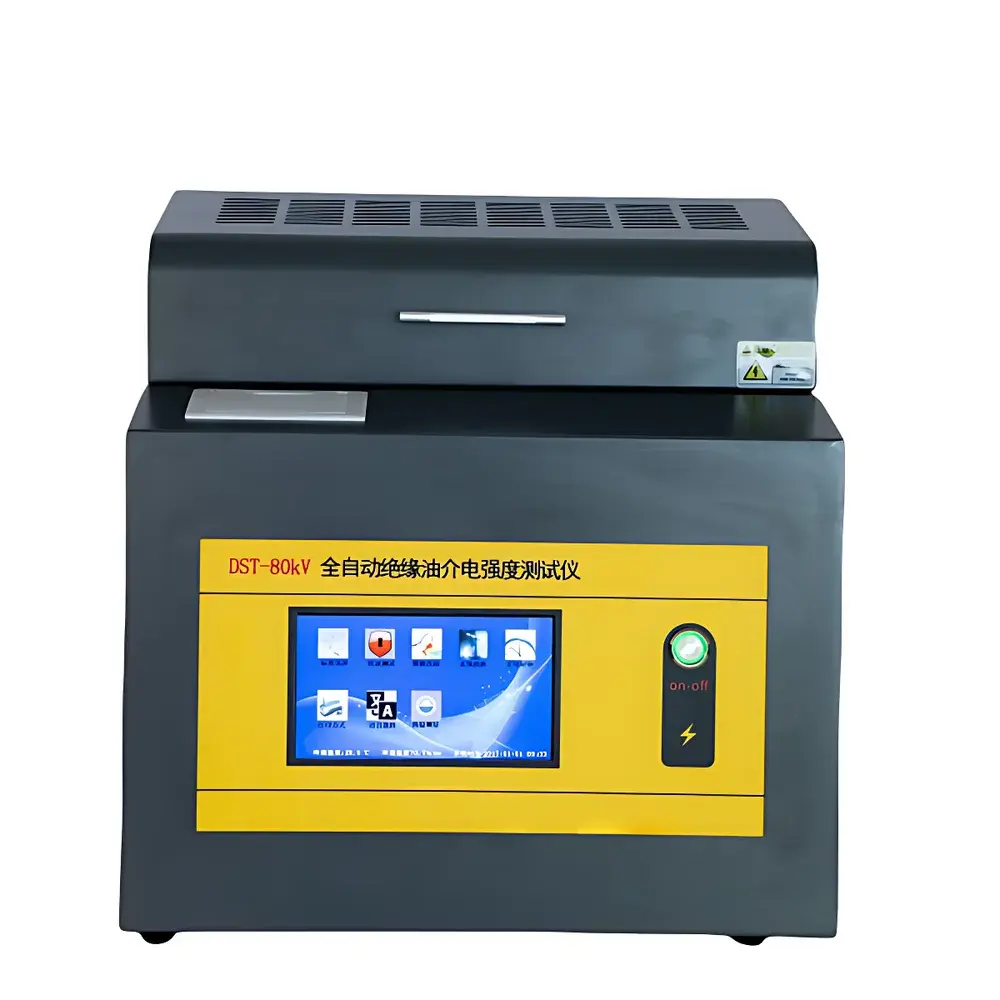
Aerospace DST-80kV Insulating Oil Dielectric Strength Tester
| Brand | Aerospace |
|---|---|
| Origin | Beijing, China |
| Manufacturer Type | Authorized Distributor |
| Product Category | Domestic |
| Model | DST-80kV |
| Breakdown Voltage Range | 0–80 kV AC (adjustable) |
| Voltage Accuracy | ±1% |
| Electrode Gap | 2.5 mm (calibrated with feeler gauge, tolerance ±0.1 mm) |
| Standard Electrodes | 12.5–13 mm diameter disc electrodes (brass or stainless steel, polished) |
| Test Cup Material | IEC 60156-compliant ceramic or borosilicate glass |
| Cup Capacity | ~500 mL |
| Rise Rate | 0.5–5.0 kV/s (programmable) |
| Trip Current Threshold | 5 mA |
| Power Consumption | ≤200 W |
| Safety Interlock | Door-activated high-voltage cutoff |
| Grounding Resistance Requirement | ≤4 Ω |
| Compliance | IEC 60156:2025, ASTM D1816, GB/T 507–2002, DL/T 846.7–2004 |
Overview
The Aerospace DST-80kV Insulating Oil Dielectric Strength Tester is an engineered solution for quantitative assessment of the dielectric integrity of hydrocarbon-based insulating oils used in high-voltage power equipment—including transformers, circuit breakers, and bushings. It operates on the principle of AC voltage-induced dielectric breakdown: under controlled ramped voltage stress, localized field enhancement at impurities (e.g., water droplets, cellulose particles, or conductive contaminants) initiates ionization cascades, culminating in a transient conductive path across the electrode gap. The instrument precisely captures the peak voltage immediately preceding this event—defined as the dielectric strength—thereby providing a direct, standardized metric of oil purity and aging status. Designed for laboratory and substation maintenance environments, the system integrates a solid-state high-voltage generator, a temperature-stable test cell, traceable electrode geometry, and microprocessor-driven control logic to ensure repeatability, auditability, and compliance with international test protocols.
Key Features
- High-voltage AC output: 0–80 kV range with continuous digital adjustment and ±1% measurement accuracy (traceable to national standards)
- IEC 60156-compliant test cell: 500 mL capacity ceramic or borosilicate glass cup with engraved fill line and integrated grounding port
- Precision electrode assembly: 12.5–13 mm diameter disc electrodes (brass or passivated stainless steel), surface roughness Ra ≤ 0.4 µm, fixed 2.5 mm gap calibrated via certified feeler gauge
- Programmable rise rate: Adjustable from 0.5 to 5.0 kV/s in 0.1 kV/s increments; default setting aligns with GB/T 507 (3.0 kV/s) and IEC 60156 (2–3 kV/s)
- Automated test sequencing: Supports up to six consecutive breakdown cycles per sample with automatic stirring (0–1 min 39 sec), settling delay (0–10 min 39 sec), and post-test zero-reset
- Integrated safety architecture: Electromechanical door interlock disables HV output upon chamber opening; real-time ground continuity monitoring; <4 Ω grounding resistance verification prompt
- Robust electrical insulation: Epoxy-cast HV transformer with reinforced creepage distance and thermal overload protection (max. 200 W input)
Sample Compatibility & Compliance
The DST-80kV is validated for use with mineral insulating oils, synthetic esters, and silicone fluids exhibiting kinematic viscosity ≤350 mm²/s at 40 °C. It meets the physical and procedural requirements of multiple globally recognized standards: IEC 60156:2025 (defining electrode geometry, ambient temperature control [20 ± 5 °C], and statistical treatment of ≥6 breakdown values), ASTM D1816 (specifying spherical electrodes and 23 ± 2 °C conditioning), GB/T 507–2002 (mandating disc electrodes and 3 kV/s ramp), and DL/T 846.7–2004 (addressing electromagnetic compatibility, mechanical durability, and safety labeling). All firmware logic—including data averaging, outlier rejection (per ISO/IEC 17025 guidance), and report timestamping—is structured to support GLP/GMP-aligned documentation workflows. The system does not require external environmental chambers but recommends ambient lab conditions of 10–35 °C and RH ≤75%.
Software & Data Management
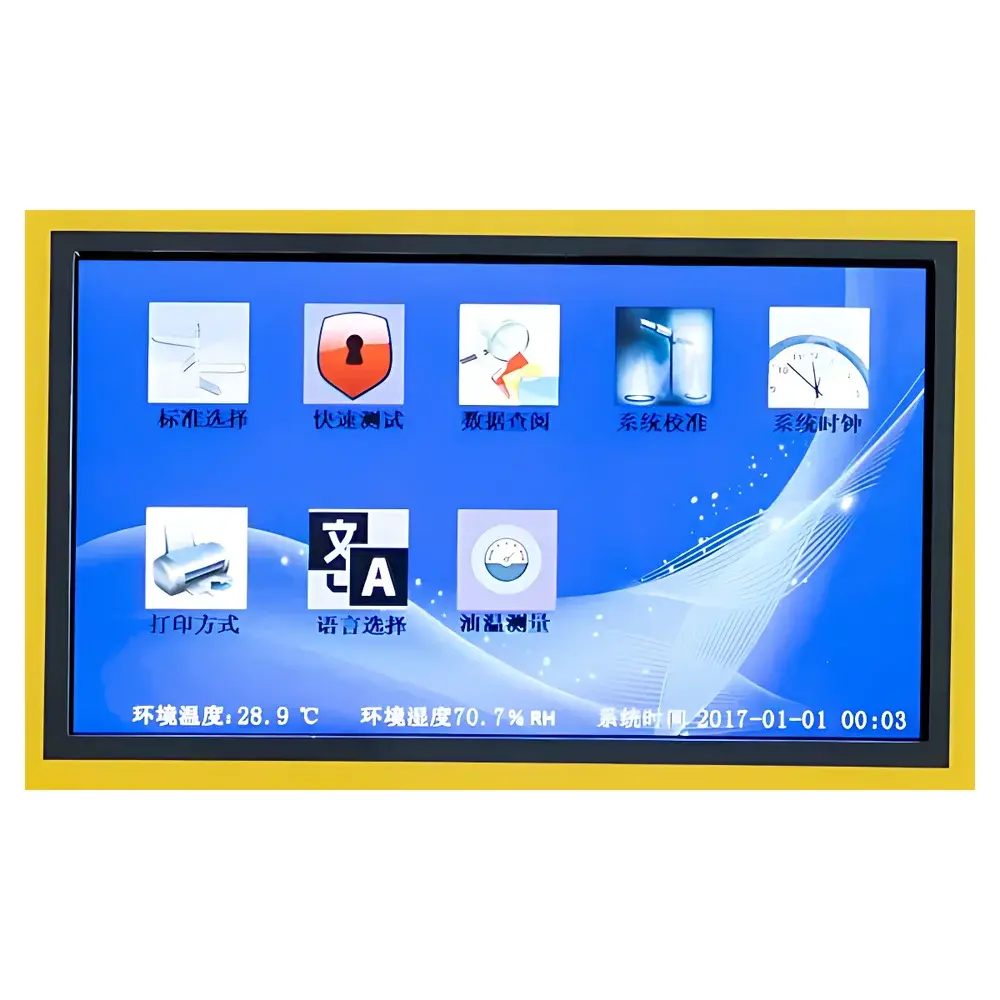
The embedded control interface provides menu-driven configuration of test parameters (voltage range, rise rate, cycle count, stir/settle durations) and real-time display of applied voltage, leakage current, and elapsed time. Test results—including individual breakdown voltages, arithmetic mean, standard deviation, and pass/fail status relative to user-defined thresholds (e.g., ≥30 kV for new oil per GB/T 507)—are stored internally with ISO 8601 timestamps. Data export is supported via USB 2.0 to CSV format for integration into LIMS or QA databases. While the base unit does not include FDA 21 CFR Part 11-compliant electronic signatures or audit trail logging, optional firmware upgrade packages are available for regulated utilities requiring full ALCOA+ (Attributable, Legible, Contemporaneous, Original, Accurate, Complete, Consistent, Enduring, Available) data governance.
Applications
This tester serves critical roles across the power infrastructure lifecycle: incoming inspection of new oil batches prior to transformer filling; periodic condition monitoring of in-service oils during preventive maintenance outages; forensic analysis following internal fault events (e.g., arcing or thermal degradation); and R&D validation of reconditioning processes (e.g., vacuum dehydration, adsorption filtration). Its reproducibility (typical coefficient of variation <3.5% across six replicates on homogeneous samples) enables trending of dielectric strength decline over time—a key indicator of oxidation byproduct accumulation and moisture ingress. Field technicians and laboratory analysts alike rely on its deterministic output to inform decisions on oil replacement, reclamation, or continued service—directly supporting IEEE C57.106 and IEC 60422 maintenance guidelines.
FAQ
What electrode configuration does the DST-80kV use, and can it be changed to comply with ASTM D1816?
The standard configuration uses parallel disc electrodes per IEC 60156 and GB/T 507. Spherical electrodes meeting ASTM D1816 specifications (12.7 mm diameter, 2.5 mm gap) are available as a factory-installed option—requiring recalibration and firmware parameter update.
Is temperature control built into the test cell?
No. The instrument assumes ambient laboratory temperature control per standard requirements (e.g., 20 ± 5 °C for IEC/GB). External thermostatic baths or climate-controlled rooms must be used for strict thermal compliance.
How often must the system be calibrated?
Annual calibration using a NIST-traceable high-voltage divider is recommended. Voltage accuracy verification and electrode gap re-certification should occur before each daily test session.
Can the device store test records beyond the internal memory capacity?
Yes. All test logs are exportable via USB to external storage. No cloud connectivity or network interface is included in the base configuration.
Does the system meet electromagnetic compatibility (EMC) requirements for substation deployment?
It complies with DL/T 846.7–2004 for conducted/radiated emissions and immunity, including surge withstand capability per IEC 61000-4-5 (Level 3, 2 kV line-to-earth). Additional shielding may be required in high-RFI switchyard environments.



