
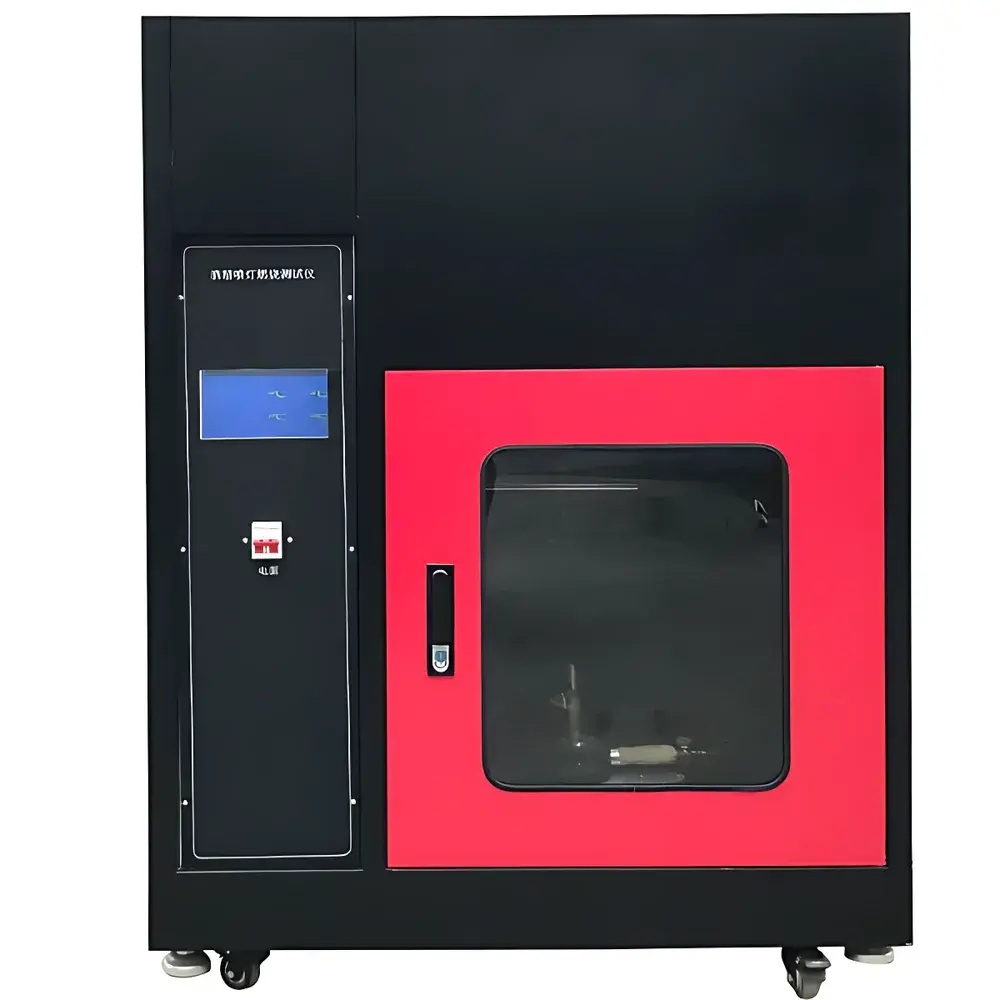
Aerospace FTA-8 Alcohol Burner Combustion Tester
| Brand | Aerospace |
|---|---|
| Origin | Beijing, China |
| Model | FTA-8 |
| Display | 7-inch full-color TFT touchscreen (800×480 resolution, RS232 interface, FPGA-driven, zero boot time) |
| Combustion Chamber Dimensions | 660 mm × 660 mm × 1065 mm (L×W×H) |
| Flame Height Adjustment Range | 150–180 mm |
| Fuel Consumption Rate | 2.55 ± 0.15 mL/min |
| Flame Temperature Verification | 960 ± 60 °C at 50 mm from burner orifice (validated via 0.71 mm bare copper wire melt test within 6 s) |
| Timing Accuracy | ±0.1 s for both ignition and afterflame/afterglow duration |
| Repeatability Error | ±0.1 s |
| Fuel Composition | 5% (v/v) methanol + 95% (v/v) ethanol (user-prepared) |
| Construction | Electrostatically painted steel enclosure |
| Data Management | Internal storage (1 GB), historical test recall, automatic timing for ignition, flame-on, and afterflame/afterglow phases |
| Compliance Standards | MT 914–2008, GB 16413–2009, MT 113–1995 |
| Power Supply | 220 V ±10%, 50 Hz, 100 W |
| Ventilation Requirement | Mandatory fume hood or integrated exhaust & purification system |
Overview
The Aerospace FTA-8 Alcohol Burner Combustion Tester is a precision-engineered apparatus designed to evaluate the flame resistance and afterflame/afterglow behavior of polymeric materials under standardized thermal insult conditions. It operates on the principle of controlled open-flame exposure using a calibrated alcohol-fueled burner, conforming to the fundamental methodology defined in ASTM D5048 (though adapted for Chinese national and coal-industry-specific standards). The device delivers reproducible thermal flux through a geometrically stable, vertically oriented or 45°-inclined flame generated from a regulated mixture of ethanol and methanol—ensuring consistent energy input across successive tests. Its core function is to quantify critical fire-response parameters: ignition time, flame propagation duration, and post-ignition combustion persistence (afterflame and afterglow), all measured with sub-second temporal resolution. Unlike generic flame testers, the FTA-8 integrates hardware-level timing synchronization, eliminating software latency and enabling traceable, audit-ready event logging essential for GLP-compliant laboratories and regulatory submissions.
Key Features
- 7-inch industrial-grade TFT touchscreen with FPGA-accelerated rendering (zero boot delay), 800×480 resolution, and dual communication interfaces (RS232 + 3.3V CMOS/TTL serial) for integration with LIMS or external controllers
- Manually adjustable pure-copper burner head mounted on a rigid support arm, equipped with a dedicated preheating trough and ergonomic positioning handle for safe, repeatable flame alignment
- Calibrated flame height control (150–180 mm) and verified thermal output: 960 ± 60 °C at 50 mm from orifice, confirmed via standardized 0.71 mm copper wire melt test (≤6 s)
- Dual independent high-precision timers (±0.1 s accuracy) for simultaneous monitoring of ignition onset, flame duration, and afterflame/afterglow periods
- Matte-black interior chamber (660 × 660 × 1065 mm) meeting optical contrast requirements per MT 914–2008 and GB 16413–2009 for unambiguous visual assessment of flame spread and glowing embers
- Onboard non-volatile memory (1 GB) storing complete test records—including timestamps, operator ID, sample ID, flame height setting, and pass/fail status—with searchable history and export capability
- Electrostatically coated steel enclosure with reinforced structural integrity, optimized for long-term stability in industrial laboratory environments
Sample Compatibility & Compliance
The FTA-8 is validated for testing non-metallic components used in underground coal mining infrastructure, including but not limited to conveyor belts (fabric-core, steel-cord, and steel-wire rope types), hydraulic hose assemblies, plastic and rubber tubing, coated ventilation ducts, polymer mesh, electrical cable jackets, and fiberglass-reinforced enclosures. Its operational envelope aligns explicitly with three mandatory Chinese standards: MT 914–2008 (vertical spray test for fabric-core flame-retardant belts), GB 16413–2009 (45° inclined flame test for FRP products), and MT 113–1995 (general methodology for flame resistance and antistatic evaluation of polymer-based mine equipment). While not certified to UL 94 or IEC 60695 series by default, its burner geometry, fuel delivery rate (2.55 ± 0.15 mL/min), and thermal profile are dimensionally and energetically comparable—enabling method adaptation under documented SOPs for cross-standard validation studies.
Software & Data Management
The embedded control firmware implements deterministic real-time event capture without reliance on operating-system-level scheduling. All timing events—including burner activation, flame establishment confirmation, sample ignition detection (via optical sensor feedback loop), and extinction verification—are logged with microsecond-precision timestamps into a tamper-resistant internal database. Data export is supported via USB mass-storage mode or RS232 ASCII dump, generating CSV-formatted reports compliant with FDA 21 CFR Part 11 requirements when paired with external audit-trail-enabled LIMS. User access levels (operator, supervisor, administrator) restrict parameter modification and data deletion rights. Calibration logs, maintenance entries, and flame verification records are stored separately and linked to test sequences for full traceability during GMP or ISO/IEC 17025 audits.
Applications
Primary use cases include quality assurance testing of flame-retardant polymers prior to deployment in hazardous underground environments where methane accumulation poses explosion risks. The FTA-8 supports R&D workflows for formulating halogen-free flame retardants in thermoplastics (e.g., PVC, PE, PP composites) and elastomers (e.g., NBR, CR, EPDM), enabling correlation between additive concentration and afterflame suppression efficiency. It further serves as a reference instrument for inter-laboratory round-robin studies coordinated by CNCA (China National Certification and Accreditation Administration) and provincial coal safety inspection bureaus. In academic settings, it facilitates fundamental research on char formation kinetics, heat release rate proxies, and pyrolysis gas composition analysis when coupled with FTIR or GC-MS exhaust sampling systems.
FAQ
What fuel mixture is required for operation?
A precisely prepared blend of 5% (v/v) methanol and 95% (v/v) ethanol must be used. This ratio is critical to achieving the specified flame temperature and stability per MT 914–2008.
Is flame temperature calibration mandatory before each test?
Yes—daily verification using the copper wire melt test at 50 mm from the burner orifice is required to ensure thermal consistency and regulatory compliance.
Can the FTA-8 be integrated into an automated test line?
It supports RS232 command protocol for remote start/stop, parameter upload, and result retrieval, enabling integration with PLC-controlled material handling systems.
What ventilation specifications apply during operation?
The unit must be installed inside a certified fume hood with ≥0.5 m/s face velocity or connected to a dedicated exhaust manifold feeding into an activated carbon + scrubber-based air purification system.
Does the system meet electromagnetic compatibility (EMC) requirements for industrial labs?
Yes—the enclosure meets GB/T 18268.1–2010 (equivalent to IEC 61326-1) for Class A emission limits and immunity to electrostatic discharge (±8 kV contact, ±15 kV air) and radiated RF fields (10 V/m, 80 MHz–2 GHz).



