
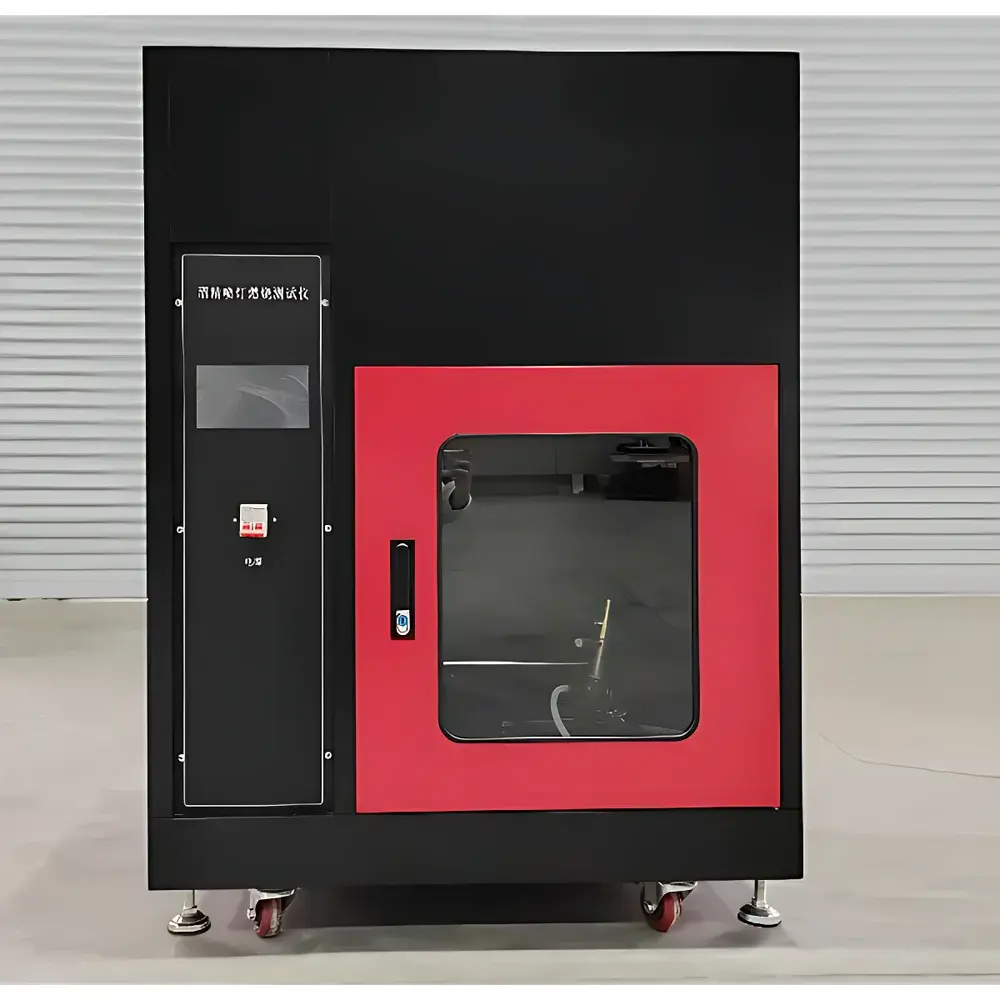
Aerospace FTA-8 Alcohol-Fueled 45° Tilt Combustion Test Chamber for Flammability Assessment of Textiles and Plastics
| Brand | Aerospace |
|---|---|
| Origin | Beijing, China |
| Manufacturer Type | Authorized Distributor |
| Country of Origin | China |
| Model | FTA-8 |
| Price Range | USD 3,500 – 7,000 |
| Application Field | Fire-Retardant Coatings |
| Test Objects | Plastics, Woven & Nonwoven Textiles |
| Repeatability Error | ±0.1 s |
| Compliance Standard | GB 14645–2014 (Equivalent to ISO 14054 for 45° flammability testing) |
Overview
The Aerospace FTA-8 Alcohol-Fueled 45° Tilt Combustion Test Chamber is a precision-engineered instrument designed for standardized flammability evaluation of textile and polymeric materials under controlled laboratory conditions. It operates on the principle of defined-angle flame impingement—specifically, a calibrated alcohol-fueled flame applied at a 45° inclination to the specimen surface for a fixed duration (30 s), in strict accordance with GB 14645–2014. This standard mirrors internationally recognized methodologies such as ISO 14054 and ASTM D1230 (for apparel textiles), ensuring data compatibility across global regulatory and certification workflows. The system measures three primary response parameters: afterflame time (duration of flaming combustion post-ignition), afterglow time (duration of non-flaming, smoldering combustion), and char length (maximum extent of irreversible thermal damage along the specimen’s longitudinal axis). These metrics collectively inform classification under fire safety standards including GB/T 5455, UL 94 (for plastics), and EN 1107–1 (for decorative fabrics). The chamber’s thermally stable stainless-steel construction, integrated flame-height regulation, and real-time timing architecture ensure high reproducibility across sequential test cycles.
Key Features
- 45° ±3° specimen tilt mechanism with precision-machined sample holder (490 mm × 320 mm), accommodating standard 330 mm × 230 mm specimens per GB 14645–2014
- Alcohol-based ignition system with adjustable flame height (45 ±2 mm), validated via calibrated digital manometer and visual reference gauge
- 7-inch industrial-grade resistive touchscreen (800 × 480 resolution) with FPGA-accelerated display engine, zero-boot latency, and RS232/CMOS serial interface for external logging
- Self-contained timing module with independent counters for afterflame time, afterglow time, and manual entry fields for char length (cm) and char area (cm²)
- Combustion chamber constructed from heat- and corrosion-resistant 304 stainless steel; front observation door made of high-temperature borosilicate glass (≥800 °C tolerance)
- Dual-mode gas control: manual “Gas On/Off” toggle and auto-shutoff after 30 s flame application; compatible with LPG, propane, or butane per GB 14645–2014 Annex B
- Integrated energy management: low-power ARM Cortex-M3 controller with dynamic sleep mode, consuming ≤100 W nominal during operation
Sample Compatibility & Compliance
The FTA-8 supports flat, rigid, and semi-rigid specimens up to 5 mm thickness—including woven and knitted textiles, coated fabrics, laminates, thermoplastic sheets (e.g., PVC, PET, PP), and intumescent fire-retardant coatings. Specimen preparation follows strict orientation rules: three specimens per fabric direction (warp and weft), each cut ≥100 mm from selvage, with dimensional tolerances maintained within ±1 mm. The instrument meets full mechanical and procedural requirements of GB 14645–2014, including ambient operating conditions (10–30 °C, 15–85 % RH), flame geometry verification, and repeatability validation (±0.1 s inter-test deviation confirmed via NIST-traceable stopwatch calibration). While not certified to UL or EN standards out-of-the-box, its operational parameters are directly translatable to ISO 14054 Annex A and ASTM D1230 Section 7.2 protocols when used with documented procedural equivalence statements.
Software & Data Management
The embedded firmware provides deterministic real-time event sequencing without reliance on general-purpose OS. All timing events—including flame-on initiation, automatic gas cutoff at 30 s, afterflame start/stop, and afterglow start/stop—are timestamped with microsecond-level hardware synchronization. Measured values (afterflame time, afterglow time, char length, char area) are stored locally in non-volatile memory (1 GB flash) with date/time stamp, test ID, and operator input metadata. Export is supported via USB mass storage or RS232 ASCII dump (CSV-compatible format), enabling integration into LIMS platforms compliant with GLP and ISO/IEC 17025 documentation requirements. Audit trails include firmware version, calibration status flag, and last-system-reset timestamp—satisfying baseline traceability needs for internal QA and third-party accreditation audits.
Applications
The FTA-8 serves critical roles in R&D laboratories developing flame-inhibiting additives, quality control labs verifying batch-to-batch consistency of fire-rated upholstery or automotive interior trim, and certification bodies conducting pre-audit screening for GB 8624 (building material classification) or GA 304 (fireproofing product approval). It is routinely deployed for evaluating: (1) intumescent coating efficacy on steel substrates; (2) melt-dripping behavior of halogen-free flame-retarded polyolefins; (3) smolder propagation resistance in mattress ticking fabrics; and (4) comparative flammability ranking of bio-based fibers (e.g., lyocell vs. modacrylic blends). Its 45° configuration specifically addresses vertical-spread risk scenarios relevant to drapery, wall coverings, and transportation seating—making it indispensable for compliance with CNCA-C13-02:2020 and CCC fire safety mandates.
FAQ
What gases are permitted for use with the FTA-8?
Only liquefied petroleum gas (LPG), propane, or butane may be used. Industrial-grade propane or butane is mandatory for arbitration testing per GB 14645–2014 Clause 6.4. Natural gas or hydrogen are strictly prohibited.
Is the instrument suitable for testing foam materials?
Yes—when mounted on the supplied rigid backing board per GB 14645–2014 Section 5.3.2. Free-standing foam specimens must be stabilized using non-combustible clamps to prevent deformation during flame exposure.
How is flame height calibrated and verified?
Flame height is adjusted via the needle valve on the Bunsen burner assembly while observing the calibrated scale behind the burner tip. Verification requires a 2-minute stabilization period before each test series, followed by visual confirmation using the integrated reference ruler.
Does the FTA-8 support automated data export to Excel?
Yes—via USB drive or RS232 serial output. The exported CSV file contains columns for Test ID, Date/Time, Afterflame (s), Afterglow (s), Char Length (cm), Char Area (cm²), and Operator Initials.
What maintenance is required for long-term accuracy?
Monthly inspection of gas line integrity, quarterly cleaning of burner orifice with 0.3 mm tungsten wire, and annual verification of touchscreen touch-response linearity using the built-in diagnostic grid.



