
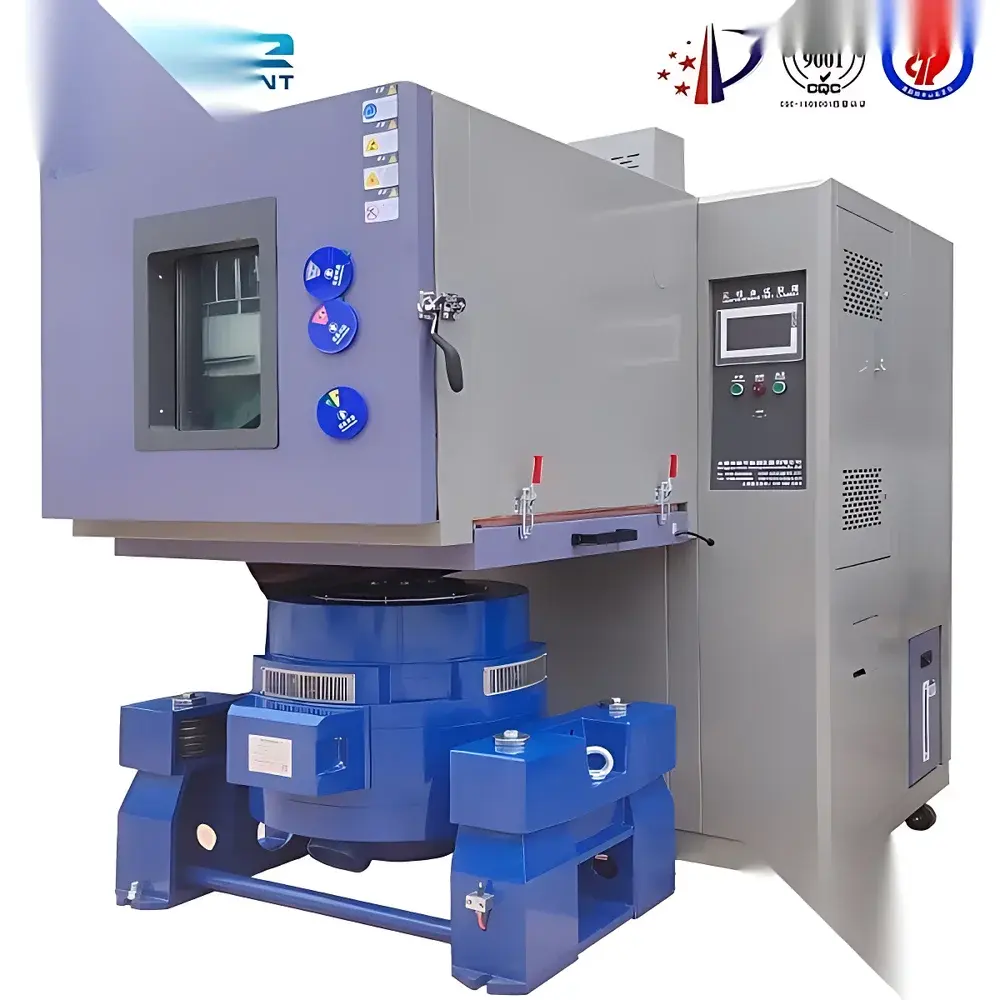
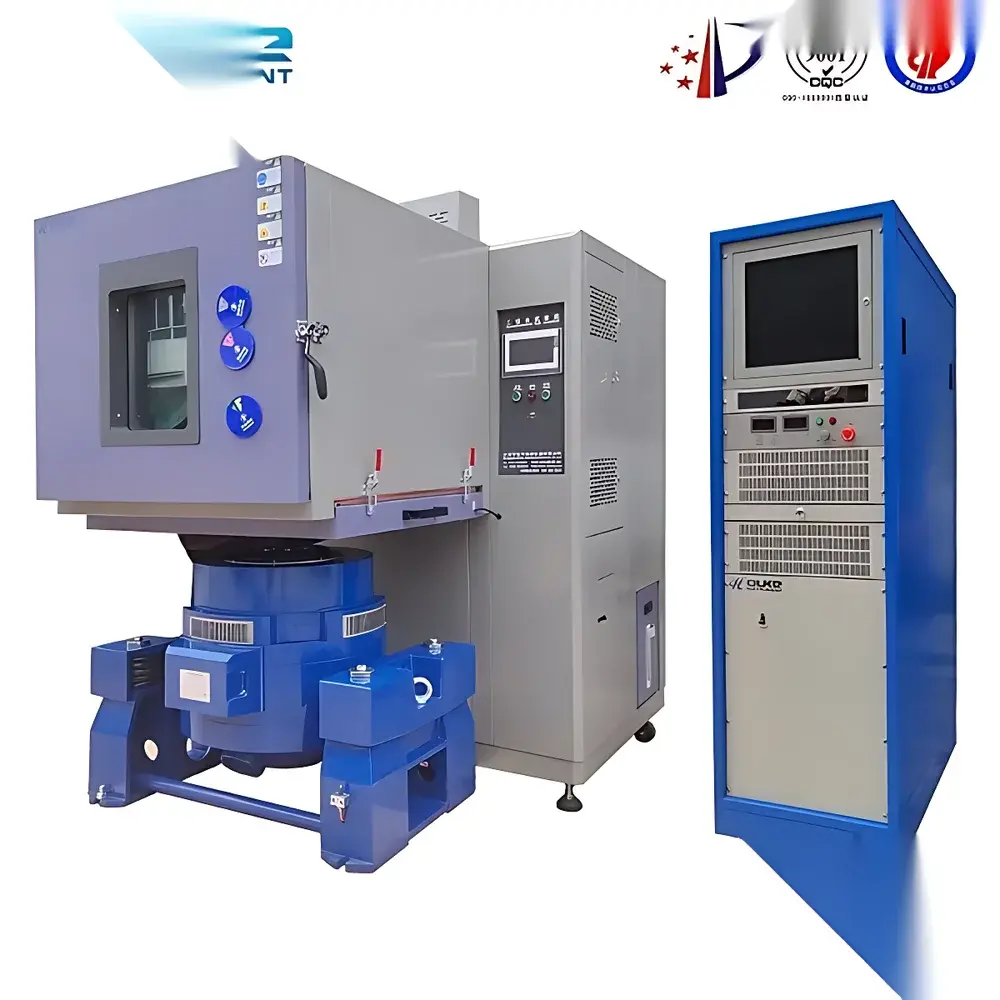
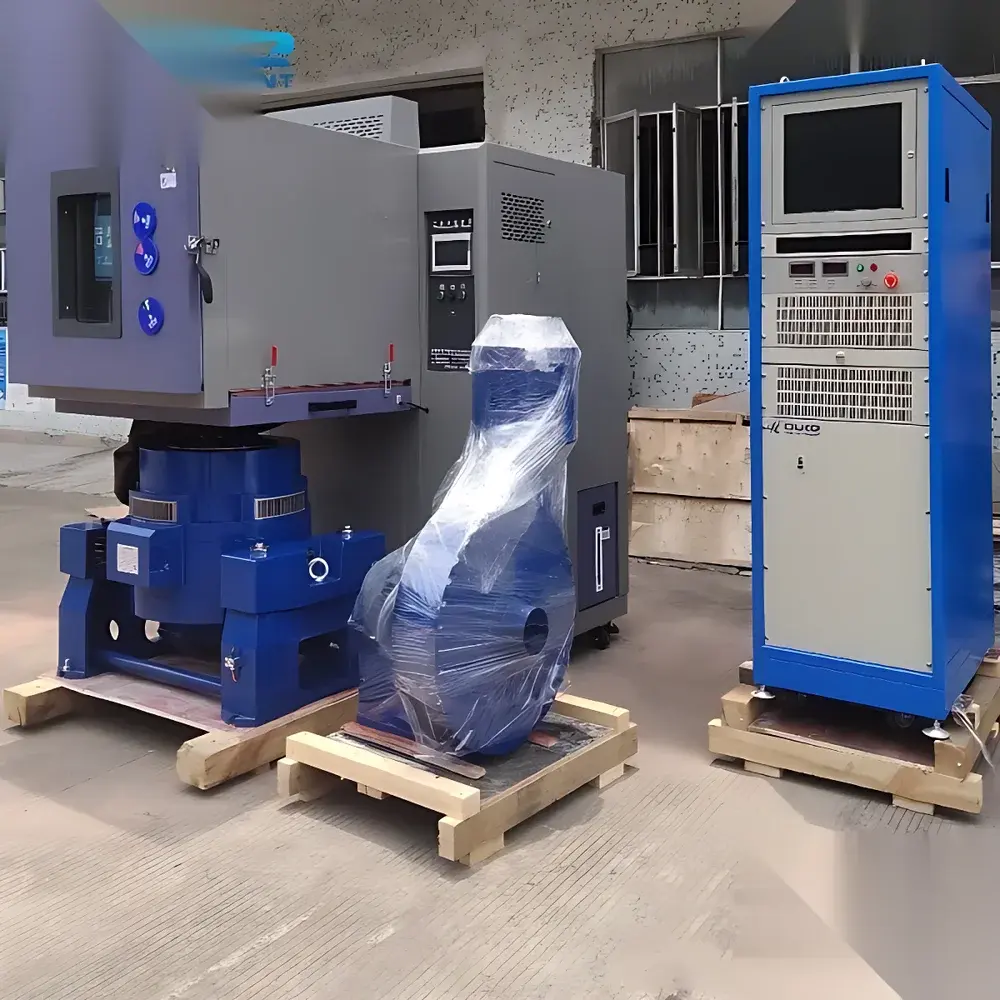
Aerospace-Grade Combined Temperature, Humidity, and Vibration Environmental Test Chamber
| Brand | Other Brands |
|---|---|
| Origin | Imported |
| Manufacturer Type | Authorized Distributor |
| Price | USD 21,000 (FOB) |
| Compliance | GB/T 5170.2–1996, GB/T 2423.1–1989, GB/T 2423.2–1989, GB/T 2423.3–1993, GJB 150.3–1986, GJB 150.4–1986 |
Overview
The Aerospace-Grade Combined Temperature, Humidity, and Vibration Environmental Test Chamber is an integrated reliability validation platform engineered for rigorous qualification testing of aerospace components, avionics systems, satellite subsystems, and defense-grade electronics under simultaneous multi-stress conditions. Unlike sequential or single-stress chambers, this system implements synchronized control of thermal cycling (−70 °C to +180 °C), relative humidity (10 %RH to 98 %RH), and mechanical vibration (typically 5–2000 Hz, up to 100 g peak acceleration, depending on shaker configuration) — all within a single test cycle. Its operational principle relies on a closed-loop air circulation architecture with independent but coordinated PID-controlled subsystems: a nickel-chromium alloy resistive heating array embedded in the conditioning chamber’s air plenum; a stainless-steel steam-type humidifier integrated into the airflow duct; and a high-efficiency refrigeration/defrost/dehumidification circuit utilizing dual evaporators (one for cooling, one for condensation-based dehumidification). Airflow uniformity — critical for compliance with aerospace thermal gradient specifications — is maintained via a rear-mounted laminar flow duct system housing precision-matched fans, calibrated Pt100 temperature/humidity sensors, and distributed thermal mass elements.
Key Features
- Triple-stress synchronization: Real-time coordinated control of temperature, humidity, and vibration profiles via unified controller interface with programmable ramp rates and dwell times.
- High-fidelity air management: Rear-mounted insulated duct system with optimized cross-sectional geometry ensures ≤ ±1.0 °C temperature uniformity and ≤ ±3 %RH humidity uniformity across 1 m³ working volume (per GB/T 5170.2–1996 verification protocol).
- Corrosion-resistant internal construction: 304 stainless steel inner chamber walls; PTFE-coated silver-plated aviation-grade wiring for heater circuits; electropolished stainless humidifier tank with anti-scale design.
- Modular vibration integration: Designed for coupling with electrodynamic or hydraulic shakers (not included); features reinforced floor mounting points, seismic isolation base interface, and vibration-transmission minimized duct suspension.
- Redundant safety architecture: Dual independent over-temperature cutoffs, humidity saturation limiters, emergency power-off (EPO) circuit, and real-time fault logging compliant with IEC 61000-4-2/4-3 immunity requirements.
Sample Compatibility & Compliance
This chamber accommodates payloads up to 100 kg with dimensional constraints aligned to MIL-STD-810H and ECSS-Q-ST-30C test article envelopes. It supports standard test fixtures, thermocouple feedthroughs (up to 16 channels), and external sensor interfaces (RS-485, Ethernet/IP). The system is validated per national and military standards including GB/T 2423.1–1989 (cold), GB/T 2423.2–1989 (dry heat), GB/T 2423.3–1993 (damp heat), and GJB 150.3–1986 / GJB 150.4–1986 (military high/low temperature). Calibration traceability follows ISO/IEC 17025 requirements through accredited third-party providers. While not inherently certified to DO-160G or RTCA/DO-160 Section 24 (vibration) without shaker integration, its structural interface and environmental control fidelity meet prerequisite conditions for full DO-160G combined environment testing when paired with qualified vibration exciters.
Software & Data Management
The embedded controller runs deterministic real-time firmware supporting up to 99 programmable test cycles with nested subroutines. Data acquisition records temperature, humidity, and (when interfaced) vibration acceleration spectra at user-defined intervals (100 ms minimum). Export formats include CSV, XML, and PDF reports compliant with GLP/GMP audit trails. Optional PC-based software enables remote monitoring, alarm escalation (email/SMS), trend analysis, and export to MATLAB or Python-compatible HDF5 files. All data logs include timestamped operator ID, parameter set version, and hardware calibration certificate reference — satisfying FDA 21 CFR Part 11 electronic record requirements when deployed in regulated quality systems.
Applications
- Qualification testing of flight-critical PCBAs and embedded controllers per ECSS-E-ST-10-06C.
- Accelerated life testing of thermal interface materials (TIMs), conformal coatings, and hermetic seals under thermo-hygro-mechanical stress.
- Verification of satellite battery pack performance degradation under cyclic thermal-vibration-humidity exposure.
- Environmental stress screening (ESS) of radar transceivers and phased-array antenna modules prior to HALT/HASS.
- Validation of connector integrity and solder joint reliability in launch vehicle avionics bays.
FAQ
Does the chamber include a built-in vibration shaker?
No — this unit provides the environmental chamber portion only. Vibration excitation requires external electrodynamic or hydraulic shakers mounted on a reinforced foundation, coupled via a rigid transition plate compatible with ISO 10816-3 alignment tolerances.
What is the typical temperature stabilization time from −40 °C to +85 °C?
Approximately 25 minutes for a 1 m³ empty chamber, verified per GB/T 5170.2–1996 methodology using nine-point uniformity mapping.
Can the system be upgraded to support salt fog or UV exposure?
Not natively — those are discrete test modalities requiring separate chamber configurations. However, modular auxiliary ports allow integration of external gas dosing or UV lamp arrays with appropriate safety interlocks.
Is third-party calibration documentation provided with shipment?
Yes — a factory-issued calibration certificate traceable to NIM (China National Institute of Metrology) is included, covering temperature, humidity, and airflow velocity sensors.
What communication protocols are supported for integration into a central MES or SCADA system?
Standard Modbus TCP/IP and optional OPC UA (UA Profile for Analytical Devices) are available for bidirectional control and telemetry streaming.



