
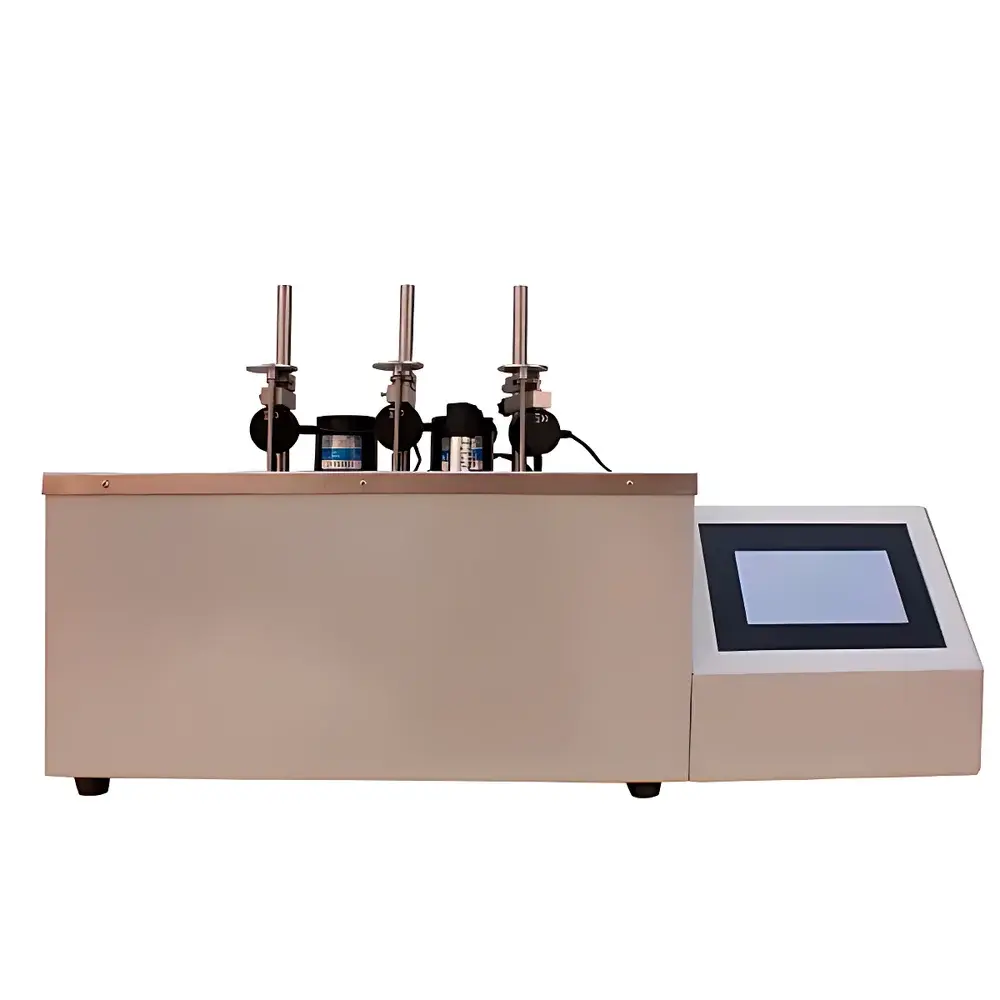
Aerospace HDT-VST-300E Heat Deflection Temperature & Vicat Softening Point Tester
| Brand | Aerospace |
|---|---|
| Origin | Beijing, China |
| Model | HDT-VST-300E |
| Temperature Range | Ambient to 300 °C |
| Temperature Resolution | 0.1 °C |
| Heating Medium | Methyl Silicone Oil (up to 300 °C) or Transformer Oil (up to 200 °C) |
| Standard Config | 3 Test Stations |
| Load Application | Mechanical Deadweight via Precision Calibration Weights |
| Temperature Sensing | PT100 Platinum Resistance Thermometer |
| Deformation Sensing | High-Resolution Digital Micrometer Sensor (0–10 mm range, 0.001 mm resolution) |
| Control System | 32-bit ARM Embedded Processor with Real-Time Isothermal Ramp Algorithm |
| Compliance | ISO 75-1:1993, ISO 306:1994, GB/T 1633–2000, GB/T 1634–2001 |
Overview
The Aerospace HDT-VST-300E is a dual-mode thermal performance tester engineered for precise determination of Heat Deflection Temperature (HDT) and Vicat Softening Temperature (VST) in thermoplastic and thermosetting polymers. It operates on two standardized mechanical–thermal principles: (1) HDT measurement per ISO 75-1 and GB/T 1634, where a rectangular test specimen is subjected to a specified flexural load while immersed in a thermally conductive fluid bath; deformation onset at defined deflection thresholds (e.g., 0.34 mm or 0.25 mm) is recorded as the HDT; (2) VST measurement per ISO 306 and GB/T 1633, wherein a needle of 1 mm² cross-section applies a fixed load (e.g., 10 N or 50 N) onto a flat specimen surface, and the temperature at which the needle penetrates 1 mm defines the VST. The instrument employs a high-stability oil bath system—using methyl silicone oil (≤300 °C) or transformer oil (≤200 °C)—with dual mechanical stirrers and a 20 L reservoir to ensure uniform thermal distribution and minimal axial/radial gradients (<±0.3 °C across 100 mm span). Its rigid, monolithic steel sample support structure (machined from solid billet, not assembled) guarantees dimensional stability under thermal expansion and eliminates differential creep—critical for reproducibility across multi-station testing.
Key Features
- Triple-test-station configuration (standard), with optional scalable multi-station variants up to six positions for high-throughput QA/QC labs.
- Monolithic, CNC-machined steel sample supports with adjustable span (64–100 mm); eliminates joint-induced compliance and ensures consistent thermal expansion behavior across all stations.
- Real-time adaptive ramp control algorithm: continuously integrates historical and instantaneous PT100 feedback to maintain linear heating rates (e.g., 50 °C/h or 120 °C/h) within ±0.5 °C/h tolerance—even under ambient voltage drift or ambient thermal load fluctuations.
- Dual-sensor architecture: 24-bit ADC digitization of both temperature (PT100, 0.1 °C resolution, ±0.5 °C max error) and displacement (digital micrometer, 0.001 mm resolution, ±0.01 mm full-scale error).
- Modular load application: five calibrated deadweight sets (26 g, 256 g, 970 g, 1310 g, 5052 g) enable full compliance with ISO/GB-defined load conditions for both HDT (1.80 MPa, 0.45 MPa) and VST (10 N, 50 N).
- Embedded 32-bit ARM controller with local LCD interface; no PC dependency for routine operation—supports parameter entry, real-time curve plotting, auto-stop logic, and on-device result storage.
- Safety-critical firmware: automatic thermal cutoff at user-defined upper limit; post-test cooldown notification; overtemperature lockout with audible/visual alert.
Sample Compatibility & Compliance
The HDT-VST-300E accommodates standard ISO/GB-compliant specimens: HDT bars (80 × 10 × 4 mm or 120 × 15 × 10 mm), VST discs (≥10 mm diameter × ≥3 mm thickness), and irregular molded parts meeting minimum dimensional and surface flatness requirements. All test protocols are fully traceable to ISO 75-1:1993 (HDT), ISO 306:1994 (VST), GB/T 1633–2000 (VST), and GB/T 1634–2001 (HDT). The system supports GLP-aligned documentation practices: each test record includes timestamped temperature/displacement curves, operator ID (if networked), calibration certificate references, and environmental metadata (ambient T/RH logged at start). While not natively 21 CFR Part 11 compliant, audit trails and electronic signatures can be enabled via optional Ethernet-enabled software extension for regulated environments.
Software & Data Management
The embedded control interface stores up to 500 test records locally with full curve data (time–temperature–displacement triplets at 1 Hz sampling). Export is supported via USB flash drive in CSV format for external analysis (e.g., MATLAB, Excel, LIMS integration). Optional PC-based software (Aerospace LabSuite™) provides advanced features: batch report generation (PDF/Excel), statistical process control (SPC) charts, comparative overlay of multiple runs, automated pass/fail evaluation against specification limits, and instrument calibration log management. All digital outputs include metadata headers referencing applicable standards, load configuration, oil type, and sensor serial numbers—ensuring full metrological traceability.
Applications
This instrument serves quality assurance laboratories in polymer compounding, automotive plastics, electrical insulation materials, medical device manufacturing, and packaging R&D. Typical use cases include: qualification of heat-resistant polyamides (PA66-GF30) for under-hood components; verification of VST compliance in flame-retardant PVC used in building cables; comparative thermal stability assessment of bio-based polyesters (e.g., PLA vs. PHA); incoming raw material inspection per ASTM D648 (equivalent to ISO 75); and accelerated aging studies where HDT shift correlates with oxidative degradation. Its robust thermal design also supports method development for non-standard loads or unconventional specimen geometries—subject to internal validation per ISO/IEC 17025 clause 7.2.2.
FAQ
What heating media are compatible, and what viscosity limits apply?
Methyl silicone oil (kinematic viscosity ≤100 cSt at 25 °C) is required for tests up to 300 °C; transformer oil (≤100 cSt) may be used only up to 200 °C. Oil must be free of particulates and water to prevent sensor fouling and thermal instability.
Is the instrument suitable for ISO 10350-1 (single-point VST) and ISO 75-2 (HDT with alternative spans)?
Yes—the adjustable span (64–100 mm) and programmable load selection fully support both standards. Span-specific correction factors are applied automatically in calculation modules when enabled.
Can deformation data be exported in real time during testing?
Yes—via USB-C serial streaming (ASCII protocol) at 1 Hz, enabling live feed to SCADA or custom DAQ systems.
What maintenance intervals are recommended for long-term accuracy?
PT100 sensor verification every 6 months; micrometer zero-check before each test series; oil replacement every 12 months or after 500 cumulative test hours—whichever occurs first.
Does the system support automated calibration routines?
Yes—embedded self-calibration includes temperature offset adjustment using certified reference baths and displacement linearity verification via gauge blocks (NIST-traceable).





