
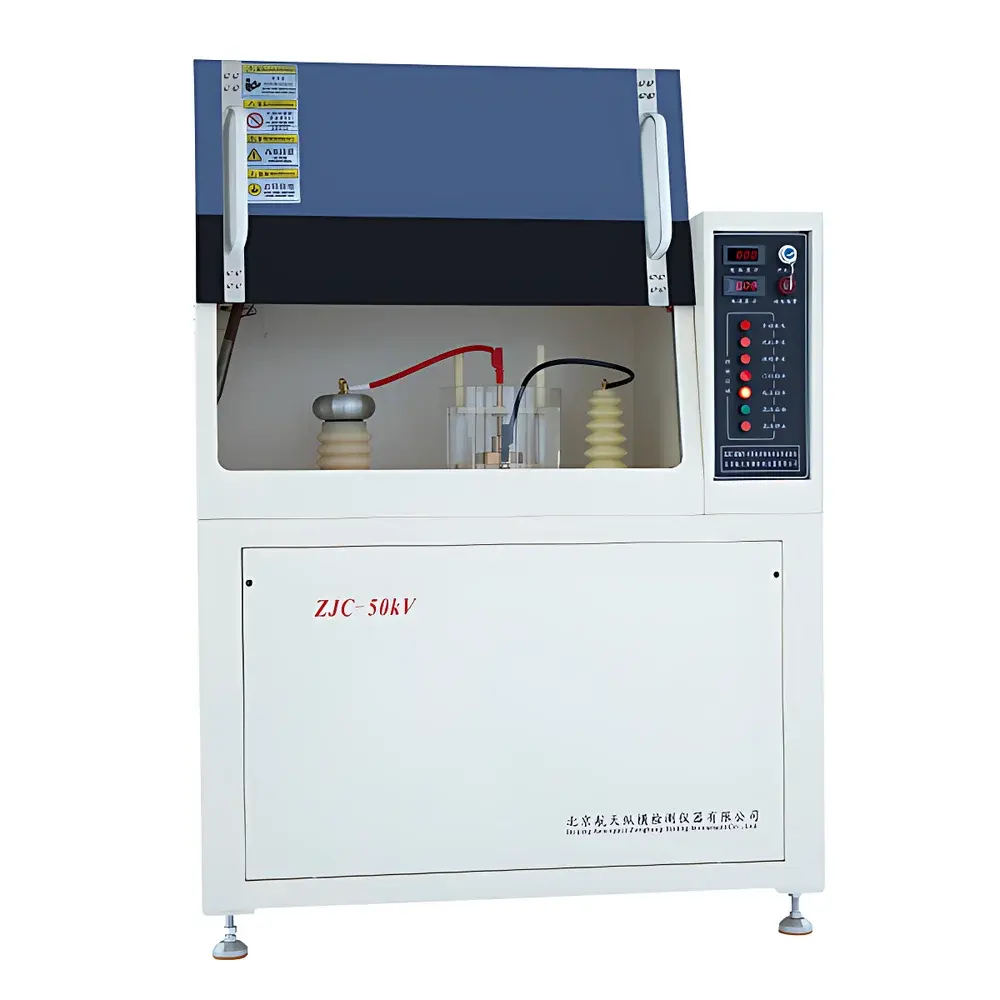
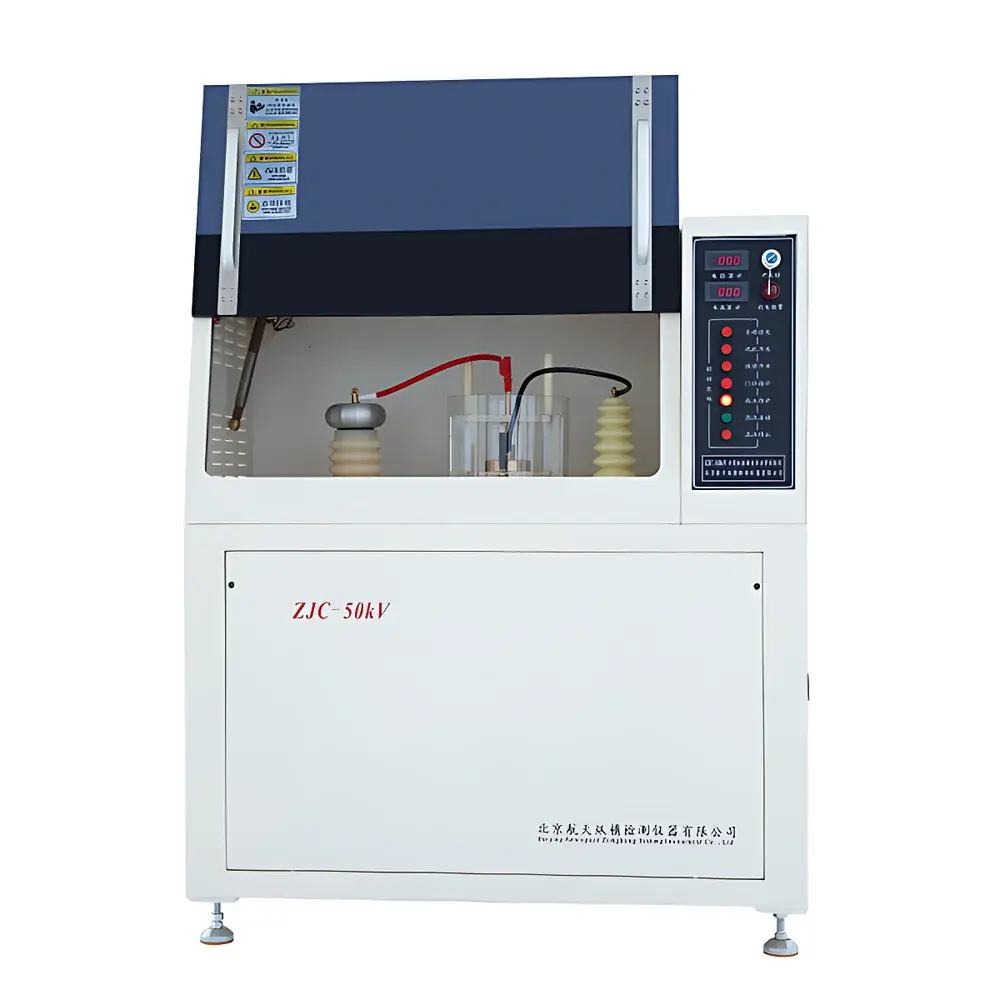
Aerospace Longitudinal ZJC-20KV Dielectric Strength Tester
| Brand | Aerospace Longitudinal |
|---|---|
| Origin | Beijing, China |
| Model | ZJC-20KV Dielectric Strength Tester |
| Maximum Output Voltage | 20 kV AC/DC |
| Input Power | 220 V, 50–60 Hz |
| Voltage Ramp Rate | 0.05–5 kV/s (continuously adjustable) |
| Protection Response Time | <10 ms (main circuit breaker), <50 µs (solid-state backup) |
| Leakage Current Range | 1–100 mA (software-configurable) |
| Overcurrent Trip Range | 1–60 mA |
| Ripple Factor | ≤2% |
| Test Capacitance Options | 100 pF @ 20 kV, 100 pF @ 50 kV, 100 pF @ 100 kV, 100 pF @ 150 kV |
| Operating Temperature Range (Environmental Chamber) | –70 °C to +300 °C |
| Partial Discharge Sensitivity | 0.1 pC |
| Thermal Monitoring Accuracy | ±1 °C |
| Compliance | IEC 60270, IEC 60664, GB/T 1408.1, GB/T 1695, JJG 1005 |
Overview
The Aerospace Longitudinal ZJC-20KV Dielectric Strength Tester is a precision-engineered high-voltage testing platform designed for the quantitative evaluation of electrical insulation performance in solid dielectric materials. It operates on the principle of controlled voltage stress application—either AC or DC—to induce dielectric breakdown under standardized conditions defined by IEC 60270, GB/T 1408.1, and ASTM D149. The system applies programmable ramped voltage across specimen electrodes while continuously monitoring leakage current, partial discharge activity, and thermal transients. Breakdown is identified by a rapid, irreversible current surge exceeding user-defined thresholds, with automatic voltage termination and data capture at sub-millisecond resolution. This enables accurate determination of dielectric strength (kV/mm), breakdown voltage (kV), and comparative tracking of insulation degradation mechanisms—including treeing, surface tracking, and volumetric conduction—under ambient or thermally conditioned environments.
Key Features
- High-fidelity voltage control architecture supporting continuous ramp rates from 0.05 kV/s to 5 kV/s, enabling compliance with slow-ramp (IEC 60270), step-stress, and impulse-type test protocols.
- Dual-mode operation: intuitive local touchscreen interface (with real-time waveform preview) and remote PC-based control via Ethernet-connected V2.0 test software with full audit trail logging.
- Integrated multi-parameter acquisition: synchronized sampling of voltage, current, partial discharge magnitude/phase, and chamber temperature/humidity/pressure—each timestamped with microsecond precision.
- Eight-tier safety architecture including primary high-speed circuit breaker (<10 ms), redundant solid-state electronic switch (<50 µs), mechanical isolation knife switch (<200 ms), overcurrent trip (1–60 mA, adjustable), flashover detection, ground fault monitoring, interlock-enabled access doors, and automatic post-breakdown discharge sequencing.
- Thermally stabilized test chamber with ±1 °C infrared thermal mapping and phase-resolved partial discharge visualization (0.1 pC sensitivity), supporting accelerated aging studies and temperature-dependent breakdown modeling per IEC 60243-2.
- Compact floor-standing design with seismic-grade anti-vibration base, omnidirectional casters, and modular high-voltage module compartmentalization for serviceability and electromagnetic compatibility (EMC) isolation.
Sample Compatibility & Compliance
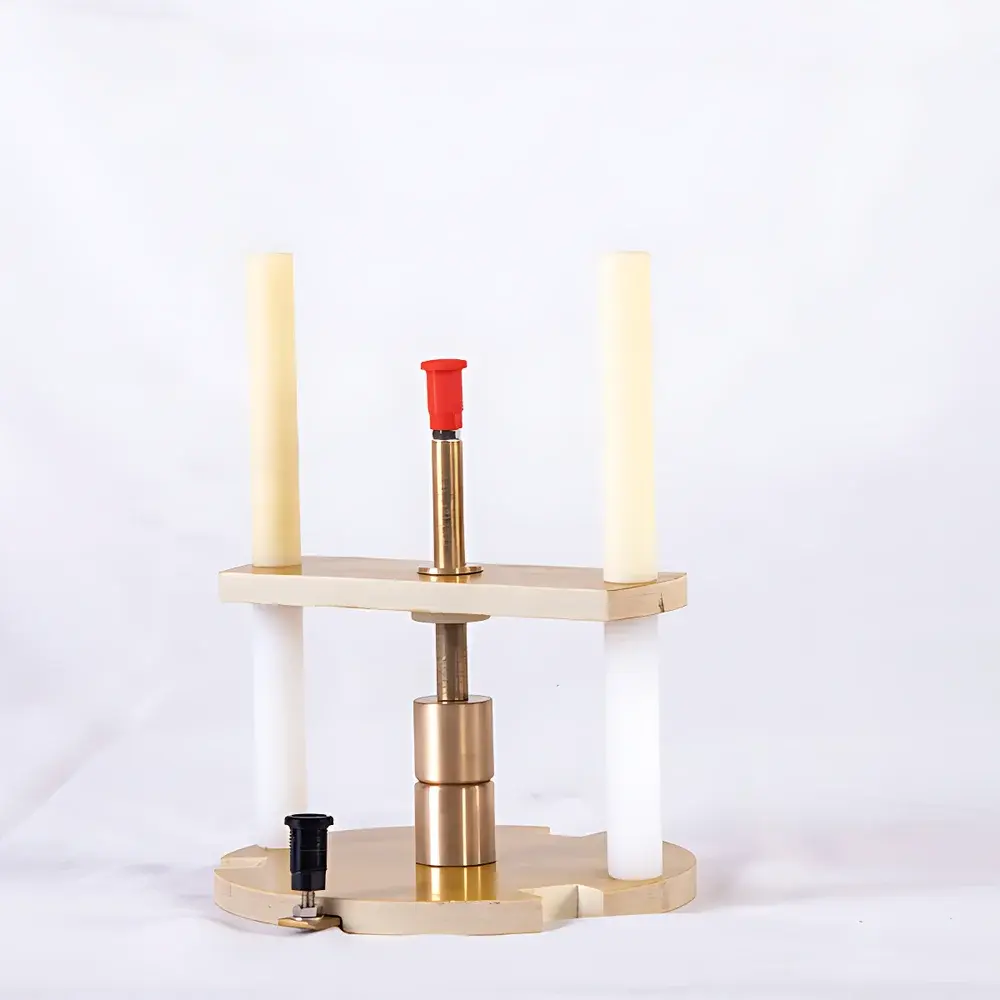
The ZJC-20KV accommodates standard ASTM D149 and GB/T 1408.1 specimen geometries—including discs (25–100 mm diameter), sheets (up to 10 mm thick), and molded bars—with electrode configurations conforming to sphere-sphere, sphere-plane, and needle-plane arrangements. It supports both immersed (oil or silicone fluid) and air-gap testing modes. All firmware, calibration records, and test reports comply with CNAS and CMA accreditation requirements for accredited laboratories. Data integrity meets GLP/GMP traceability standards, with optional 21 CFR Part 11-compliant electronic signatures, role-based user access, and immutable audit logs. Electrical safety design adheres to IEC 61010-1 (measurement category CAT III 300 V) and incorporates creepage/clearance margins per IEC 60664-1 (altitude derating factor 1.25 up to 2000 m).
Software & Data Management
The proprietary V2.0 test software provides ISO/IEC 17025-aligned workflow automation: pre-defined test templates (e.g., “IEC 60243-1 AC Ramp”, “GB/T 1695 Impulse DC”), dynamic pass/fail logic, real-time statistical process control (SPC) charting, and automated report generation in PDF/XLSX formats with embedded metadata (operator ID, calibration certificate ID, environmental readings). Raw binary data (voltage, current, PD, temp) is stored in HDF5 format for third-party analysis. The system supports 16-sample concurrent comparison with overlayable breakdown voltage histograms, Weibull distribution fitting, and confidence interval estimation. All data archives include digital signatures, version-controlled configuration snapshots, and tamper-evident hashing—fully auditable during regulatory inspections.
Applications
- Power Systems: Routine dielectric qualification of transformer bushings, cable insulation (XLPE, EPR), and GIS spacers per GB 1094 and IEC 62271-1.
- Electronics Manufacturing: Screening of PCB substrates (FR-4, polyimide), encapsulants (silicone gels, epoxy molding compounds), and semiconductor packaging materials under DC-biased or pulsed stress conditions.
- Advanced Materials R&D: Structure–property correlation studies of nanocomposites (e.g., Al₂O₃/PVDF), biodegradable polymers, and high-temperature ceramics across –70 °C to 300 °C thermal gradients.
- Automotive & Aerospace: Validation of wire harness insulation (SAE AS4373), battery separator films (Li-ion), and radome materials under combined thermal–electrical stress per DO-160 Section 22.
- Academic Research: Investigation of space charge dynamics using pulsed electroacoustic (PEA) coupling, time-lag breakdown statistics, and Townsend–Meek transition modeling.
FAQ
What voltage ranges does the ZJC-20KV support?
The base model is rated for 0–20 kV AC/DC output. Optional high-voltage modules extend capability to 50 kV, 100 kV, or 150 kV with corresponding 100 pF test capacitors.
Is the system compliant with international calibration standards?
Yes—calibration follows JJG 1005 national metrological verification regulation, with traceability to NIM (National Institute of Metrology, China) and optional UKAS/NIST-traceable certificates available upon request.
Can the instrument perform partial discharge measurements alongside breakdown testing?
Yes—the integrated IEC 60270-compliant PD detection unit provides phase-resolved pulse analysis with 0.1 pC sensitivity and real-time spectral mapping.
What environmental conditions are supported during testing?
The integrated climate chamber maintains –70 °C to +300 °C at ±0.5 °C stability, with simultaneous RH (10–95%) and pressure (50–110 kPa) control and automatic compensation algorithms.
How is data integrity ensured for regulated laboratory use?
All operations generate ALCOA+ compliant records: attributable, legible, contemporaneous, original, accurate, complete, consistent, enduring, and available—with electronic signature support and 21 CFR Part 11 readiness as an optional configuration.



