
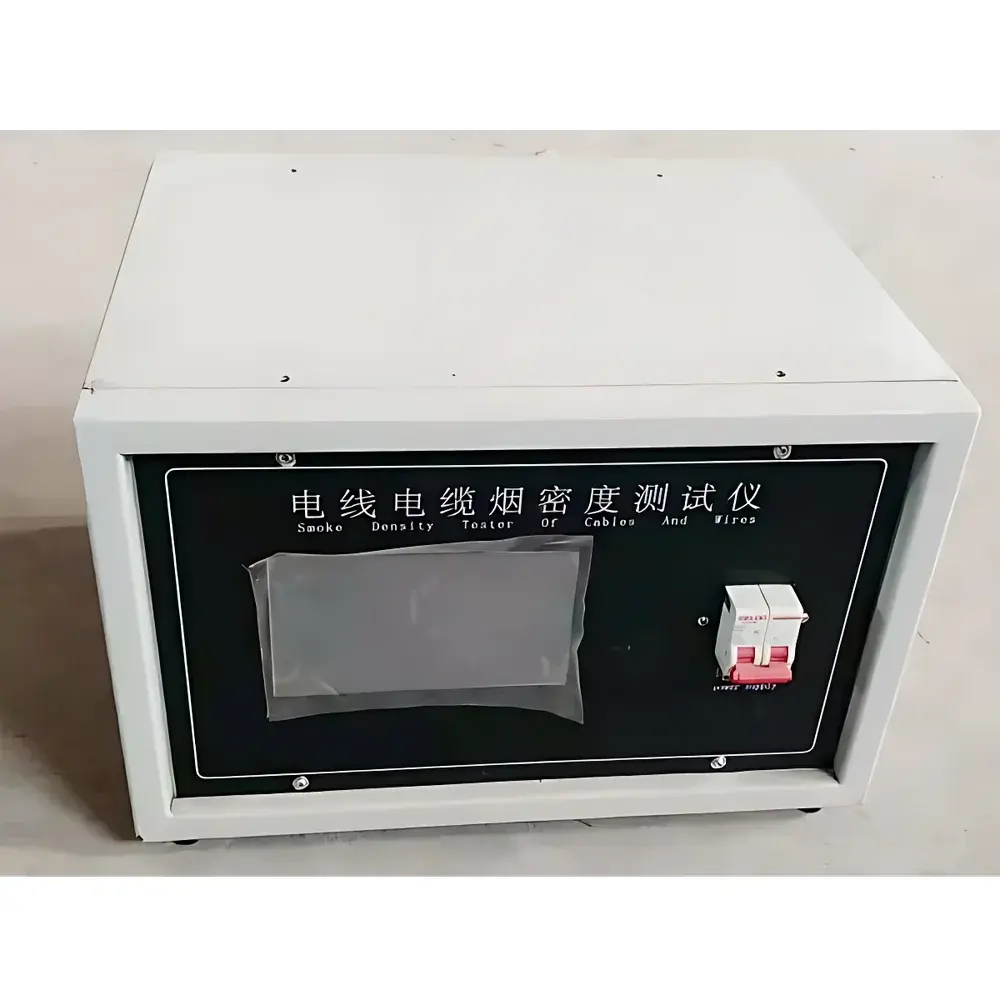
Aerospace SDC-2 Smoke Density Chamber for Wire & Cable Fire Testing
| Brand | Aerospace |
|---|---|
| Origin | Beijing, China |
| Model | SDC-2 |
| Chamber Volume | 27 m³ (3 m × 3 m × 3 m) |
| Light Source | 12 V, 100 W quartz-halogen lamp (400–750 nm) |
| Photodetector | Silicon photodiode |
| Transmittance Range | 0.0001–100% |
| Accuracy | ±3% |
| Power Supply | 220–240 V AC, 50 Hz, 4 kW |
| Operating Ambient | 15–40 °C, RH ≤85%, no direct sunlight or forced airflow |
| Compliance | GB/T 17651.1–2, IEC 61034-1–2 |
| Ignition System | Integrated automatic alcohol-based ignition |
| Software | Proprietary Windows-based transmittance acquisition and reporting suite with real-time curve plotting and GLP-compliant data export |
Overview
The Aerospace SDC-2 Smoke Density Chamber is a standardized optical measurement system engineered for quantitative assessment of smoke obscuration generated during the combustion of wires and cables under controlled fire conditions. It operates on the principle of light attenuation—measuring the reduction in luminous transmittance (%) across a defined 3 m × 3 m × 3 m test volume as smoke particles scatter and absorb incident radiation from a calibrated 12 V quartz-halogen source (spectral range: 400–750 nm). The system conforms strictly to the physical configuration, operational protocols, and data interpretation requirements specified in GB/T 17651.1–2 and IEC 61034-1–2, which define the apparatus (Part 1) and test methodology (Part 2) for evaluating smoke generation from electrical cables and optical fiber cables. This measurement directly informs critical safety parameters—including egress visibility during fire emergencies and firefighter approach feasibility—and serves as a mandatory input for flame-retardant material qualification in building codes, rail transit specifications, and marine regulatory frameworks.
Key Features
- Modular chamber construction: Supports either site-built brick enclosure (with engineering supervision provided) or factory-assembled steel-frame structure—both maintaining strict volumetric fidelity (27 m³ ±0.5%) and thermal stability.
- Dual-control architecture: Fully functional touchscreen HMI integrated into the control cabinet, plus optional PC-based operation via proprietary software with USB/RS-485 interface—enabling seamless switching between local and remote control modes.
- Integrated ignition subsystem: Stainless-steel alcohol pan (210 × 110 mm base / 240 × 140 mm top, 80 mm depth) paired with electric spark igniter and precision flow-regulated fuel delivery—eliminating manual flame application and enhancing repeatability and operator safety.
- Optical path integrity: Collimated 1.5 m ±0.1 m diameter beam generated by stabilized 100 W halogen source; silicon photodiode receiver mounted at geometric center ensures linear response across full 0–100% transmittance range with <±3% measurement uncertainty per IEC 61034 calibration traceability.
- Environmental stabilization: Built-in temperature sensor (mounted 1.5 m above floor, 0.5 m from wall) monitors ambient drift; programmable pre-test blank run (using ethanol only) establishes baseline thermal equilibrium at 25 ±5 °C prior to specimen ignition.
- Forced convection homogenization: Low-turbulence desktop fan installed at chamber base ensures uniform smoke dispersion without inducing localized stratification or flow artifacts that compromise optical sampling validity.
Sample Compatibility & Compliance
The SDC-2 accommodates all standard wire and cable geometries—including single-core, multi-core, armored, and jacketed configurations—mounted on adjustable stainless-steel supports within the central combustion zone. Specimen positioning follows IEC 61034-2 requirements: horizontal orientation, 0.8 m length, centered beneath the optical axis. The system meets essential regulatory alignment for Type Approval testing under EN 50399, UL 719, and CSA C22.2 No. 0.3. Full compliance documentation—including dimensional verification reports, photometric calibration certificates (NIST-traceable reference standards), and electrical safety certification (IEC 61010-1)—is supplied with each unit. Data records support audit readiness for GLP and ISO/IEC 17025-accredited laboratories, with timestamped raw transmittance values, environmental logs, and user-action metadata retained in non-volatile memory.
Software & Data Management
The embedded Windows-based software provides real-time transmittance curve visualization, automatic calculation of maximum smoke density (Dsmax) and average density (Dsavg) per IEC 61034-2 Annex B, and export of tabular reports in CSV and PDF formats. All data files include digital signatures, operator ID, test date/time, chamber ID, and instrument firmware version. Audit trail functionality complies with FDA 21 CFR Part 11 requirements for electronic records—supporting user-defined roles, password-protected access levels, and immutable log history. Raw signal outputs (mV vs. time) are preserved alongside processed transmittance (%), enabling third-party reanalysis or integration into enterprise LIMS platforms via OPC UA or Modbus TCP protocols.
Applications
- Qualification testing of low-smoke zero-halogen (LSZH) insulation and jacketing compounds for data centers, subway systems, and aircraft wiring harnesses.
- Comparative evaluation of flame-retardant additives (e.g., magnesium hydroxide, aluminum trihydrate) in polymer formulations.
- Development and validation of fire-safe cable assemblies meeting NFPA 130, BS 6853, and EN 45545-2 hazard level HL3 requirements.
- Root-cause analysis of smoke generation anomalies during production lot release testing.
- Technical support for notified body assessments and CE marking submissions under EU Construction Products Regulation (CPR) Annex ZA.
FAQ
What standards does the SDC-2 explicitly comply with?
The SDC-2 is designed and verified to meet the mechanical, optical, and procedural specifications of GB/T 17651.1–2 and IEC 61034-1–2. Additional alignment with EN 50399 and UL 719 is achieved through configurable test parameter sets and optional accessory kits.
Is the combustion chamber supplied assembled or as a kit?
Two configurations are available: fully welded steel enclosure (shipped disassembled for site installation) or turnkey brick-constructed chamber (design package + on-site engineering supervision included). Both maintain identical internal dimensions and thermal mass characteristics.
Does the system include calibration tools or reference standards?
Yes—a certified neutral-density filter set (0%, 10%, 50%, and 90% transmittance) and lamp intensity verification protocol are provided. Annual recalibration services are available through Aerospace’s ISO/IEC 17025-accredited metrology lab.
Can the software generate reports compliant with ISO/IEC 17025 documentation requirements?
Yes. All exported reports contain mandatory elements: unique test ID, equipment calibration status, environmental conditions, operator credentials, raw and processed data, and digital signature with cryptographic hash verification.
What ventilation infrastructure is required for safe operation?
A dedicated exhaust duct (minimum 300 mm diameter) must connect the chamber’s roof-mounted pressure-relief port to an external fume hood or centralized smoke scrubbing system capable of handling 2,500 m³/h peak flow with ≥95% particulate capture efficiency.



