
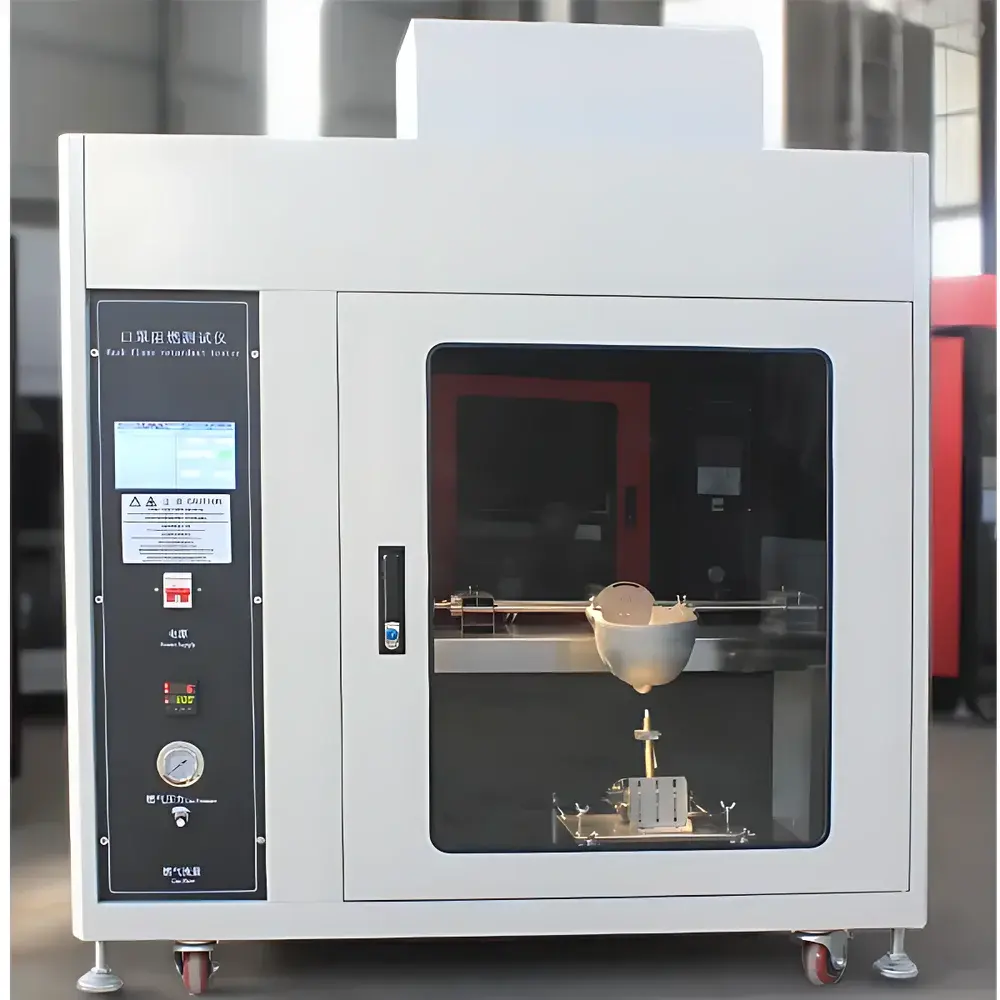
Aerospace TFR-1 Mask Flame Retardancy Tester
| Brand | Aerospace |
|---|---|
| Origin | Beijing, China |
| Model | TFR-1 |
| Dimensions (W×D×H) | 1160 mm × 600 mm × 1310 mm (including feet) |
| Sample Holder | Anthropomorphic Metallic Headform (1:1 scale) |
| Flame Temperature Range | 750–950 °C |
| Headform Travel Speed | (60 ± 5) mm/s |
| Afterflame Timing Resolution | 0.1 s |
| Power Supply | 220 V, 50 Hz, 150 W |
| Fuel Compatibility | Propane, Liquefied Petroleum Gas (LPG), or ≥98% Methane |
| Compliance Standards | GB 2626, GB 19082, GB 19083, GB/T 32610, YY 0469, YY/T 0969 |
Overview
The Aerospace TFR-1 Mask Flame Retardancy Tester is a purpose-built vertical flame resistance evaluation system engineered for precise assessment of filtration facepiece respirators and medical masks under controlled ignition conditions. It operates on the principle of standardized radiant and convective flame exposure—specifically simulating transient thermal insult to the mask surface using a calibrated Bunsen-type burner positioned at defined spatial and thermal parameters. The instrument implements a dynamic headform traversal protocol: a life-sized metallic headform moves horizontally through the flame zone at a fixed velocity of (60 ± 5) mm/s, enabling reproducible measurement of afterflame time—the duration a specimen continues burning after flame removal—as stipulated in multiple national regulatory standards. This methodology aligns with fundamental fire behavior metrics used in personal protective equipment (PPE) certification, where flame propagation inhibition, self-extinguishing capability, and melt-drip suppression are quantitatively evaluated.
Key Features
- Anthropomorphic metallic headform fabricated to exact 1:1 human facial geometry per GB 2626 Annex A, ensuring anatomically representative flame exposure distribution across nose bridge, cheek contours, and chin regions.
- Motorized headform carriage with repeatable positioning accuracy and programmable traverse path; integrated optical limit switches guarantee consistent start/stop points relative to burner nozzle axis.
- Adjustable-height burner assembly with precision micrometer fine-tuning (±0.5 mm resolution) to maintain standardized flame impingement distance as required by test protocols.
- Dual-mode flame initiation: high-voltage piezoelectric ignition ensures reliable, spark-free burner lighting without manual intervention or external pilot flames.
- Digital real-time afterflame timer with 0.1-second resolution and automatic start/stop triggering via flame sensor feedback loop—eliminating operator-dependent reaction delays.
- Integrated flame temperature monitoring via 1.5 mm diameter thermocouple probe mounted adjacent to burner tip, enabling verification of thermal profile compliance within 750–950 °C range prior to each test cycle.
- Front-access observation window with heat-resistant borosilicate glass and internal LED illumination for unobstructed visual monitoring during flame exposure.
Sample Compatibility & Compliance
The TFR-1 accommodates flat-folded, cup-shaped, and contoured surgical/mask respirators mounted directly onto the headform using standardized retention fixtures. Its mechanical and thermal design satisfies the physical configuration requirements of GB 2626–2019 (Respiratory Protective Devices), GB 19082–2009 (Medical Disposable Protective Gowns), GB 19083–2010 (Medical Protective Masks), GB/T 32610–2016 (Daily Protective Masks), YY 0469–2011 (Surgical Masks), and YY/T 0969–2013 (Disposable Medical Masks). All critical operational parameters—including headform speed tolerance, flame temperature stability, and timing resolution—are traceable to national metrological verification procedures. The system supports audit-ready documentation for GLP-compliant laboratories and fulfills prerequisite instrumentation criteria for regulatory submissions under China NMPA Class II/III PPE registration pathways.
Software & Data Management
The TFR-1 employs an embedded microcontroller-based control interface with dedicated firmware for sequence orchestration and data logging. Test records—including date/time stamp, flame temperature reading, measured afterflame duration, operator ID, and pass/fail status per standard thresholds—are stored internally in non-volatile memory. Export is supported via USB flash drive in CSV format for integration into laboratory information management systems (LIMS). While no proprietary PC software is bundled, raw output files conform to ISO/IEC 17025–recommended structured data schemas and include checksum validation for integrity assurance. Audit trails retain all parameter modifications, user logins, and calibration event timestamps—supporting compliance with CNAS-CL01:2018 and FDA 21 CFR Part 11 principles when deployed in validated environments.
Applications
- Pre-market evaluation of disposable and reusable respiratory protection devices for domestic regulatory approval (NMPA) and export certification (CE, FDA 510(k)).
- In-process quality control testing in mask manufacturing facilities to verify batch-to-batch consistency in flame retardant treatment efficacy.
- R&D screening of novel nonwoven substrate formulations, flame-retardant coatings (e.g., phosphorus/nitrogen synergists), and laminated composite architectures.
- Comparative analysis of thermal degradation onset temperatures across material classes (polypropylene, polyester, cellulose acetate, melt-blown electret media).
- Root cause investigation of non-conformance events related to afterflame exceedance, melt-through, or flaming droplet generation during certification retesting.
FAQ
What flame fuel gases are compatible with the TFR-1?
Propane, liquefied petroleum gas (LPG), or methane with purity ≥98% may be used. A pressure-regulated supply delivering 0.3 MPa at the inlet is mandatory; regulators must be rated for the selected fuel type.
Is exhaust ducting mandatory for safe operation?
Yes. The unit generates combustion byproducts including CO, NOx, and particulate matter. A rigid 100 mm diameter exhaust duct must vent effluent to an external fume hood or centralized smoke abatement system meeting local occupational health regulations.
Does the TFR-1 require annual calibration?
Per GB/T 27025–2019, the flame temperature probe, timer circuit, and headform speed actuator shall undergo functional verification before each daily test session; full metrological calibration by an accredited provider is recommended every 12 months.
Can the headform be replaced with custom anthropometric variants?
No. Only the original aerospace-certified headform (compliant with GB 2626 dimensional tolerances) ensures measurement equivalence across laboratories and preserves inter-laboratory reproducibility.
What safety interlocks are implemented?
Hardware-enforced gas shutoff upon door opening, flame sensor–triggered emergency fuel cutoff, and overtemperature shutdown (>1000 °C) are active during operation. All safety circuits comply with GB/T 5226.1–2019 electrical equipment safety standards.



