
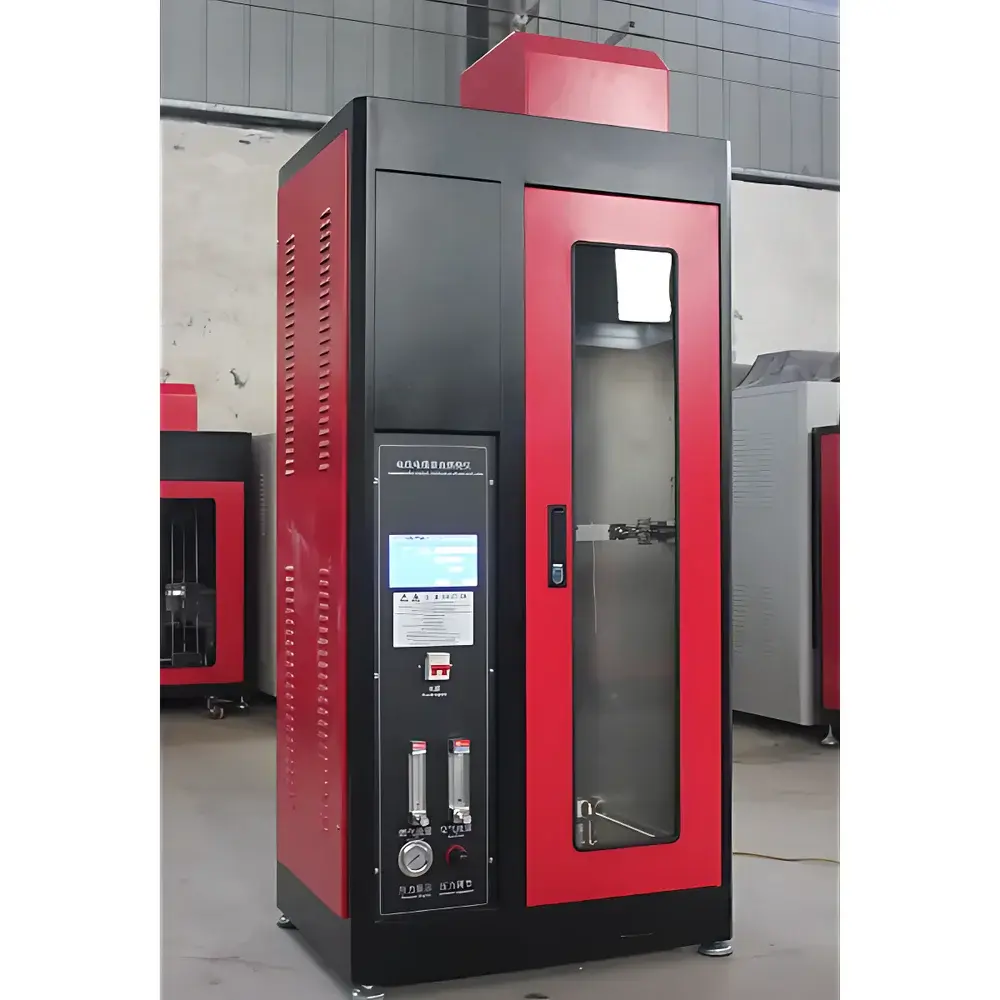
Aerospace VFT-3 Vertical Flame Test Chamber for Wires and Cables
| Brand | Aerospace |
|---|---|
| Origin | Beijing, China |
| Model | VFT-3 |
| Applicable Standard | GB/T 18380.11–2022, GB/T 18380.12–2022, IEC 60332-1/2 |
| Flame Power | 1 kW |
| Flame Angle | 45° |
| Timing Resolution | ±0.1 s (0–999.9 s) |
| Repeatability Error | ±0.1 s |
| Gas Supply | 95% propane (LPG-compatible) |
| Power Supply | AC 220 V / 50 Hz |
| Enclosure Material | Electrostatically Painted Steel Plate |
| Dimensions (W×D×H) | 720 × 580 × 1680 mm |
Overview
The Aerospace VFT-3 Vertical Flame Test Chamber is a precision-engineered apparatus designed to evaluate the vertical flame propagation resistance of single insulated wires and cables under controlled laboratory conditions. It operates on the principle of standardized flame exposure—applying a defined 1 kW pre-mixed propane-air flame at a 45° tilt angle to the vertically mounted specimen for a prescribed duration, followed by measurement of afterflame time, afterglow time, and char length. The system complies strictly with GB/T 18380.11–2022 and GB/T 18380.12–2022, which are technically equivalent to IEC 60332-1-2, ensuring full alignment with international regulatory expectations for flame-retardant validation in low-voltage power, control, elevator, marine, and mining cable applications. Its architecture integrates high-reliability ignition control, digital timing with ±0.1 s resolution, and robust mechanical actuation of the Bunsen burner assembly—enabling repeatable, auditable, and operator-safe execution of vertical flame tests per recognized fire safety protocols.
Key Features
- Automated 45° burner positioning and timed flame application via programmable relay logic, eliminating manual alignment errors
- High-stability 1 kW pre-mixed flame generation using regulated propane (95% purity) and compressed air, with independent flow and pressure monitoring for both gases
- Digital real-time display of flame-on time (Ta), afterflame time (T), and optional filter paper ignition time (T₂), all logged with timestamped resolution of 0.1 s
- Electrostatically coated steel enclosure (720 × 580 × 1680 mm) engineered for corrosion resistance against acidic combustion byproducts
- Integrated high-voltage piezoelectric igniter with triple-pulse auto-ignition sequence, reducing pilot-light dependency and enhancing operational consistency
- Modular gas manifold with dual isolation valves, calibrated flowmeters, and pressure gauges—designed for rapid gas changeover and leak-tight integrity verification
- Front-access observation window with heat-resistant tempered glass and integrated exhaust fan for post-test fume evacuation
Sample Compatibility & Compliance
The VFT-3 accommodates round and flat-profile insulated cables with outer diameters ranging from ≤25 mm up to >75 mm; for non-circular geometries, equivalent circular diameter is calculated from measured perimeter. It supports testing of PVC, PE, LSZH (low-smoke zero-halogen), cross-linked polyolefins, irradiated insulation compounds, and other polymer-based sheathing materials. All test procedures conform to the mandatory requirements of GB/T 18380.12–2022 for flame application durations (60 s for D ≤ 25 mm; 480 s for D > 75 mm), flame geometry validation (inner cone height: 50–60 mm; outer flame height: 170–190 mm), and copper block calibration (10 g, 9 mm Ø, 100 °C → 700 °C rise in 46 ± 6 s). The system satisfies functional prerequisites for GLP-compliant laboratories, including traceable timing, manual override capability, and physical evidence of flame stability during qualification.
Software & Data Management
While the VFT-3 operates via embedded microcontroller-based logic without external PC dependency, its interface provides full manual data capture and structured storage functionality. Each test cycle records Ta (flame application time), T (afterflame duration), and optional T₂ (filter paper ignition time), with automatic pop-up prompts after six consecutive trials. Data entries include date/time stamps, operator ID field (manual input), and pass/fail flags based on char length limits per GB/T 18380.12. All timing events are hardware-locked to internal quartz oscillators, ensuring metrological traceability. For audit readiness, the device supports printed log export via optional RS-232 or USB-to-serial adapters (not included), enabling integration into LIMS environments compliant with ISO/IEC 17025 documentation requirements. Flame calibration logs, gas pressure histories, and maintenance records may be maintained externally in accordance with FDA 21 CFR Part 11 principles when paired with validated electronic record systems.
Applications
The VFT-3 serves as a primary screening tool for flame-retardant qualification across multiple industry segments: wire and cable manufacturers validating new insulation formulations; QC laboratories performing incoming raw material checks on LSZH compounds; certification bodies conducting third-party type testing for CCC, CE, or UL recognition; and R&D teams optimizing halogen-free flame retardant packages for 105 °C irradiated polyolefin systems. It is routinely deployed in fire safety assessments for building wiring, rail transit cabling, offshore platform instrumentation loops, and medical equipment interconnects where limited flame spread and reduced toxic smoke emission are mandated. Its design facilitates comparative analysis between candidate materials under identical thermal insult conditions—supporting formulation iteration, supplier qualification, and regulatory dossier preparation.
FAQ
What gases are approved for use with the VFT-3?
Only 95% pure propane is specified in GB/T 18380.12–2022. Liquefied petroleum gas (LPG) may be substituted only if composition and calorific value meet ASTM D1835 specifications and flame calibration criteria are re-verified.
Is flame calibration required before each test series?
Yes—flame geometry (inner/outer cone dimensions) or copper block temperature rise must be confirmed prior to any formal test run, per Clause 7.2 of GB/T 18380.12–2022.
Can the VFT-3 be used for multi-conductor or armored cables?
No—the standard applies exclusively to single insulated conductors. Multi-core or metal-sheathed cables require alternative test methods such as GB/T 18380.3X or IEC 60332-3.
How often should gas line integrity be verified?
Leak checks using soap solution or certified gas detectors must be performed before every test session, and hose assemblies shall be replaced per manufacturer’s service interval (typically every 12 months or after 500 cycles).
Does the VFT-3 support automated report generation?
Not natively—the unit stores six sequential test results locally; full reporting requires manual transcription or integration with external data acquisition software via serial interface.



