
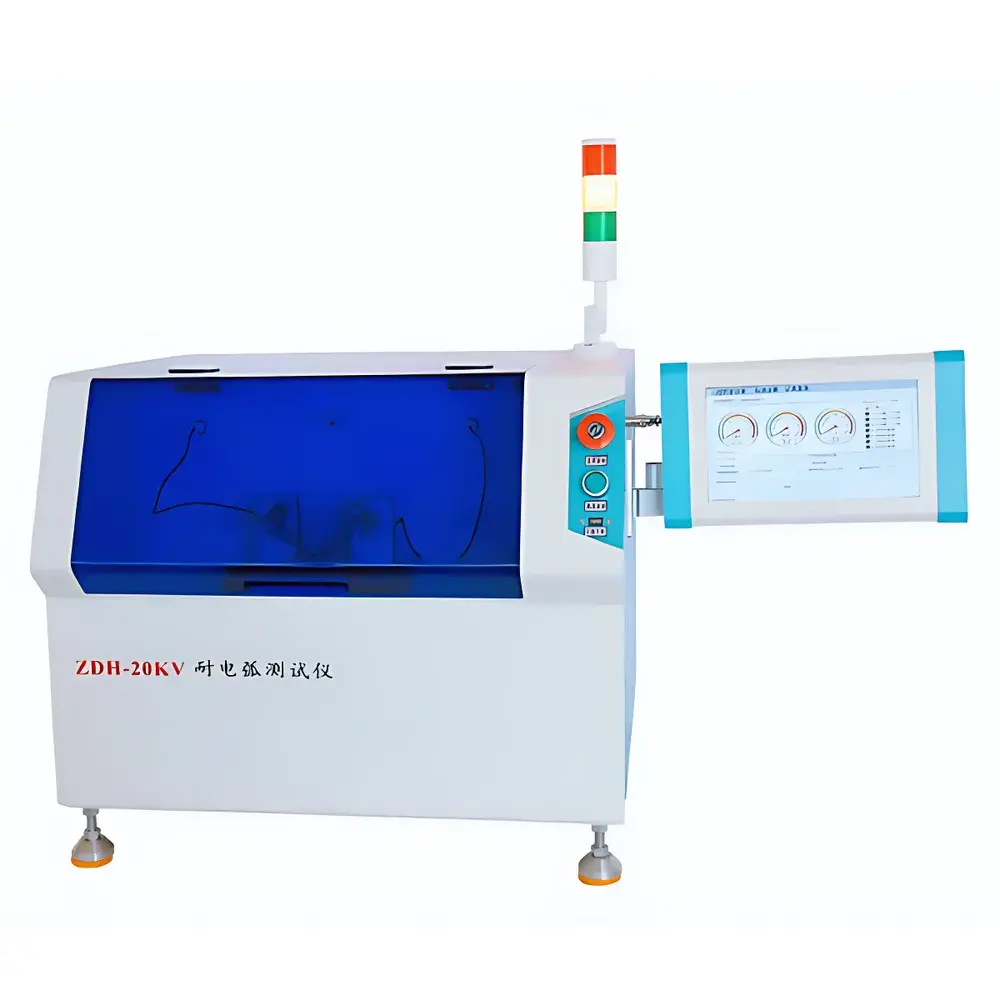
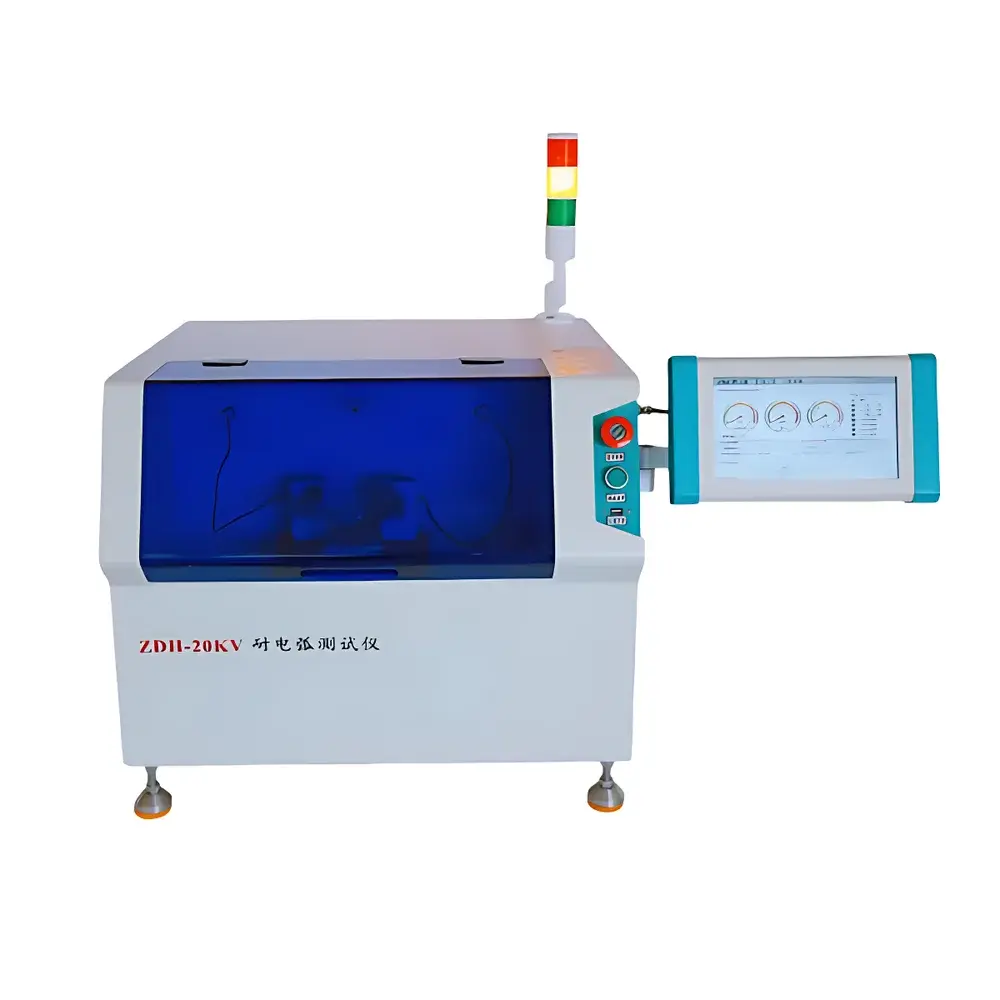
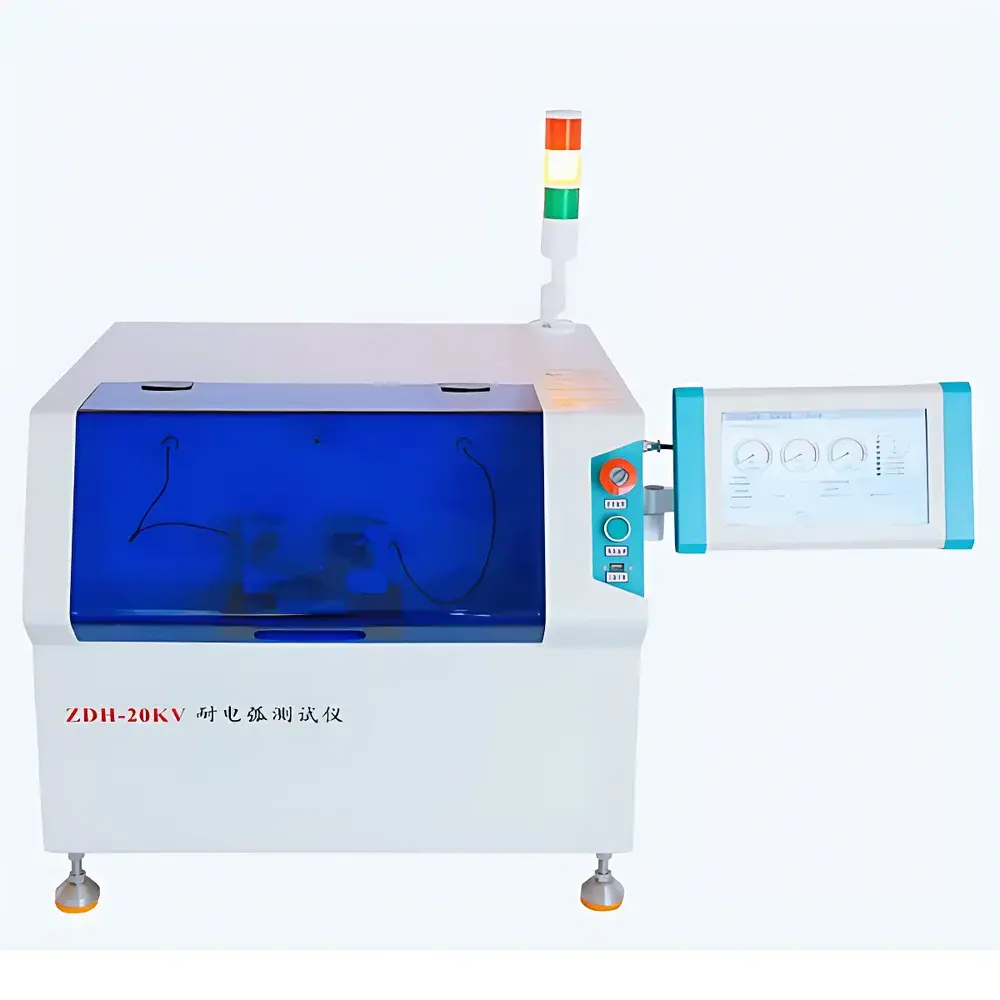
Aerospace ZDH-20kV Arc Resistance Tester
| Brand | Aerospace |
|---|---|
| Origin | Beijing, China |
| Model | ZDH-20kV |
| Breakdown Voltage | 20 kV |
| Compliance Standards | IEC 61621, ASTM D495, GB/T 1411 |
| Electrode Spacing | 4 mm or 6.35 mm (adjustable) |
| Arc Current Range | 10–40 mA |
| Output Voltage | AC/DC, 0–20 kV |
| Safety Features | Interlocked arc chamber, emergency stop, grounding resistance ≤2 Ω |
| Calibration Interval | Semi-annual (±2% voltage accuracy) |
Overview
The Aerospace ZDH-20kV Arc Resistance Tester is a precision-engineered instrument designed to quantify the ability of solid insulating materials to withstand high-energy electric arcing under standardized conditions. It operates on the principle of controlled arc initiation between two tungsten or copper electrodes positioned above a flat specimen surface, simulating real-world degradation mechanisms such as surface tracking, carbonization, and conductive path formation in high-voltage environments. Unlike dielectric strength testers that measure instantaneous breakdown, this system evaluates time-dependent resistance to progressive thermal and electrochemical erosion—critical for validating insulation integrity in power transmission components, switchgear housings, aerospace composites, and EV battery enclosures. The device complies with internationally recognized test methodologies including IEC 61621 (electrical insulating materials — determination of resistance to arc), ASTM D495 (standard test method for dielectric breakdown voltage of insulating oils), and GB/T 1411 (Chinese national standard for arc resistance of plastics), ensuring data comparability across global R&D and quality assurance laboratories.
Key Features
- High-stability high-voltage generator delivering adjustable AC or DC output up to 20 kV with fine current control (10–40 mA) for reproducible arc initiation.
- Interchangeable electrode assemblies—tungsten (2–3 mm diameter, high-temperature resistant) or copper—with precise micrometer-driven spacing adjustment (4 mm per IEC 61621; 6.35 mm per ASTM D495).
- Dual-mode arc control: continuous arc mode for accelerated aging studies and timed intermittent mode (e.g., 1 s ON / 1 s OFF) to replicate pulsed discharge conditions.
- Integrated timing and failure detection module automatically records arc endurance time (in seconds) or number of arcs sustained before surface carbonization, charring, or conductive bridge formation.
- Robust safety architecture featuring electromagnetic door interlock, Class I grounding (≤2 Ω resistance), emergency power cutoff, and optical shielding compliant with EN 61482-1-2 for operator protection against UV radiation and plasma flash.
- Modular design supporting routine maintenance: electrode wear monitoring (replacement threshold: >0.5 mm tip erosion), semi-annual voltage calibration traceable to NIST-equivalent reference dividers, and removable arc chamber liner for efficient carbon residue removal.
Sample Compatibility & Compliance
The ZDH-20kV accommodates rigid sheet specimens sized 100 × 100 × 3 mm (per ASTM D495 and IEC 61621), including thermoplastics (e.g., PEEK, polyamide), thermosets (epoxy, silicone rubber), laminates (G10/FR4), ceramics, and filled composites. Surface preparation follows strict cleanliness protocols—ISO 8502-3 compliant cleaning with isopropyl alcohol prior to testing eliminates contamination-induced premature failure. Environmental conditioning is recommended at 23 ± 2 °C and 50 ± 5 % RH (per ISO 291) to minimize humidity-related variability. All test sequences adhere to documented procedures aligned with GLP requirements, enabling audit-ready reporting for regulatory submissions under FDA 21 CFR Part 11 (when paired with validated software).
Software & Data Management
While the base unit operates via front-panel controls, optional PC-based software provides full test automation, parameter scripting, real-time arc waveform logging (voltage/current vs. time), and statistical analysis (mean time to failure, standard deviation, Weibull distribution fitting). Data export supports CSV, PDF, and XML formats compatible with LIMS integration. Audit trails record user ID, timestamp, parameter changes, and calibration events—meeting requirements for ISO/IEC 17025 accreditation and GMP-aligned quality systems. Firmware updates are delivered via secure HTTPS and include cryptographic signature verification.
Applications
- Materials development: Screening polymer formulations containing flame retardants, glass fiber, or alumina fillers for enhanced arc resistance in medium-voltage switchgear.
- Quality control: Final inspection of molded insulators used in circuit breakers, requiring ≥120 s arc endurance per ASTM D495 Class A criteria.
- Fault forensics: Post-failure evaluation of degraded bushings or busbar coatings to determine residual dielectric capability after partial discharge exposure.
- Standards harmonization: Cross-validation of IEC vs. ASTM results during international product certification (e.g., UL 746A, VDE 0303).
- Correlative testing: Paired use with comparative tracking index (CTI) testers (IEC 60112) and glow-wire apparatus (IEC 60695-2-10) for comprehensive electrical safety profiling.
FAQ
What is the difference between arc resistance and dielectric strength testing?
Arc resistance measures time-to-failure under sustained surface arcing; dielectric strength determines the peak voltage causing bulk insulation breakdown—two distinct failure modes governed by different physical mechanisms.
Can the ZDH-20kV be used for liquid dielectrics?
No—it is specifically configured for solid planar specimens. Liquid testing requires separate ASTM D877 or D1816 setups with immersed electrodes and containment cells.
How often must the tungsten electrodes be replaced?
Electrodes should be inspected after every 50 test cycles; replacement is mandatory if tip erosion exceeds 0.5 mm or if arc stability degrades despite cleaning.
Is humidity control essential during testing?
Yes—ambient relative humidity above 60 % RH accelerates carbon track propagation and reduces repeatability. Testing must occur in climate-controlled labs (40–60 % RH, 23 ± 2 °C).
Does the system support automated pass/fail judgment based on standards?
Yes—the software module includes configurable acceptance thresholds (e.g., “≥180 s” per IEC 61621 Class 3) with auto-flagging of nonconforming results and integrated certificate generation.



