
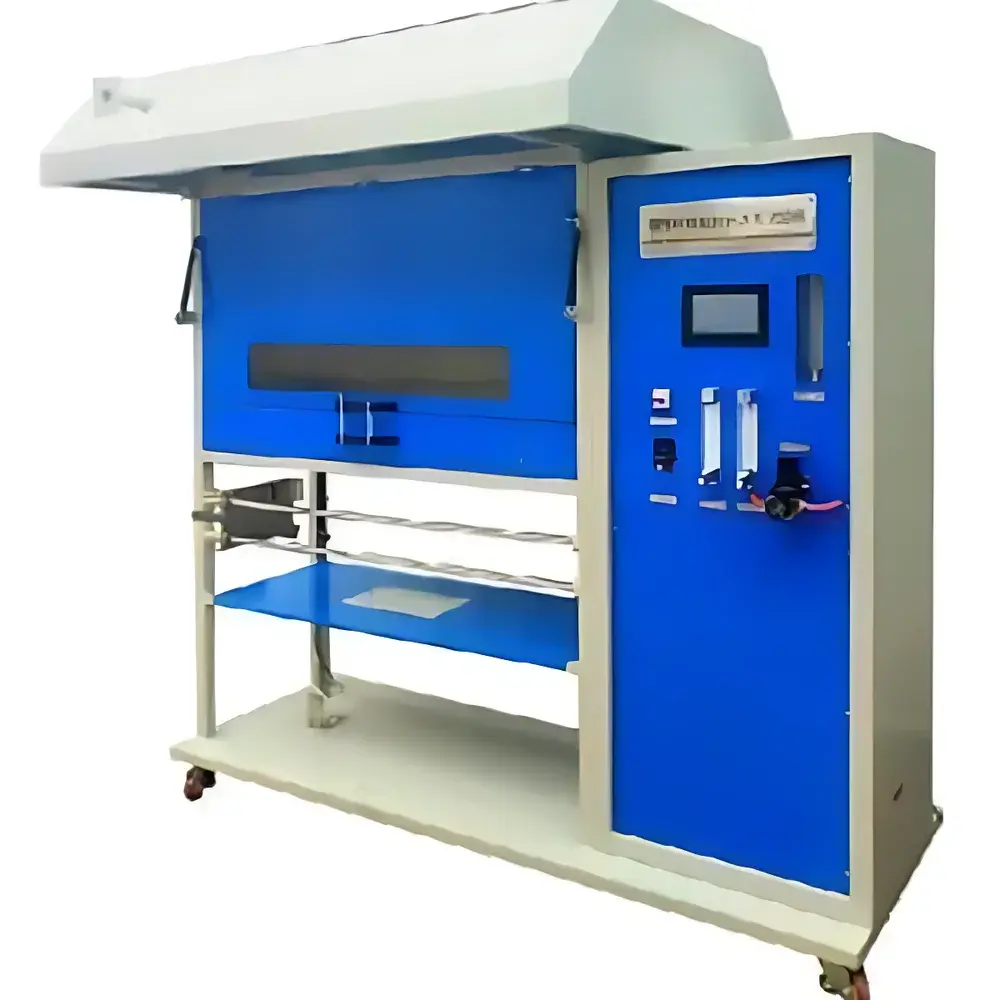
Aerospace ZFA-1 Radiant Heat Source Floor Covering Flammability Tester
| Brand | Aerospace |
|---|---|
| Origin | Beijing, China |
| Manufacturer Type | Authorized Distributor |
| Country of Origin | China |
| Model | ZFA-1 |
| Price Range | USD 17,200 – 20,700 |
| Power Supply | AC 220 V, 50 Hz, ~0.5 kW |
| Exhaust Air Velocity | (2.5 ± 0.2) m/s |
| Fire-Resistant Porous Board Dimensions | (300 ± 10) mm × (450 ± 10) mm,耐900°C+ |
| Radiant Panel Blackbody Temperature Range | 480–530 °C |
| Radiant Panel Temperature Accuracy | ±0.5% of reading |
| Thermocouple | 3.2 mm stainless steel sheathed K-type |
| Heat Flux Meter Range | 0–15 kW/m² |
| Heat Flux Meter Accuracy | ±3%, ±0.2 kW/m² |
| Anemometer Accuracy | ±0.1 m/s |
| Timer Accuracy | <1 s/h |
| Overall Dimensions (L×W×H) | 2400 mm × 1340 mm × 3100 mm (incl. duct bend) |
Overview
The Aerospace ZFA-1 Radiant Heat Source Floor Covering Flammability Tester is a precision-engineered apparatus designed to evaluate the critical flame spread behavior of floor covering materials under controlled laboratory conditions, in strict compliance with GB/T 11785–2005 and ISO 9239–1:2002. It implements the radiant heat source method—a standardized test principle wherein a horizontal specimen is exposed to a defined, spatially uniform thermal radiation field generated by a calibrated ceramic radiant panel, while a small pilot flame initiates combustion at the leading edge. The apparatus quantifies flame propagation distance over time, enabling derivation of the critical radiant flux—the minimum incident heat flux at which flame spread ceases—thereby providing a reproducible, comparative metric for material classification. It is explicitly intended for standardized laboratory assessment and does not model full-scale fire dynamics or serve as a standalone predictor of real-world fire hazard; rather, it delivers traceable, inter-laboratory comparable data essential for regulatory submission, product development validation, and quality control within flooring manufacturing and building material certification workflows.
Key Features
- Dual-control architecture: Fully functional operation via integrated industrial touchscreen interface or dedicated Windows-based PC software—seamlessly switchable without hardware reconfiguration.
- Automated ignition sequence with real-time failure detection and audible/visual alarm, ensuring procedural integrity and operator safety.
- Pre-calibrated radiant panel system with active thermal stabilization: Achieves and maintains blackbody temperature stability within ±5 °C of target (480–530 °C) after ≥60 min preheat, verified via high-accuracy thermocouples and radiant thermometry.
- Traceable heat flux calibration: Integrated water-cooled heat flux meter (0–15 kW/m², ±0.2 kW/m² absolute accuracy) enables point-wise mapping across the 110–910 mm test zone per ISO 9239–1 Annex B, supporting GLP-compliant calibration records.
- Controlled exhaust environment: Precision-regulated ventilation system maintains smoke extraction velocity at (2.5 ± 0.2) m/s throughout testing, minimizing convective interference with radiant heat transfer.
- Modular specimen handling: Robust sliding platform and adjustable clamping fixtures accommodate standard specimens (1050 mm × 230 mm) and permit secure mounting of multi-layer assemblies—including backing substrates, adhesives, and underlays—as required by EN 13238 conditioning protocols.
Sample Compatibility & Compliance
The ZFA-1 accommodates a broad spectrum of commercial and industrial floor coverings, including but not limited to tufted and woven textiles (e.g., nylon, wool, polypropylene carpets), resilient materials (PVC, rubber, linoleum), engineered wood composites, cork tiles, and spray-applied acoustic/protective coatings. Specimen preparation strictly follows ISO 9239–1 Section 6 and GB/T 11785 Clause 2.1: six specimens per orientation (three parallel, three perpendicular to production direction), conditioned per EN 13238 (23 °C ± 2 °C, 50% RH ± 5%, ≥48 h). For bonded systems, minimum 72-hour post-installation curing is mandated prior to testing. All test data generated are fully compliant with reporting requirements for CE marking (EN 13501–1), ASTM E648 (for North American equivalency mapping), and Chinese CCC certification pathways. The system’s measurement traceability chain—anchored to NIST-traceable heat flux meters and calibrated thermocouples—supports audit readiness under ISO/IEC 17025 accredited laboratory environments.
Software & Data Management
The proprietary Windows application provides full instrument control, real-time parameter monitoring (chamber temperature, blackbody temperature, heat flux profile, flame front position), and automated data logging at user-defined intervals (default: 10-minute flame propagation readings). All raw sensor values—including thermocouple voltages, anemometer outputs, and timer stamps—are stored in CSV-compatible structured files with embedded metadata (test ID, operator, date/time, calibration status). The software enforces 21 CFR Part 11–compatible audit trails: every action (start, stop, calibration, parameter edit) is timestamped and logged with operator ID. Report generation supports multi-test averaging, automatic critical radiant flux calculation, and customizable PDF export—no runtime dependency on the host PC; reports may be archived offline or distributed via secure network shares. Network configuration uses static IPv4 addressing (default: 192.168.1.10); DHCP fallback and VLAN segmentation are supported for enterprise IT integration.
Applications
This tester serves core functions across R&D, QC, and regulatory affairs departments: benchmarking flame-retardant additive efficacy in polymer formulations; validating batch-to-batch consistency of commercial carpet tiles against Class Bfl-s1 or Cfl-s1 Euroclass thresholds; supporting fire safety documentation for LEED v4.1 MR credits; conducting root-cause analysis of field-reported flaming incidents; and fulfilling mandatory testing requirements for public infrastructure projects (airports, hospitals, mass transit hubs). Its data directly feed into fire modeling inputs (e.g., FDS boundary conditions) and support harmonized classification under multiple frameworks—ISO, EN, GB, and ASTM—reducing redundant testing costs across global markets.
FAQ
What standards does the ZFA-1 fully comply with?
The instrument is engineered and validated to meet all mechanical, thermal, and procedural requirements of ISO 9239–1:2002 and GB/T 11785–2005, including radiant panel geometry, flux uniformity, exhaust velocity tolerance, and specimen mounting specifications.
Is calibration verification required before each test?
Per ISO 9239–1 Clause 7.2, full system calibration (radiant flux mapping, blackbody temperature, chamber temperature) must be performed monthly—or immediately following any major maintenance, relocation, or component replacement—to ensure metrological continuity.
Can the ZFA-1 test non-horizontal configurations?
No. The test method mandates horizontal specimen orientation under a downward-directed radiant field; inclination or vertical mounting violates the fundamental physics assumptions of ISO 9239–1 and invalidates comparative data.
How is data integrity ensured during long-duration tests?
The embedded controller maintains independent timing and sensor sampling even if the PC connection is interrupted; all measurements continue and synchronize upon reconnection, preventing data loss during 30-minute flame propagation sequences.
Does the system support remote diagnostics?
Yes—via secure SSH-enabled Ethernet access, authorized service engineers can remotely verify firmware version, calibration history, and sensor health logs without physical site visits, minimizing instrument downtime.



