
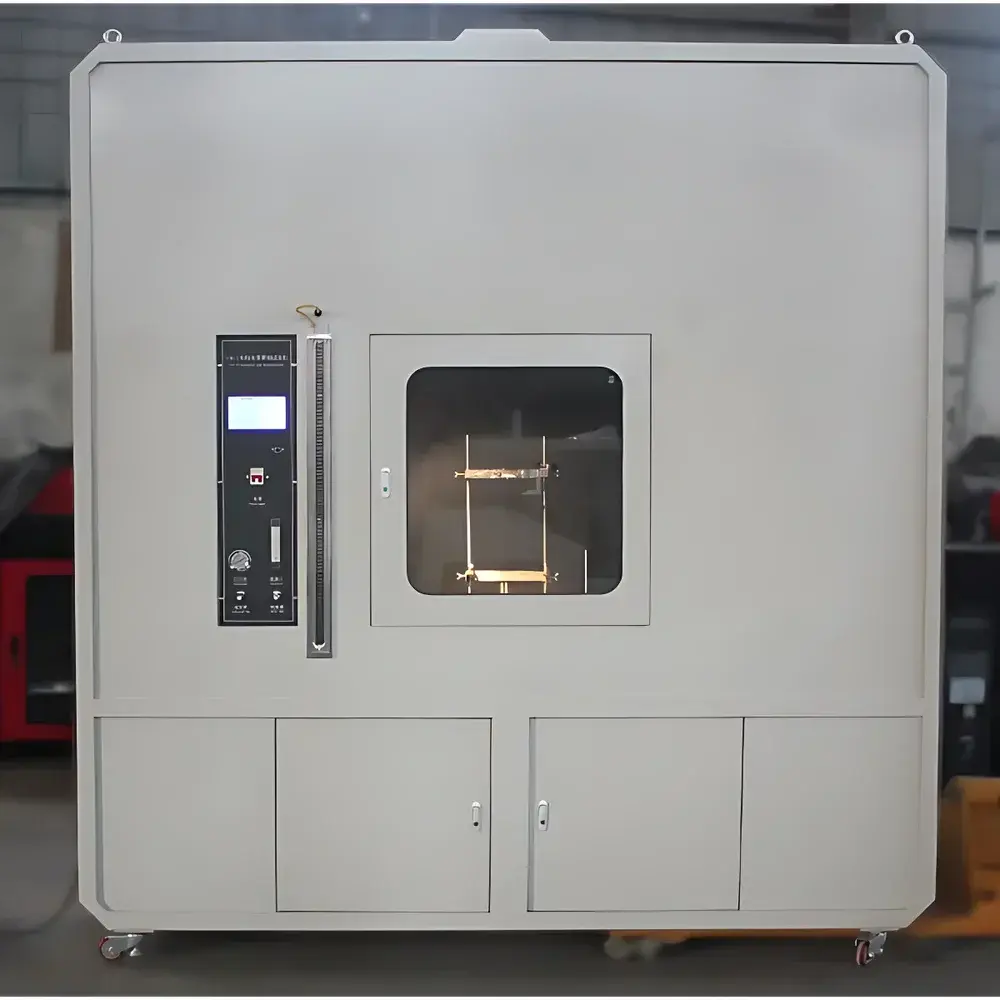
Aerospace ZHONGHENG VFT-1 Vertical & Horizontal Flame Test Chamber for Wire and Cable Combustion Performance Evaluation
| Brand | Aerospace ZHONGHENG |
|---|---|
| Model | VFT-1 |
| Origin | Beijing, China |
| Compliance | UL 2556-2021, UL 1581-2020 (Sections 1060, 1080, 1090, 1100) |
| Dimensions (Integrated) | 2400 × 1000 × 2800 mm |
| Combustion Chamber | 2360 × 980 × 1800 mm |
| Power Supply | AC 220 V ±10%, 50–60 Hz |
| Rated Power | 200 W |
| Thermocouple Range | 0–1300 °C, Ø1 mm |
| Bunsen Burner Inner Diameter | Φ9.5 mm |
| Fuel | 95% Methane |
| Ignition Time Range | 0–999.9 s |
| Afterflame Time Measurement Range | 0–999.9 s |
| Timing Resolution | 0.1 s |
| Burner Tilt Angle | 0°–45° adjustable |
| Weight | ≈350 kg |
| Repeatability Error | ±0.1 s |
Overview
The Aerospace ZHONGHENG VFT-1 Vertical & Horizontal Flame Test Chamber is a precision-engineered combustion evaluation system designed to assess the flame propagation resistance and flaming droplet behavior of insulated wires, cables, cords, and flexible conductors under standardized thermal stress conditions. It operates in strict accordance with UL 2556-2021 *Standard for Safety – Wire and Cable Test Methods* and UL 1581-2020 *Reference Standard for Electrical Wires, Cables, and Flexible Cords*, supporting critical test protocols including FT1 (vertical flame), VFT-1 (vertical specimen flame test), FH/FT2 (horizontal flame and flaming droplet), and FV-2 (vertical flame for appliance wiring). The chamber employs a calibrated Bunsen burner delivering a defined methane-air flame (95% CH₄), with precise positional control over burner angle (0°–45°), ignition timing, and afterflame duration measurement. Its dual-axis motorized specimen stage enables reproducible positioning of samples relative to flame impingement zones—ensuring compliance with geometric tolerances specified in UL clauses 1060, 1080, 1090, and 1100. The system’s microprocessor-based architecture integrates real-time thermocouple monitoring (0–1300 °C), pressure-regulated gas flow control, and automated flame application sequences—minimizing operator variability and enhancing inter-laboratory reproducibility.
Key Features
- Modular integrated design with optional split configuration (floor cabinet + 2020 mm tall combustion chamber) for flexible lab integration.
- High-precision touch-screen HMI enabling selection and execution of UL-compliant test methods: horizontal flame (FT2/FH), vertical flame (FT1/VFT-1), and user-defined multi-cycle protocols.
- Motorized, programmable specimen holder with XYZ-axis adjustment—controlled via touchscreen or external PC software—to maintain exact specimen-to-flame geometry per UL 1581 Annex A.
- Dual-stage gas regulation system featuring pressure gauge, fine-tuning pressure valve, mass flow meter, and methane-specific regulator (user-supplied) for stable, repeatable flame output.
- Integrated safety subsystems: forced-exhaust ventilation fan (post-test toxic fume removal), explosion-resistant observation window with heat-resistant glass, and automatic gas shutoff on motor return (configurable).
- Calibration-ready architecture with dedicated reference thermocouple port, flame height scale (±0.5 mm resolution), and standardized positioning jigs (e.g., 500 mm steel ruler, alignment sleeve) for traceable setup verification.
- Comprehensive data capture: afterflame time (0.1 s resolution), burn length (mm), cotton ignition status, and flag char percentage—all timestamped and exportable via USB or Ethernet interface.
Sample Compatibility & Compliance
The VFT-1 accommodates rigid and flexible specimens ranging from 250 mm to 610 mm in length—including single-core insulated wires, multi-conductor cables, braided cords, and appliance wiring—mounted either vertically or horizontally per test method requirements. Specimen mounting fixtures ensure axial alignment and mechanical stability during thermal exposure, mitigating sag or displacement that could compromise flame contact consistency. All test configurations comply with UL 1581’s dimensional tolerances: e.g., 254 ± 2 mm vertical offset for indicator flag placement, 75–100 mm radial cotton extension beyond specimen axis, and 6 ± 3 mm surgical cotton bedding thickness. The chamber satisfies environmental preconditioning mandates (25.0 ± 10 °C ambient equilibrium; 10–30 °C / 15–80% RH operational range) and supports full auditability for GLP/GMP environments through configurable data logging, electronic signatures, and 21 CFR Part 11–compatible software modules (available via optional PC interface).
Software & Data Management
The embedded firmware provides deterministic control over flame application cycles (e.g., 15 s on / 15 s off × 5 cycles for FT1; 60 s on / 30 s off × 3 cycles for VFT-1), automatic timer triggering upon flame ignition, and real-time calculation of linear burn rate (mm/min). Test parameters—including Ta (application time), interval delay, cycle count, and motor return logic—are fully editable and stored with metadata (date/time, operator ID, calibration status). Raw data exports as CSV files via USB drive or Ethernet connection for integration into LIMS or QA documentation systems. Optional PC-based software enables remote monitoring, batch reporting, trend analysis across multiple test runs, and generation of UL-compliant test certificates—including fields for specimen identification, observed charring length, cotton ignition confirmation, flag char percentage (>25% threshold), and pass/fail determination per UL 1581 Section 1061 or 1080 criteria.
Applications
This instrument serves quality assurance laboratories in wire and cable manufacturing, third-party certification bodies (e.g., UL, CSA, Intertek), and R&D facilities developing flame-retardant polymer formulations (e.g., PVC, LSZH, cross-linked polyolefins). It validates compliance for end-use applications including building wiring (NEC Article 725/800), automotive harnesses (SAE J1128), aerospace wiring (AS4373), and medical device cables (IEC 60601-1). Specific use cases include comparative screening of halogen-free compounds, verification of jacket integrity under thermal insult, assessment of dripping behavior in low-smoke cables, and root-cause analysis of flame spread failures during product qualification. Its adherence to UL 2556’s repeatability requirement (±0.1 s timing error) ensures data accepted in regulatory submissions and international conformity assessments.
FAQ
Which UL standards does the VFT-1 fully support?
It implements all mandatory procedures in UL 1581 Sections 1060 (FT1), 1080 (VFT-1), 1090 (FH horizontal), and 1100 (FT2), plus corresponding test methods in UL 2556-2021.
Is methane the only approved fuel gas?
Yes—UL 1581 specifies 95% minimum purity methane; propane or butane are not permitted for compliance testing.
How often must the burner flame be calibrated?
Per UL 2556 Section 1.4.3: prior to first use each day, after cylinder replacement, after any hardware maintenance, and at minimum 30-day intervals.
Can the system operate without a connected PC?
Yes—the standalone touchscreen interface executes all standard tests, stores results locally, and supports USB data export; PC connectivity is optional for advanced reporting.
What defines a “pass” for the VFT-1 vertical flame test?
Per UL 1581 Section 1080: charred length ≤ 1.6 m (63 in); afterflame time ≤ 60 s after final flame removal; no ignition of cotton bedding; and no flaming droplets igniting cotton beyond the designated test zone.



