
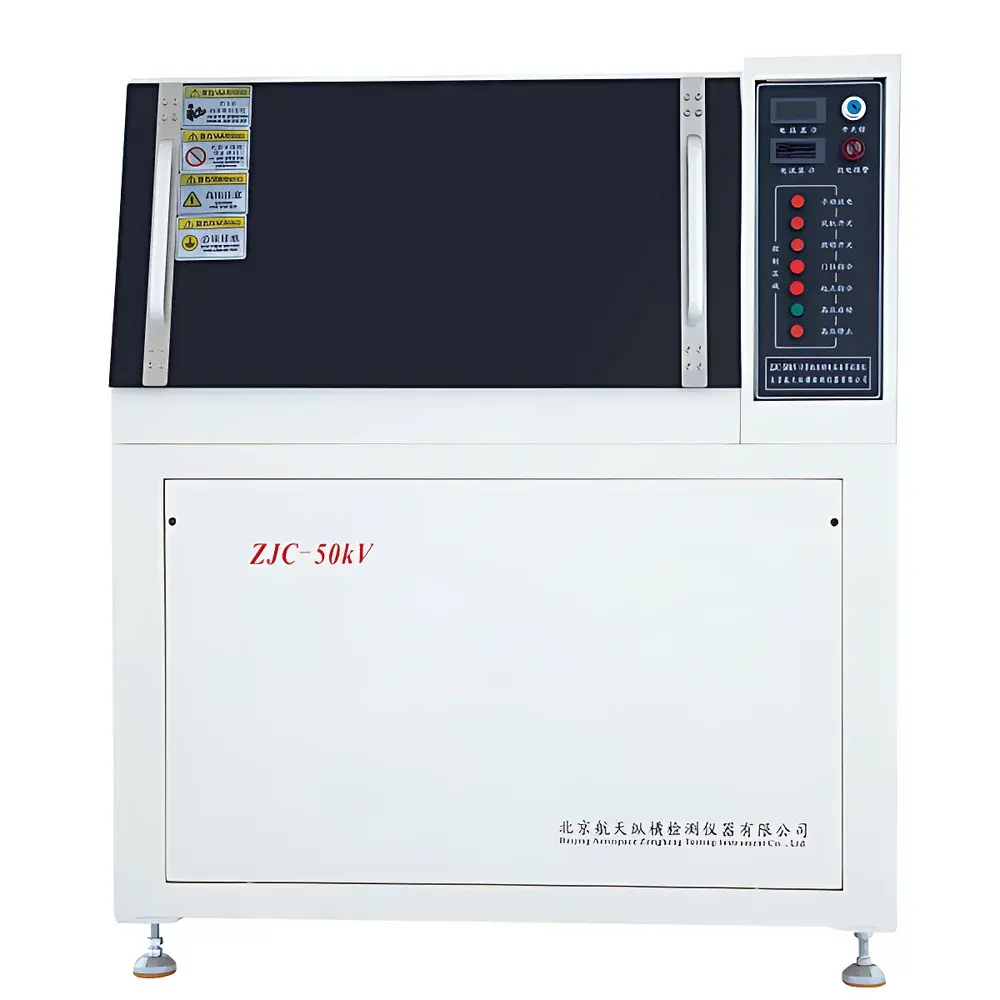
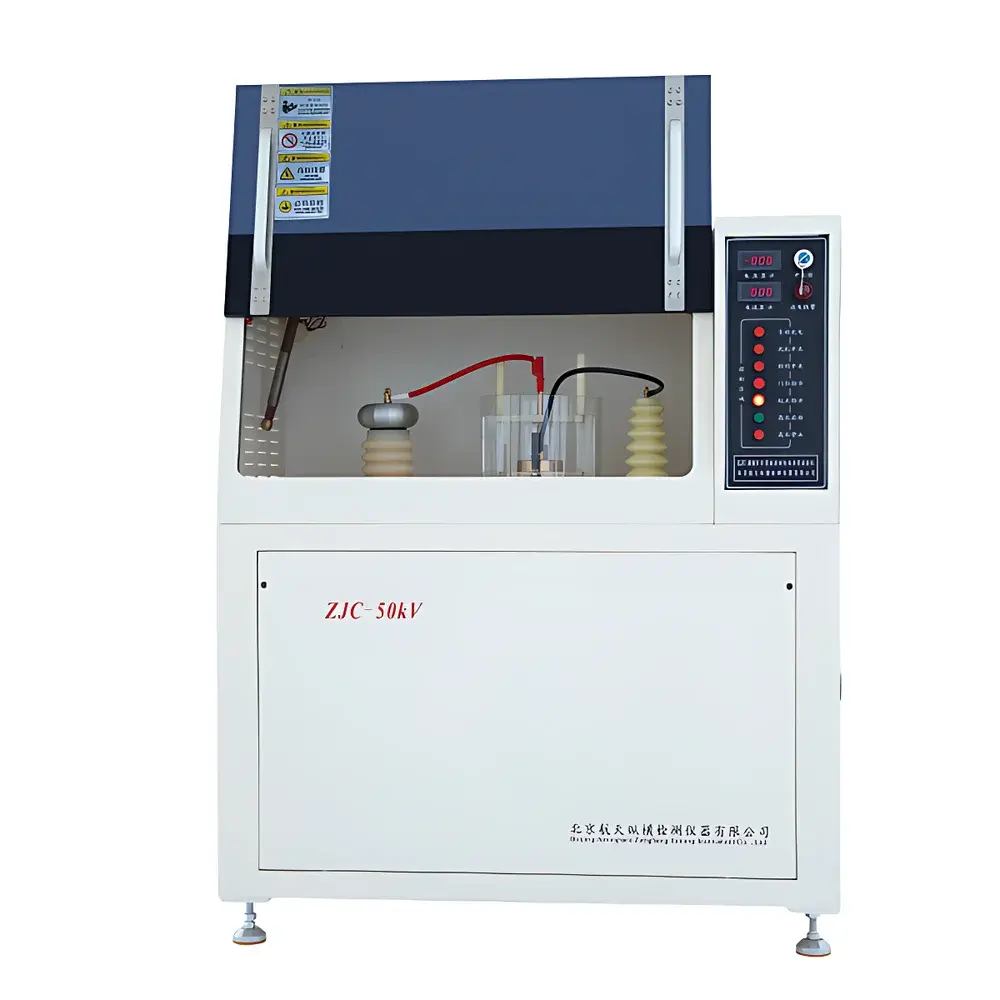
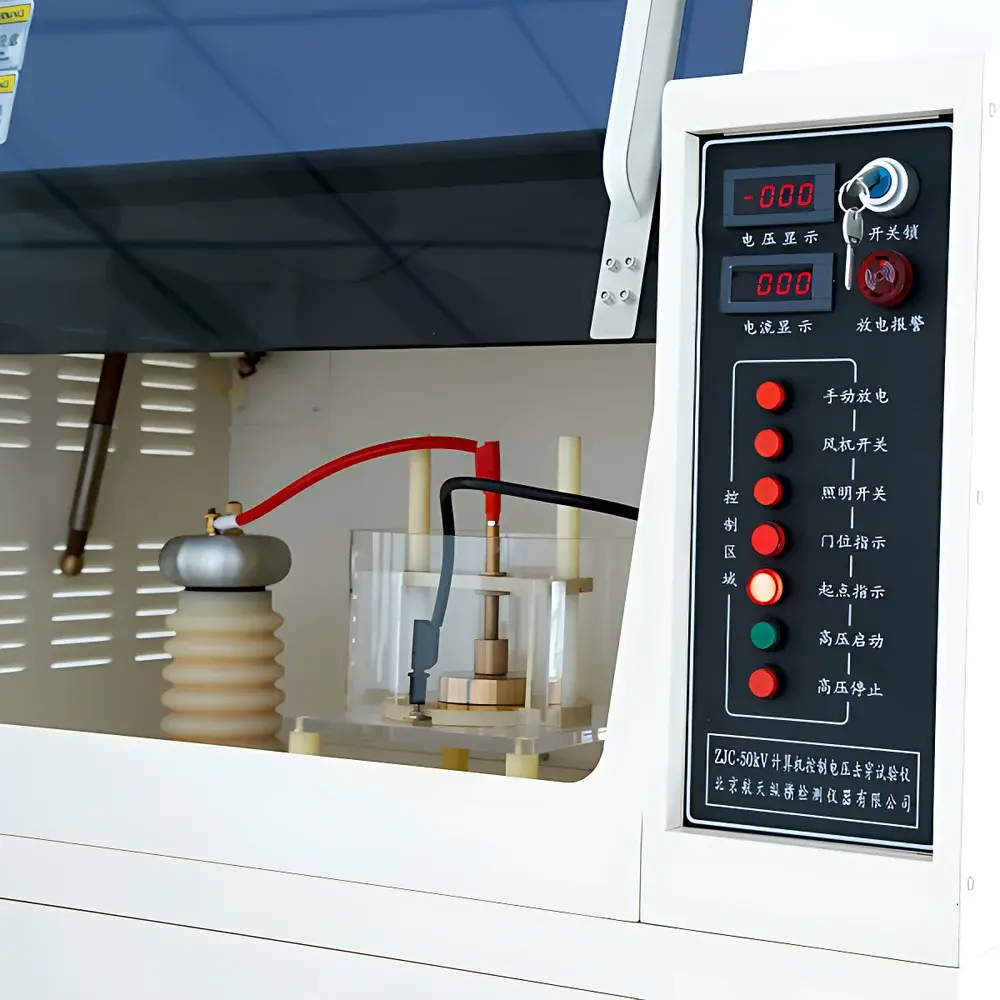
Aerospace ZJC-100KV AC/DC Dielectric Breakdown Tester
| Brand | Aerospace |
|---|---|
| Origin | Beijing, China |
| Model | ZJC-100KV |
| Maximum Output Voltage | 100 kV AC/DC |
| Voltage Accuracy | ≤ ±1% |
| Ramp Rate | 0.01–5.0 kV/s (adjustable) |
| Current Detection Threshold | 1–30 mA (configurable) |
| Trip Response Time | ≤ 0.1 s |
| Data Sampling Rate | 500 Hz |
| Test Media | Air, Insulating Oil |
| Standard Electrode Diameters | 6 mm, 25 mm, 75 mm |
| Power Rating | Up to 10 kVA |
| Hold Time Range | 0–8 h |
| Compliance | IEC 60243-1, IEC 60243-2, GB/T 1408.1, GB/T 1408.2, ASTM D149, ASTM D877 |
Overview
The Aerospace ZJC-100KV AC/DC Dielectric Breakdown Tester is an engineered high-voltage test system designed for precise determination of dielectric strength and breakdown voltage of solid and liquid insulating materials under power-frequency (50/60 Hz) conditions. It operates on the principle of controlled voltage ramping—applying a continuously increasing sinusoidal AC or steady-state DC potential across a standardized electrode configuration until electrical breakdown occurs in the specimen. The instrument captures the critical voltage at which insulation failure initiates, enabling calculation of dielectric strength (kV/mm) when normalized to sample thickness. This measurement is fundamental to evaluating material suitability for use in transformers, cables, printed circuit boards, capacitors, and high-voltage enclosures. The system complies with internationally recognized test methodologies defined in IEC 60243-1 (AC tests), IEC 60243-2 (DC tests), ASTM D149 (standard test method for dielectric breakdown voltage of solid electrical insulating materials), and GB/T 1408.1–1408.2 (Chinese national standards for electric strength testing). Its architecture integrates electromagnetic shielding, galvanic isolation, and real-time arc suppression logic to ensure measurement integrity and operator safety.
Key Features
- Programmable dual-mode output: Simultaneous AC (50/60 Hz) and DC high-voltage generation up to 100 kV, with independent control over waveform, polarity, and ramp profile.
- High-fidelity voltage regulation: Closed-loop feedback control ensures voltage accuracy within ±1% of setpoint across full range; step resolution down to 10 V for fine-tuning near breakdown thresholds.
- Adaptive ramp rate control: Adjustable linear or stepwise voltage rise (0.01–5.0 kV/s), supporting both short-time breakdown and time-lag evaluation per IEC 60243-2 Annex A.
- Dual-channel synchronized acquisition: Simultaneous sampling of voltage and leakage current at 500 Hz with low-pass filtering (cutoff: 10 kHz) to suppress RF noise from partial discharges or surface tracking.
- Multi-level hardware protection: Integrated overvoltage cutoff (±5% tolerance), overcurrent interruption (<0.1 s response), loss-of-ground detection, and interlocked enclosure monitoring compliant with IEC 61010-1 CAT III safety requirements.
- Modular electrode support: Standardized brass or stainless-steel electrodes (6 mm, 25 mm, and 75 mm diameters) conforming to IEC 60243-1 geometry specifications; optional custom fixtures available for non-standard geometries.
Sample Compatibility & Compliance
The ZJC-100KV accommodates a broad spectrum of insulating specimens—including polymer films, epoxy resins, ceramic substrates, transformer oils, silicone gels, and laminated composites—under ambient air or immersed in dielectric fluid (e.g., mineral oil per ASTM D877). Electrode configurations are selected based on material form factor and applicable standard: opposed cylinder for rigid solids, spherical-cylindrical for flexible films, and disk-disk for liquids. All test protocols adhere strictly to traceable calibration practices aligned with ISO/IEC 17025 requirements. The system supports audit-ready documentation for GLP and GMP environments, including electronic signature capability and FDA 21 CFR Part 11–compliant data logging when paired with optional software modules.
Software & Data Management
The embedded Windows-based control interface provides real-time visualization of voltage–current trajectories, automatic breakpoint detection, and configurable pass/fail criteria. Raw datasets (CSV) and annotated PDF reports—including test parameters, environmental conditions (temperature/humidity), operator ID, and timestamped event markers—are exportable via USB or Ethernet. Optional PC software enables advanced statistical analysis (Weibull distribution fitting per IEC 60243-3), batch comparison across material lots, and integration with LIMS platforms through OPC UA or RESTful API endpoints. Audit trails record all parameter modifications, test starts/stops, and calibration events with immutable timestamps.
Applications
- Material qualification: Screening candidate formulations during R&D of high-k dielectrics, nanocomposite insulators, or biodegradable polymer matrices.
- Production QC: In-line verification of batch-to-batch consistency for cable jacketing compounds, PCB prepregs, or potting resins against internal specification limits.
- Failure analysis: Correlating breakdown location (via post-test optical inspection) with microstructural defects observed via SEM or FTIR.
- Standards validation: Supporting third-party certification labs in performing accredited testing per UL 746, CSA C22.2 No. 0.3, or EN 60601-1 dielectric withstand requirements.
- Academic research: Teaching core concepts of Townsend discharge, streamer propagation, and thermal runaway mechanisms in undergraduate and graduate laboratories.
FAQ
What standards does the ZJC-100KV support for AC and DC breakdown testing?
It fully implements IEC 60243-1 (AC), IEC 60243-2 (DC), ASTM D149, ASTM D877, GB/T 1408.1, and GB/T 1408.2.
Can the system perform step-stress or hold-time testing?
Yes—users may define multi-step voltage profiles with programmable dwell times ranging from 1 second to 8 hours at any voltage level.
Is remote operation supported?
Ethernet connectivity enables secure remote monitoring and control via standard web browser or dedicated client application.
How is calibration maintained?
Voltage and current channels are calibrated using NIST-traceable reference dividers and shunts; annual recalibration is recommended and documented in accordance with ISO/IEC 17025.
Does the system include safety interlocks for operator protection?
Yes—interlocked access doors, emergency stop circuits, ground-fault detection, and automatic discharge sequencing after test completion are all hardwired into the control architecture.



