
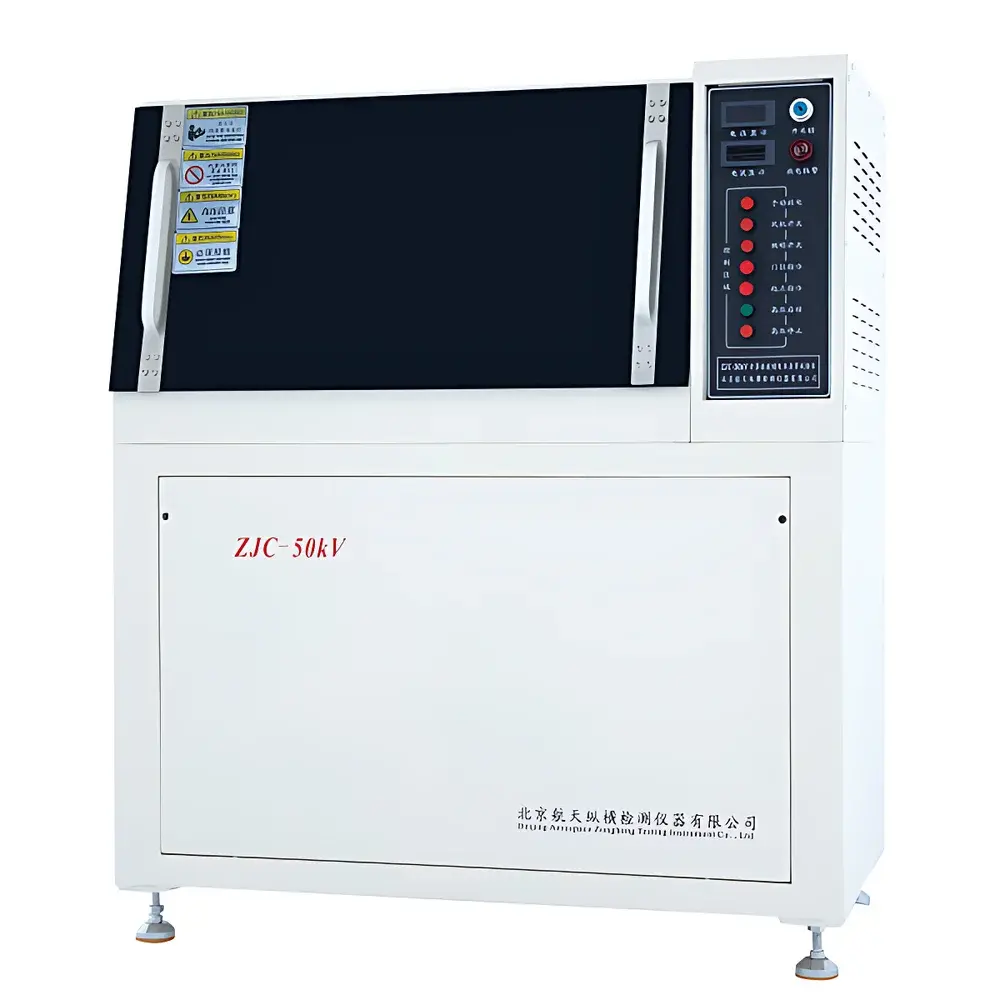
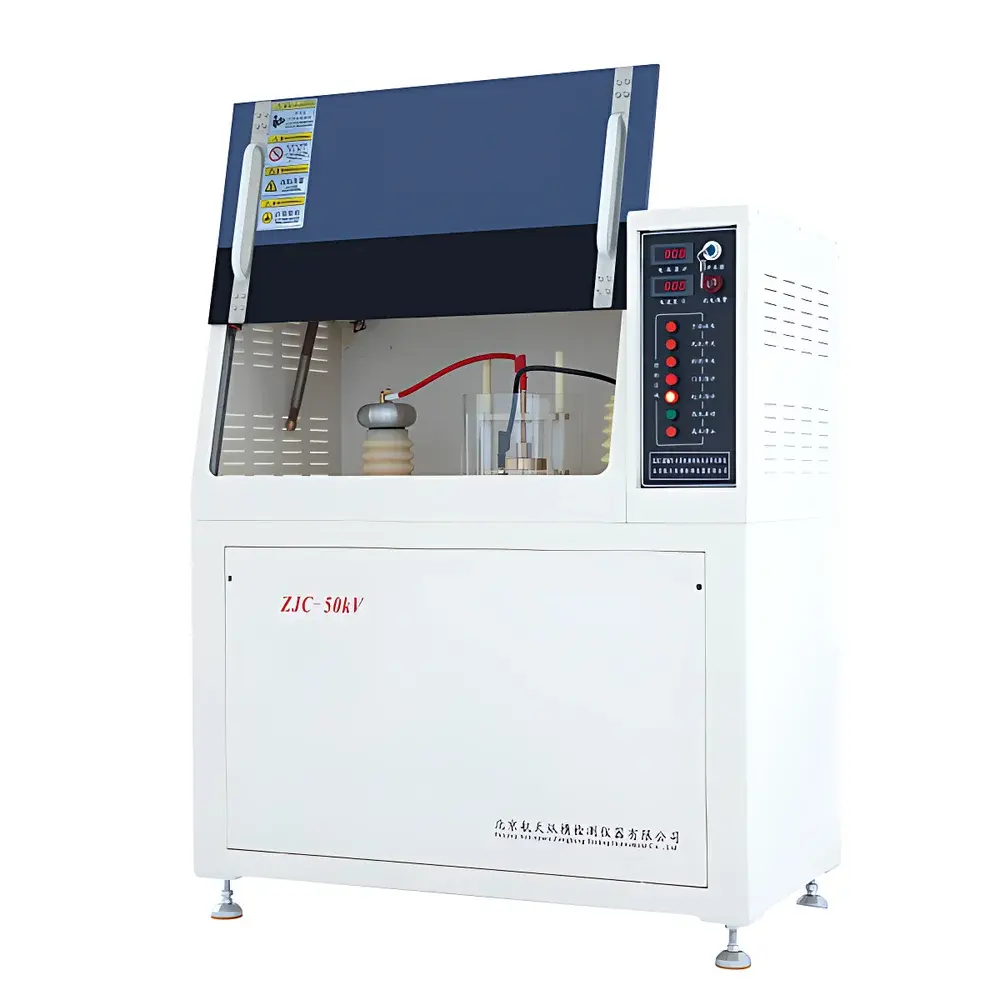
Aerospace ZJC-100KV Computer-Controlled Voltage Breakdown Tester / Dielectric Strength Tester
| Brand | Aerospace |
|---|---|
| Origin | Beijing, China |
| Model | ZJC-100KV |
| Max Output Voltage | 100 kV AC/DC |
| Voltage Measurement Range | 0–100 kV (AC/DC) |
| Voltage Accuracy | ±1.5% (10–100% of full scale) |
| Rise Rate Adjustment | 0.1–3 kV/s (continuously variable, no gear shifting) |
| Test Modes | Ramp-up, Step-up, and Hold (with programmable dwell time up to 4 h, extendable per DIN/VDE/IEC conventions) |
| Power Rating | 10 kVA |
| Overcurrent Protection | 1–30 mA (software-configurable) |
| Safety Features | Nine-level interlock system including overvoltage cutoff, door interlock, automatic discharge post-test, zero-voltage reset, independent grounding, short-circuit detection, and software operation validation |
| Dimensions (L×W×H) | 2100 × 1500 × 2100 mm |
| Net Weight | 1800 kg |
| Compliance | GB 1408.1–2006, GB 1408.2–2006, GB/T 1695–2005, ASTM D149, GB/T 3333, GB/T 12656, HG/T 3330 |
Overview
The Aerospace ZJC-100KV Computer-Controlled Voltage Breakdown Tester is an industrial-grade dielectric strength measurement system engineered for high-reliability evaluation of solid insulating materials under alternating or direct voltage stress. It operates on the fundamental principle of controlled voltage ramping until electrical breakdown occurs—defined as the point at which a material transitions from insulator to conductor under applied electric field. This event is detected via rapid current surge, triggering immediate power cutoff and data capture. The instrument delivers precise, repeatable determination of dielectric breakdown voltage (kV), dielectric strength (kV/mm), and time-lag to failure under sustained voltage (dielectric endurance). Designed for compliance with international test standards—including ASTM D149, IEC 60243-1, and GB 1408 series—the ZJC-100KV supports both research-grade characterization and quality control in production environments across electrical insulation manufacturing, polymer R&D, and cable/wire component certification.
Key Features
- Full computer integration with real-time acquisition and dynamic curve visualization: voltage vs. time, current vs. time, and derivative dI/dt traces—all overlayable in multi-color mode for comparative analysis.
- Three standardized test protocols: continuous ramp-up (linear voltage rise), stepwise voltage increment (with user-defined dwell intervals), and constant-voltage hold (programmable duration up to 4 hours; configurable for extended durations per DIN EN 60243-2 or VDE 0303 Part 1).
- Software-configurable overcurrent threshold (1–30 mA), enabling tailored sensitivity for low-conductivity ceramics versus high-dielectric-loss composites.
- Nine-layer hardware and firmware safety architecture: includes dual-channel overvoltage monitoring, electromagnetic door interlock, post-test automatic discharge circuitry (<5 s residual voltage <50 V), zero-voltage startup enforcement, redundant grounding paths, and software-based operational validation to prevent misconfigured tests.
- High-stability high-voltage generator with 10 kVA capacity and <±1.5% measurement uncertainty across 10–100% of full scale—traceable to national metrology institutes per ISO/IEC 17025 requirements.
- Continuous-duty thermal management system permitting uninterrupted operation over 8-hour shifts without derating or forced cooldown cycles.
Sample Compatibility & Compliance
The ZJC-100KV accommodates flat, rigid, and laminated specimens up to 200 mm × 200 mm × 50 mm (custom electrode fixtures available for cylindrical or irregular geometries). Compatible material classes include thermosetting resins (epoxy, phenolic), reinforced plastics (GFRP, CFRP), ceramic substrates, glass insulators, elastomeric compounds (silicone rubber, EPDM), impregnated papers (cable paper, capacitor paper), and varnish-coated films. All test methodologies adhere strictly to harmonized regulatory frameworks: GB 1408.1–2006 (equivalent to IEC 60243-1), GB 1408.2–2006 (DC-specific requirements aligned with IEC 60243-2), ASTM D149 (standard test method for dielectric breakdown voltage of solid electrical insulating materials at commercial power frequencies), and HG/T 3330 (coating film breakdown assessment). Instrument design incorporates traceable calibration pathways supporting GLP/GMP audit readiness and FDA 21 CFR Part 11-compliant electronic records when paired with validated laboratory information management systems (LIMS).
Software & Data Management
Built on a Windows-based platform, the proprietary test control software provides full I/O mapping, scriptable test sequences, and audit-trail-enabled operation logs. Raw voltage, current, and time stamps are acquired at ≥10 kHz sampling rate and stored in binary-encoded .DAT files with embedded metadata (operator ID, sample ID, environmental conditions, calibration certificate IDs). Export modules support direct conversion to CSV, Excel (.xlsx), and Word (.docx) formats—with customizable report templates meeting internal SOPs or external submission requirements (e.g., UL, TÜV, CNAS). All modifications to raw datasets are logged with timestamp, user credential, and reason code—ensuring ALCOA+ data integrity principles (Attributable, Legible, Contemporaneous, Original, Accurate, Complete, Consistent, Enduring, Available). Software updates follow a formal change control process compliant with ISO 13485 Annex C for medical device-related applications.
Applications
- Qualification testing of high-voltage bushings, transformer barriers, and switchgear insulation components.
- Development and specification verification of aerospace-grade polyimide films and ceramic matrix composites.
- QC release testing for automotive EV battery module encapsulants and busbar coatings.
- Accelerated aging studies correlating dielectric strength degradation with thermal cycling, humidity exposure, or partial discharge history.
- Comparative screening of nanofiller-modified polymers (e.g., SiO₂-, Al₂O₃-, or BN-loaded epoxies) for enhanced tracking resistance.
- Failure analysis root-cause investigation in field-failed insulators using reverse-engineered test profiles.
FAQ
What standards does the ZJC-100KV fully support for dielectric breakdown testing?
It natively implements GB 1408.1–2006, GB 1408.2–2006, ASTM D149, GB/T 1695–2005, GB/T 3333, GB/T 12656, and HG/T 3330—with firmware-calibrated waveform fidelity matching standard-specified rise times and harmonic content.
Can the instrument perform both AC and DC breakdown tests within a single session?
Yes—dual-mode HV output enables seamless switching between sinusoidal 50 Hz AC and ripple-free DC without hardware reconfiguration; polarity reversal is software-commanded and automatically verified pre-test.
Is the system suitable for use in Class 1000 cleanroom environments?
The main unit meets IP2X enclosure rating; optional stainless-steel housing and HEPA-filtered internal cooling airflow kits are available for ISO 14644-1 Class 6 (1000) integration.
How is calibration traceability maintained?
Each unit ships with a factory calibration certificate accredited to ISO/IEC 17025, referencing NIM (National Institute of Metrology, China) primary standards; annual recalibration services include full HV chain verification (transformer, divider, meter, shunt) and safety interlock functional testing.
Does the software support networked deployment across multiple instruments?
Yes—the central server edition enables synchronized scheduling, centralized database archiving, role-based access control (RBAC), and cross-instrument statistical process control (SPC) charting via ODBC-compliant SQL backend.



