
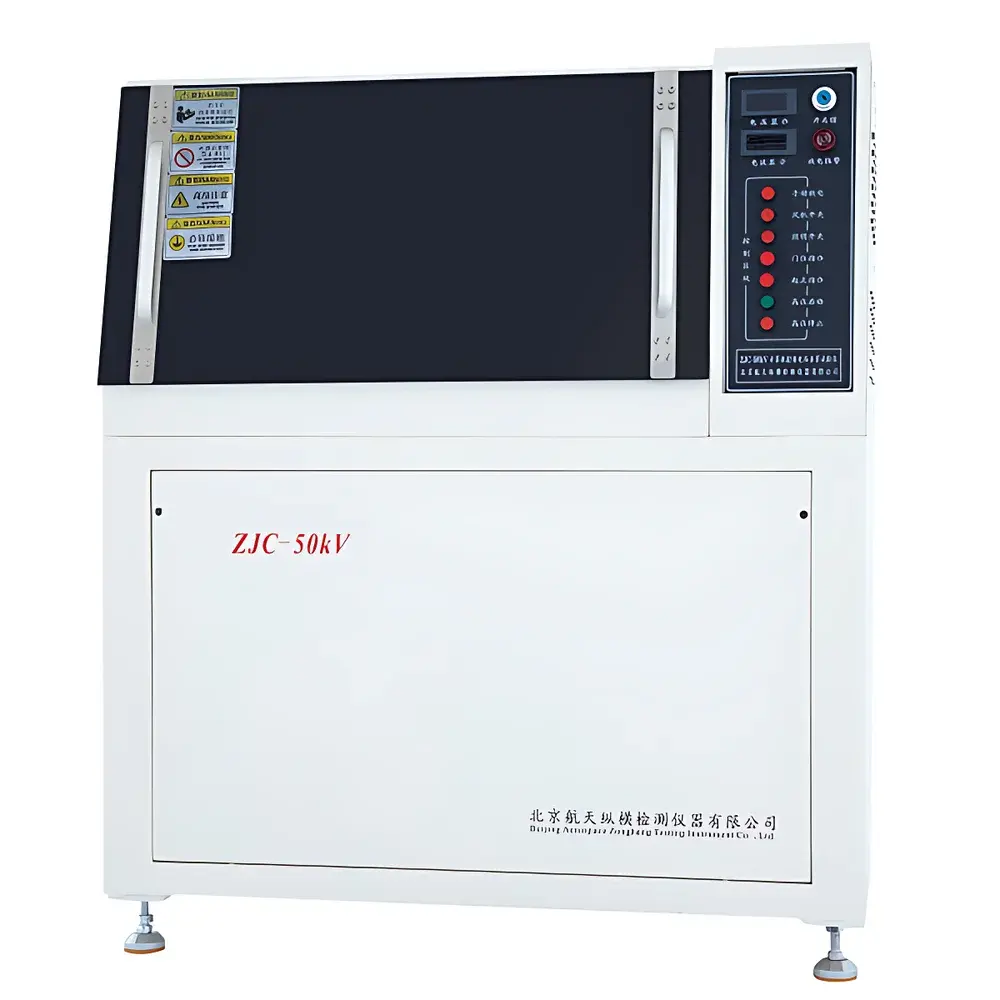
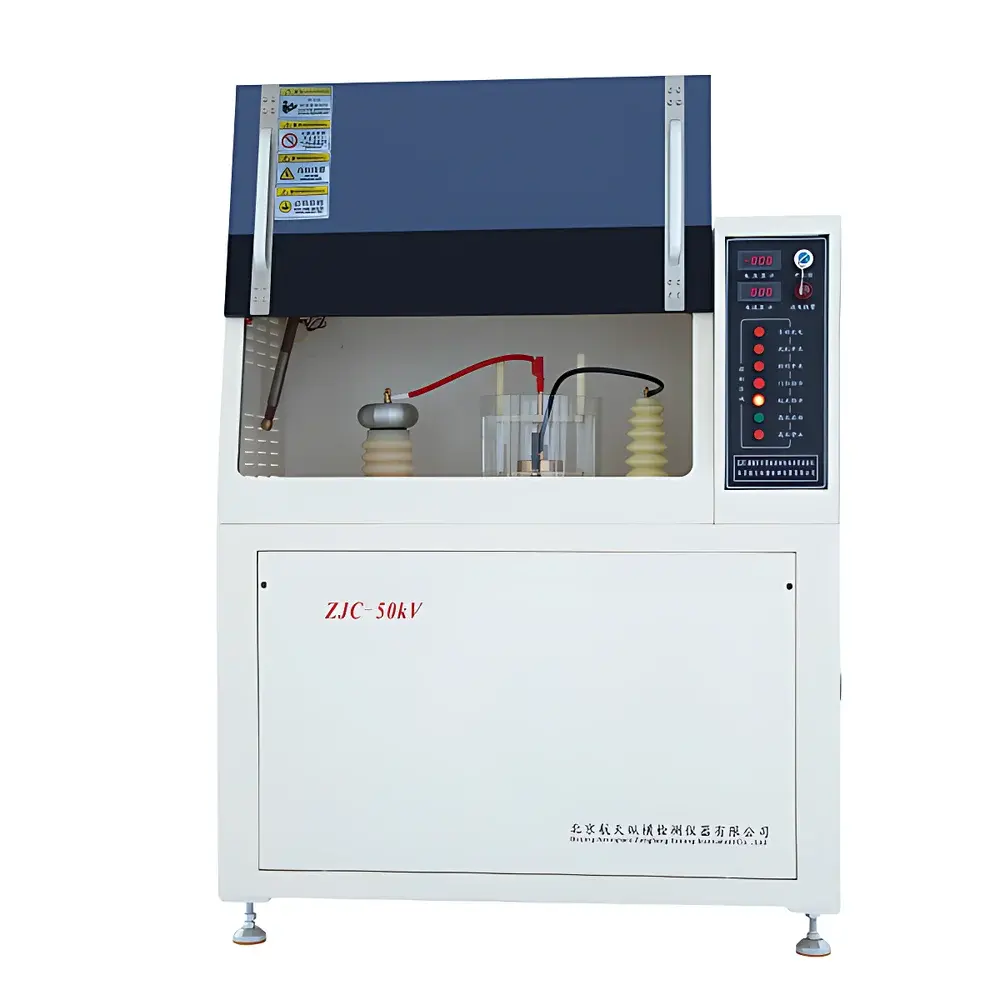
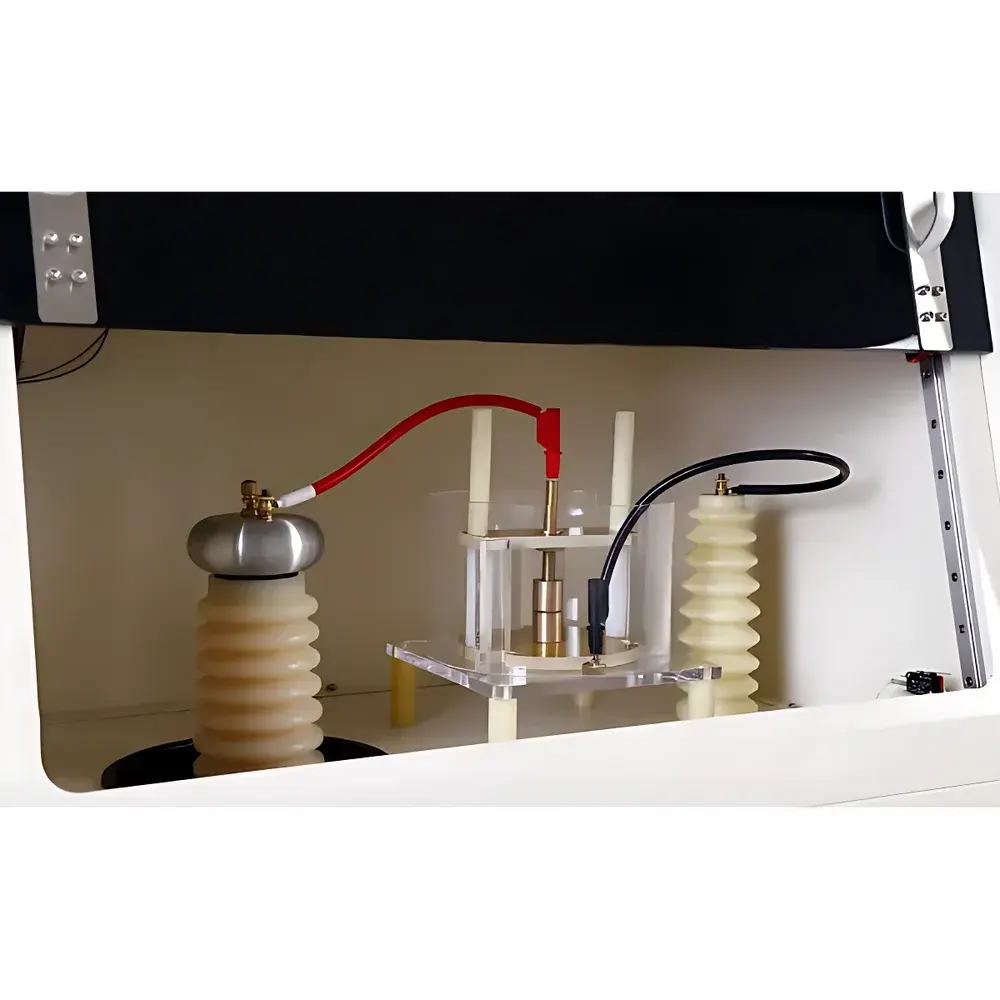
Aerospace ZJC-100KV Dielectric Strength Tester / Electrical Breakdown Voltage Tester
| Brand | Aerospace |
|---|---|
| Origin | Beijing, China |
| Model | ZJC-100KV |
| Maximum Output Voltage | 100 kV |
| Compliance | GB/T 1408.1–2016, IEC 60243-1, ASTM D149 |
| Test Modes | Short-time, Stepwise (20 s/60 s), Ramp (120–600 s), Proof Testing |
| Electrode Configurations | Coaxial cylindrical, spherical, parallel plate, rod-to-rod, foil-wrapped tubular, and custom fixtures per ISO/IEC standards |
| Voltage Regulation Accuracy | ≤ ±2% of set value |
| Rise Time Control | Adjustable from 1 V/s to 5000 V/s |
| Measurement Uncertainty | ≤ ±3% (kV), traceable to national metrology standards |
| Safety Interlocks | Dual-channel overcurrent cutoff (<5 ms response), ground-fault detection, door-activated HV disable, arc-quenching chamber |
Overview
The Aerospace ZJC-100KV Dielectric Strength Tester is a precision-engineered high-voltage test system designed for the quantitative determination of dielectric breakdown voltage and electrical strength of solid insulating materials under AC power-frequency conditions (48–62 Hz). It operates on the principle of controlled voltage ramping across standardized electrode configurations, inducing controlled electrical stress until catastrophic insulation failure—manifested as a rapid current surge and voltage collapse—occurs. This event, defined per GB/T 1408.1–2016 and aligned with IEC 60243-1 and ASTM D149, provides a reproducible metric for material qualification, process validation, and comparative analysis of insulating performance. The instrument is not intended for liquid or gaseous media testing but supports immersion in dielectric fluids—including transformer oil (IEC 60296-compliant), silicone oil, or inert gas environments—when evaluating solid specimens such as polymer films, laminates, molded resins, elastomeric tubing, and rigid composites. Its 100 kV DC/AC output capability enables evaluation of high-performance engineering plastics, aerospace-grade composites, and high-voltage cable insulation systems where conventional 50 kV testers reach operational limits.
Key Features
- High-stability 100 kV high-voltage generator with digitally regulated output, featuring <1% ripple and linearity maintained across full load range
- Multi-mode voltage application: short-time (10–20 s), stepwise (20 s/60 s per increment), continuous ramp (120–600 s), and proof-test protocols per GB/T 1408.1–2016 Annexes A–D
- Modular electrode platform supporting six standardized configurations: coaxial cylinders (25/75 mm), spherical electrodes (12.5 mm & 20 mm), parallel plates (100 × 25 mm), rod-to-rod (6 mm diameter), foil-wrapped tubular fixtures, and custom-machined holders for irregular geometries
- Integrated real-time monitoring: simultaneous acquisition of applied voltage (±3% accuracy), leakage current (0.1–100 mA range), and breakdown timing resolution <10 µs
- Dual-redundant safety architecture: hardware-based overcurrent cutoff (<5 ms), interlocked test chamber access, grounded arc containment enclosure, and automatic discharge circuitry compliant with IEC 61010-1 CAT III
- Temperature- and humidity-stabilized test environment compatibility: supports integration with climate chambers (−40 °C to +150 °C) and desiccated glove boxes for preconditioned specimen evaluation per GB/T 10580–2003
Sample Compatibility & Compliance
The ZJC-100KV accommodates specimens conforming to ISO 293, ISO 294-1/3, ISO 295, ISO 10724, GB/T 7113.2–2005, and GB/T 1981.2–2003 dimensional requirements. It validates electrical strength of thermoplastics (e.g., polyimide, PEEK), thermosets (epoxy, phenolic), elastomers (silicone rubber, EPDM), laminates (G10/FR4), paper-based insulation, and filled compounds (silicone gels, potting resins). All electrode assemblies are machined from passivated stainless steel to minimize oxidation-induced measurement drift and ensure repeatable contact geometry. The system complies with mandatory safety and metrological requirements of GB/T 1408.1–2016 (equivalent to IEC 60243-1:2013), ASTM D149–13, and supports audit-ready documentation for GLP/GMP-regulated environments. Calibration certificates are traceable to CNAS-accredited laboratories and include uncertainty budgets per ISO/IEC 17025.
Software & Data Management
The embedded Windows-based control software provides ISO/IEC 17025-aligned data integrity: all test parameters (voltage ramp rate, electrode type, ambient T/RH, specimen thickness), raw acquisition traces (V-t, I-t), and operator annotations are time-stamped and cryptographically hashed upon save. Audit trails record user login/logout events, parameter modifications, and report generation history. Export formats include CSV (for statistical analysis in JMP or Minitab), PDF/A-2b (archival), and XML (LIMS integration). Electronic signatures comply with FDA 21 CFR Part 11 when configured with PKI authentication and role-based access control. Batch reporting automates calculation of median dielectric strength (kV/mm), coefficient of variation (%), and outlier identification per ISO 5725-2.
Applications
This tester serves critical quality assurance functions across aerospace, power transmission, medical device manufacturing, and electric vehicle supply chains. It verifies insulation integrity of motor windings and battery module separators; qualifies encapsulants for high-density PCBs operating at >1 kV; screens polymer substrates for flexible high-voltage sensors; and validates thermal aging resistance of cable jacketing exposed to partial discharge. In R&D labs, it enables structure-property correlation studies—e.g., quantifying how nanofiller dispersion (SiO₂, Al₂O₃) influences breakdown threshold in epoxy nanocomposites—or assessing moisture absorption effects on aramid fiber-reinforced laminates per IEC 60270 pre-conditioning protocols. Its modular design allows adaptation to customer-specific fixtures for non-standard components such as busbar coatings or semiconductor package underfills.
FAQ
What standards does the ZJC-100KV fully support?
It implements GB/T 1408.1–2016 (identical to IEC 60243-1:2013) and ASTM D149–13 for dielectric breakdown testing. Full compliance includes electrode geometry tolerances, voltage waveform fidelity (peak-to-RMS ratio = √2 ±5%), and environmental conditioning requirements.
Can it perform tests in air, oil, and inert gas environments?
Yes—the test chamber accepts optional environmental adapters: oil-immersion tanks (with IEC 60296-compliant transformer oil), nitrogen-purged enclosures, and heated air chambers meeting GB/T 1408.1 Section 7.1 specifications.
How is measurement traceability ensured?
Each unit ships with a factory calibration certificate referencing CNAS-accredited primary standards. Voltage transducers are recalibrated annually using Fluke 7512A dividers; current sensors are verified against Keysight B2912B source-measure units.
Is automated data export compatible with LIMS or ERP systems?
Yes—XML schema definitions are provided for seamless integration with LabWare LIMS, SAP QM, and TrackWise. Custom API endpoints support RESTful data ingestion into internal QA databases.
What safety certifications apply to this instrument?
It meets IEC 61010-1:2010 (Measurement Category III, Pollution Degree 2), GB 4793.1–2007, and carries CE marking under the Low Voltage Directive (2014/35/EU) and EMC Directive (2014/30/EU).



