
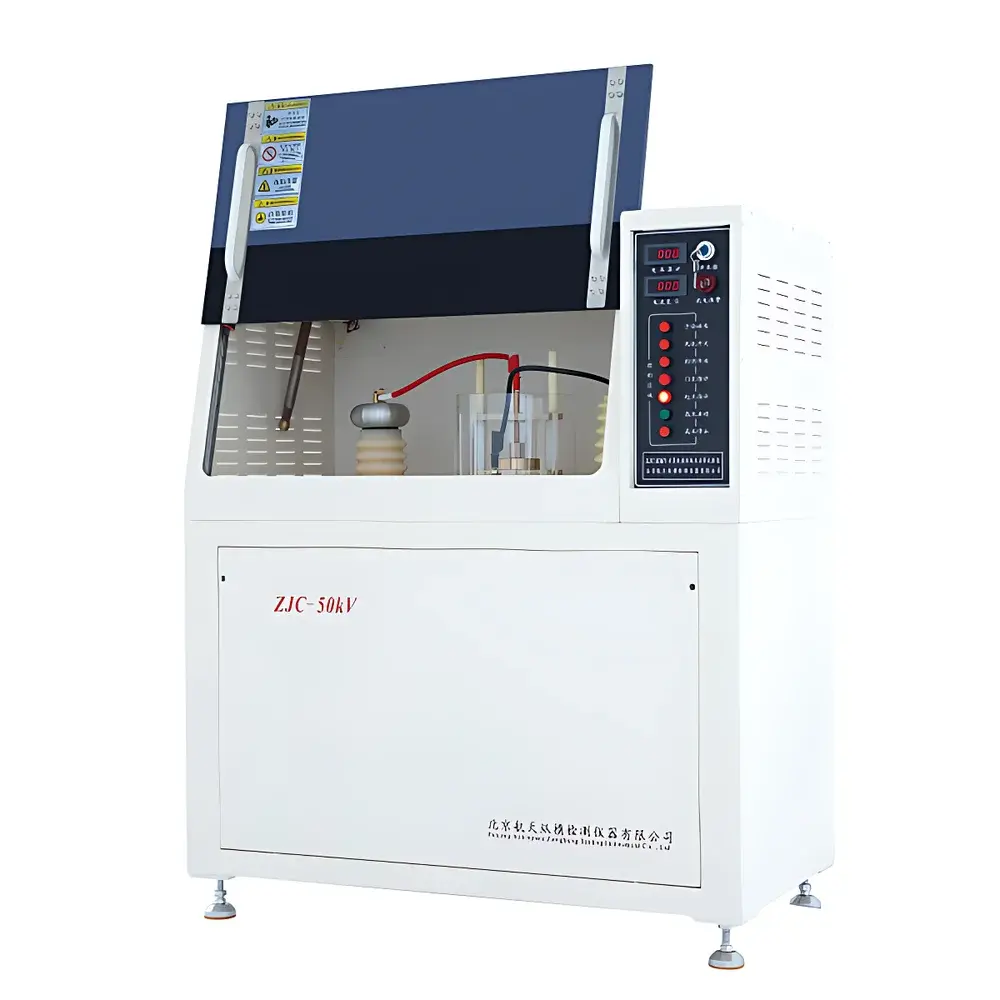
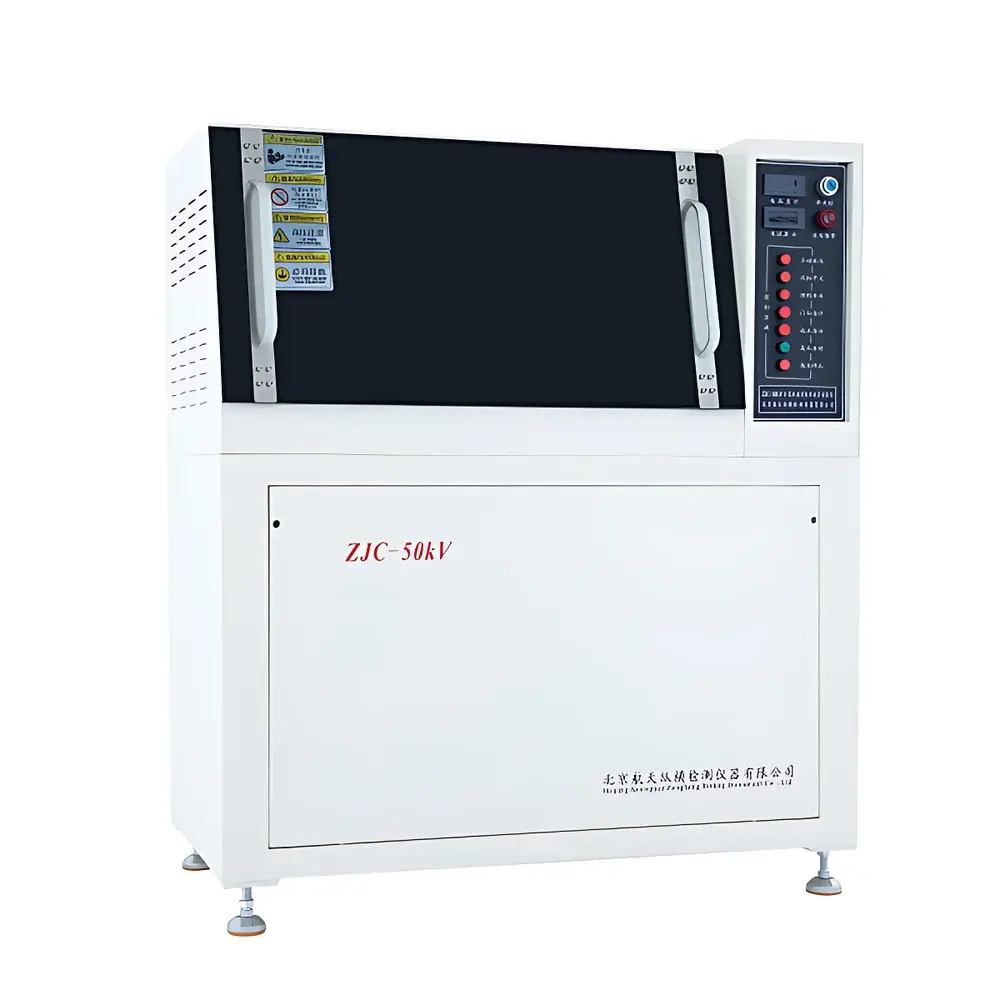
Aerospace ZJC-100KV High-Voltage Dielectric Breakdown Tester
| Brand | Aerospace |
|---|---|
| Origin | Beijing, China |
| Model | ZJC-100KV |
| Output Voltage | AC/DC 0–100 kV |
| Output Power | 5 kVA |
| Voltage Measurement Accuracy | ≤ ±2% |
| Ramp Rate | 0.1–10 kV/s |
| Withstand Test Voltage Range | 10–100 kV (continuously adjustable) |
| Withstand Duration | 0–4 h (no-current condition) |
| Input | 220 V ±10%, 50 Hz ±1% |
| Dimensions (L×W×H) | 700 × 800 × 1650 mm |
| Weight | 100 kg |
| Operating Temperature | 15–30 °C |
| Relative Humidity | 30–85% RH |
| Grounding Resistance Requirement | ≤ 4 Ω |
| Short-Circuit & Overcurrent Protection Response Time | ≤ 0.1 s |
| Compliance | GB 1408.1–2006, GB 1408.2–2006, GB/T 1695–2005, ASTM D149 |
Overview
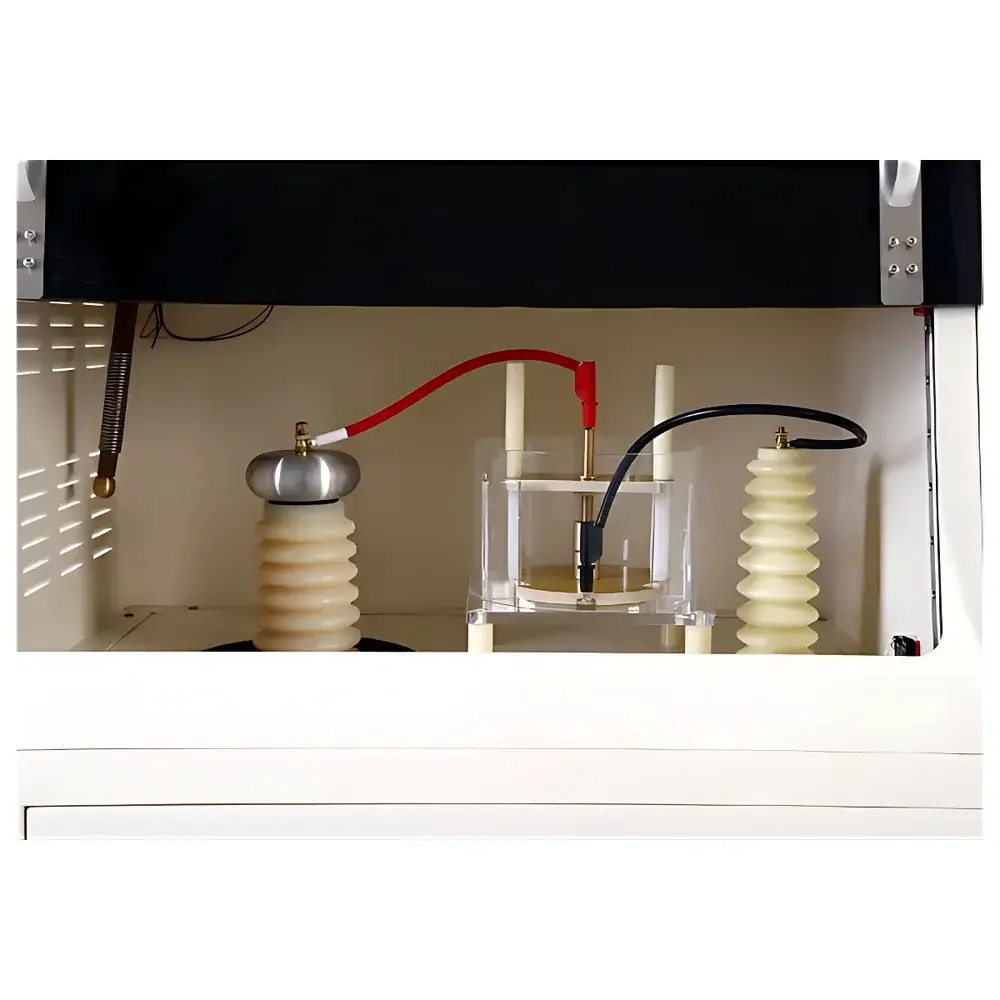
The Aerospace ZJC-100KV High-Voltage Dielectric Breakdown Tester is a precision-engineered system designed for evaluating the dielectric strength and voltage withstand performance of solid insulating materials under controlled AC or DC high-voltage stress. It operates on the principle of controlled voltage ramping until electrical breakdown occurs—defined as the onset of sustained current conduction across the specimen—enabling quantitative determination of dielectric breakdown voltage (kV) and time-lag to failure under specified test conditions. The instrument implements standardized electrode configurations (e.g., spherical, cylindrical, or parallel-plate per IEC 60243 and ASTM D149) within a shielded test chamber, minimizing electromagnetic interference and ensuring measurement repeatability. Its architecture integrates a high-stability 5 kVA high-voltage transformer, digitally regulated voltage ramp control, real-time current monitoring, and automatic circuit interruption upon breakdown detection—meeting core functional requirements for laboratory-grade dielectric characterization in R&D, quality assurance, and regulatory compliance testing.
Key Features
- Full-range AC/DC output capability up to 100 kV with programmable ramp rates from 0.1 to 10 kV/s, supporting both step-stress and continuous ramp test protocols.
- Dual-mode operation: automated dielectric breakdown testing and timed voltage withstand evaluation (0–4 hours), with real-time current threshold monitoring to detect incipient conduction prior to catastrophic failure.
- Integrated six-level safety interlock system including main power disconnect, keyed high-voltage isolation switch, test chamber door safety switch, autoreturn voltage regulator, input-side current-limiting breaker, and residual-current device—ensuring strict adherence to IEC 61010-1 and GB/T 38035–2019 safety standards.
- Automatic discharge circuitry with dual redundancy: post-test DC discharge activation upon chamber opening, plus optional manual grounding rod for emergency discharge during unexpected power loss.
- Computer-controlled data acquisition with ≥1 kHz sampling resolution; dynamic real-time plotting of voltage, current, and time curves with multi-color overlay for comparative analysis across multiple specimens or test conditions.
- Configurable pass/fail criteria based on pre-set current thresholds (e.g., 10 mA, 20 mA), enabling customizable evaluation of partial discharge inception or leakage current divergence prior to full breakdown.
- Robust mechanical construction with dedicated earth-ground interface (≤4 Ω resistance required), EMI-shielded enclosure, and thermal management for uninterrupted operation under continuous duty cycles.
Sample Compatibility & Compliance
The ZJC-100KV accommodates standardized flat-sheet, molded, or cast specimens (per ASTM D149 thickness range: 0.1–6.0 mm; GB 1408.1 minimum area: 25 cm²) across diverse material classes—including thermoset resins, epoxy coatings, silicone elastomers, polyimide films, ceramic substrates, glass insulators, and fiber-reinforced composites. Electrode assemblies (included: three sets of brass electrodes conforming to ASTM D149 Type 1 and Type 2 geometry) support surface resistivity assessment and volume conductivity evaluation when paired with optional guarded electrode fixtures. All test procedures align with internationally recognized standards: GB 1408.1–2006 (AC dielectric strength), GB 1408.2–2006 (DC-specific methodology), GB/T 1695–2005 (vulcanized rubber), and ASTM D149–2022 (industrial frequency dielectric breakdown). The system supports audit-ready documentation per GLP and ISO/IEC 17025 requirements, with timestamped test logs, operator ID tagging, and immutable parameter records.
Software & Data Management
Bundled Windows-based test software provides intuitive GUI-driven test setup, real-time visualization, and traceable data handling. Users define voltage profiles (linear, stepwise, or custom waveform), configure safety limits, assign sample IDs, and select reporting templates compliant with internal QA workflows or external regulatory submissions. All raw data—including voltage, current, time stamps, ramp rate, and breakdown event markers—are stored in encrypted binary format with SHA-256 checksum integrity verification. Export functions support CSV, Excel (.xlsx), and Word (.docx) formats for integration into LIMS or statistical process control platforms. Audit trail functionality logs user actions, parameter changes, and system events with ISO/IEC 17025-compliant metadata (e.g., calibration status, environmental readings, operator signature). Software complies with FDA 21 CFR Part 11 requirements for electronic records and signatures when configured with user authentication and role-based access control.
Applications
- Qualification testing of insulation systems in aerospace wiring harnesses, motor windings, and PCB substrates per MIL-STD-202 and DO-160 Section 20.
- QC release testing of batch-produced polymer films, encapsulants, and potting compounds against IPC-CC-830B and UL 746E specifications.
- Research into nanocomposite dielectrics, where breakdown field strength and statistical lifetime distributions inform material design rules.
- Accelerated aging studies correlating dielectric performance degradation with thermal cycling, humidity exposure, or partial discharge history.
- Validation of conformal coatings and underfill materials used in high-reliability electronics for automotive ADAS and medical implantable devices.
- Support for third-party certification labs performing CB Scheme testing to IEC 60664-1 (insulation coordination) and IEC 60950-1 (IT equipment safety).
FAQ
What voltage accuracy and stability does the ZJC-100KV guarantee during extended withstand tests?
The system maintains output voltage stability within ±2% of setpoint over 4-hour continuous operation, verified via calibrated HV divider and NIST-traceable reference meters. Line regulation is ≤0.5% for ±10% input voltage fluctuation.
Can the instrument perform step-stress testing with automatic voltage hold and dwell time control?
Yes—software-defined test sequences support multi-step voltage holds (0.1–3600 s per step), automatic ramp-to-hold transitions, and conditional branching based on real-time current response.
Is the test chamber oil-filled, and what dielectric fluid options are supported?
The standard configuration includes a single oil cup (ASTM D877-compliant mineral oil); optional upgrade supports silicone oil (for higher flash point) or synthetic ester fluids per IEC 61099.
How is data integrity ensured during power interruption or system crash?
Non-volatile memory buffers all active test data; upon restart, the software resumes logging from last valid timestamp and flags any gap in acquisition for review.
Does the system meet electromagnetic compatibility (EMC) requirements for installation in shared laboratory environments?
Yes—it complies with EN 61326-1:2013 (industrial EMC) and incorporates ferrite-core filtering, shielded cabling, and grounded chassis design to limit radiated emissions below Class B limits.



