
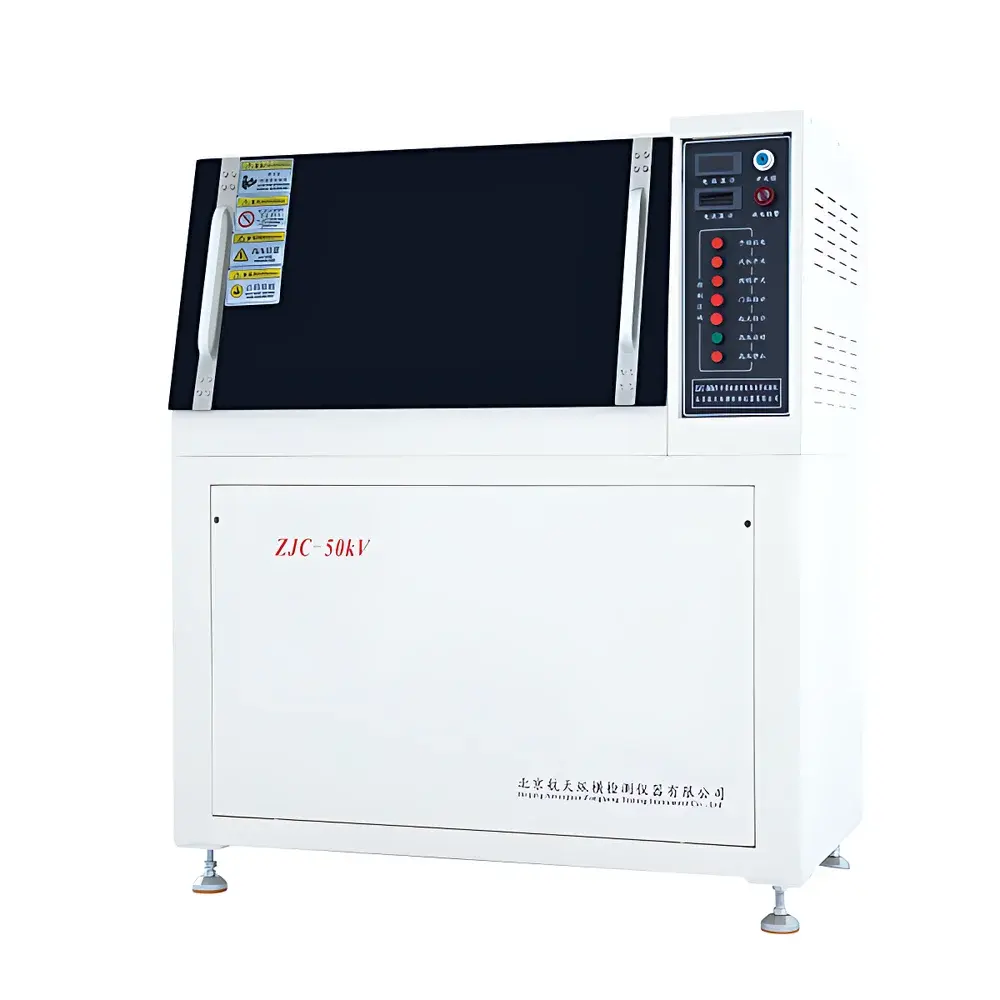
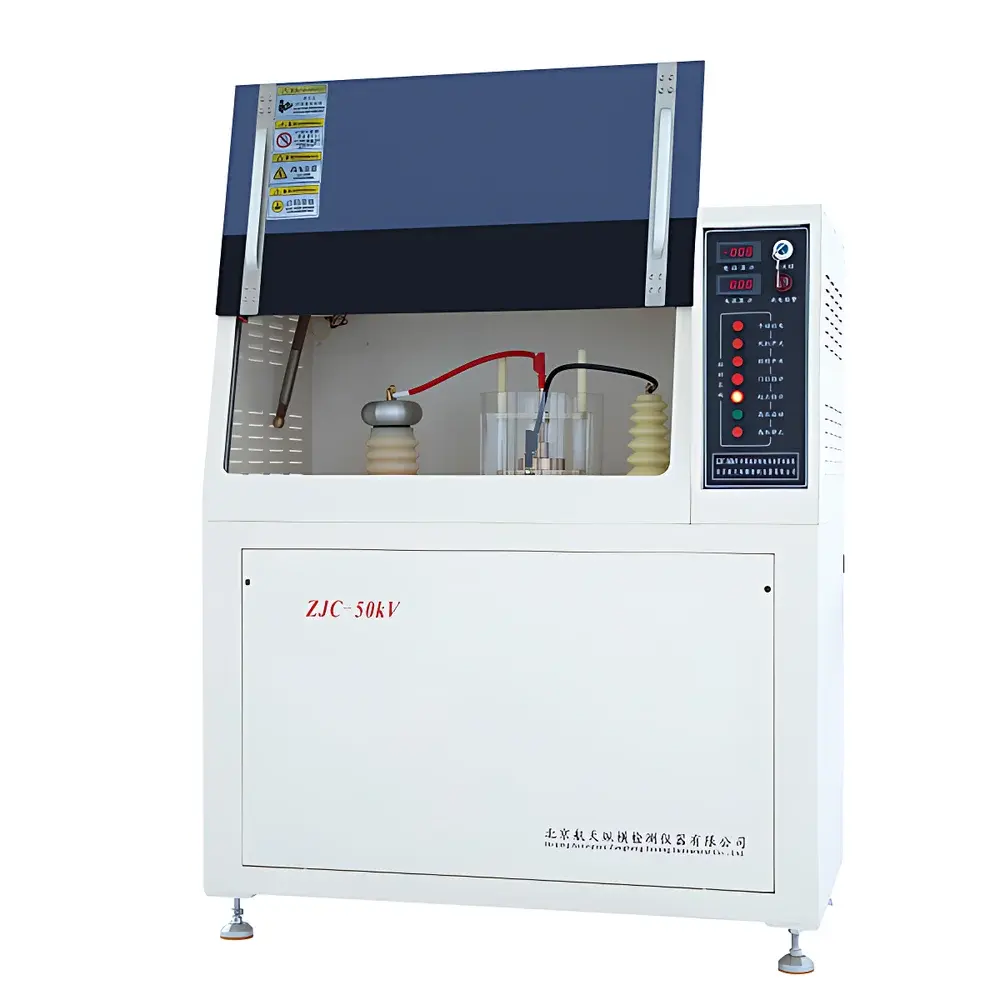
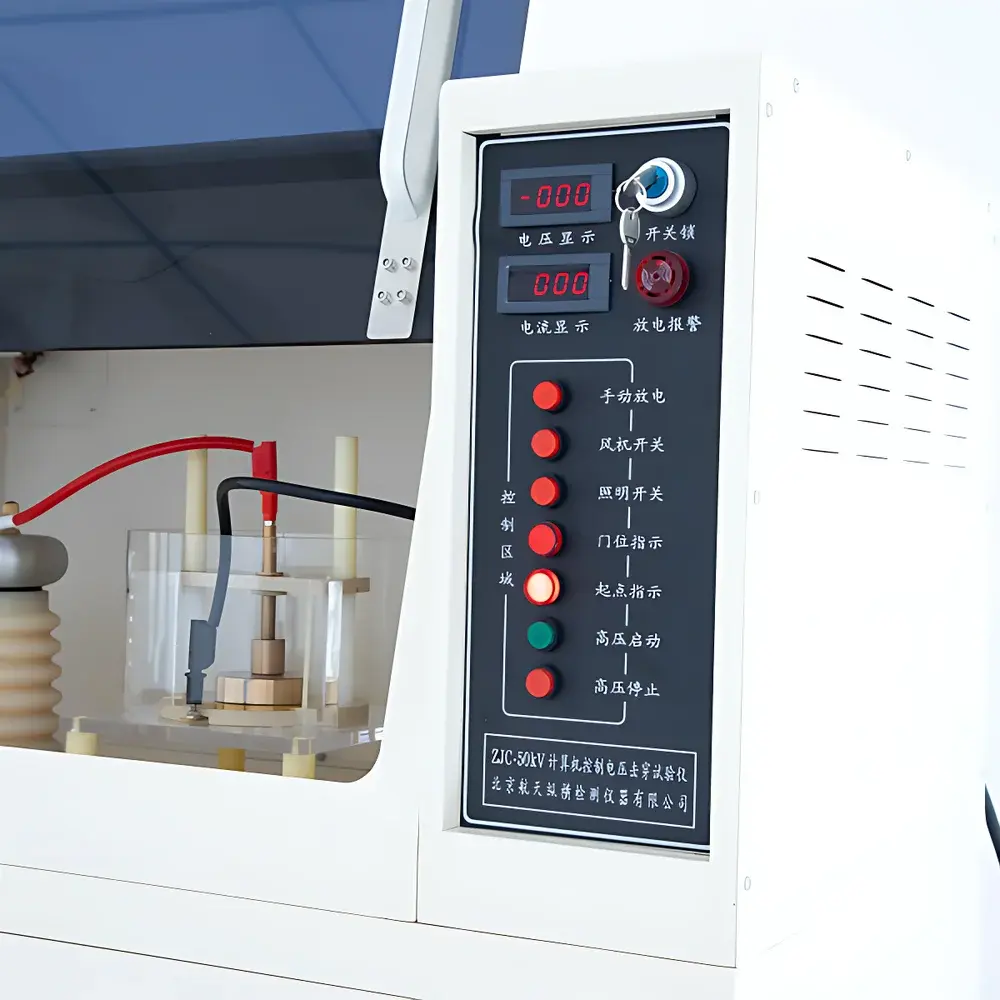
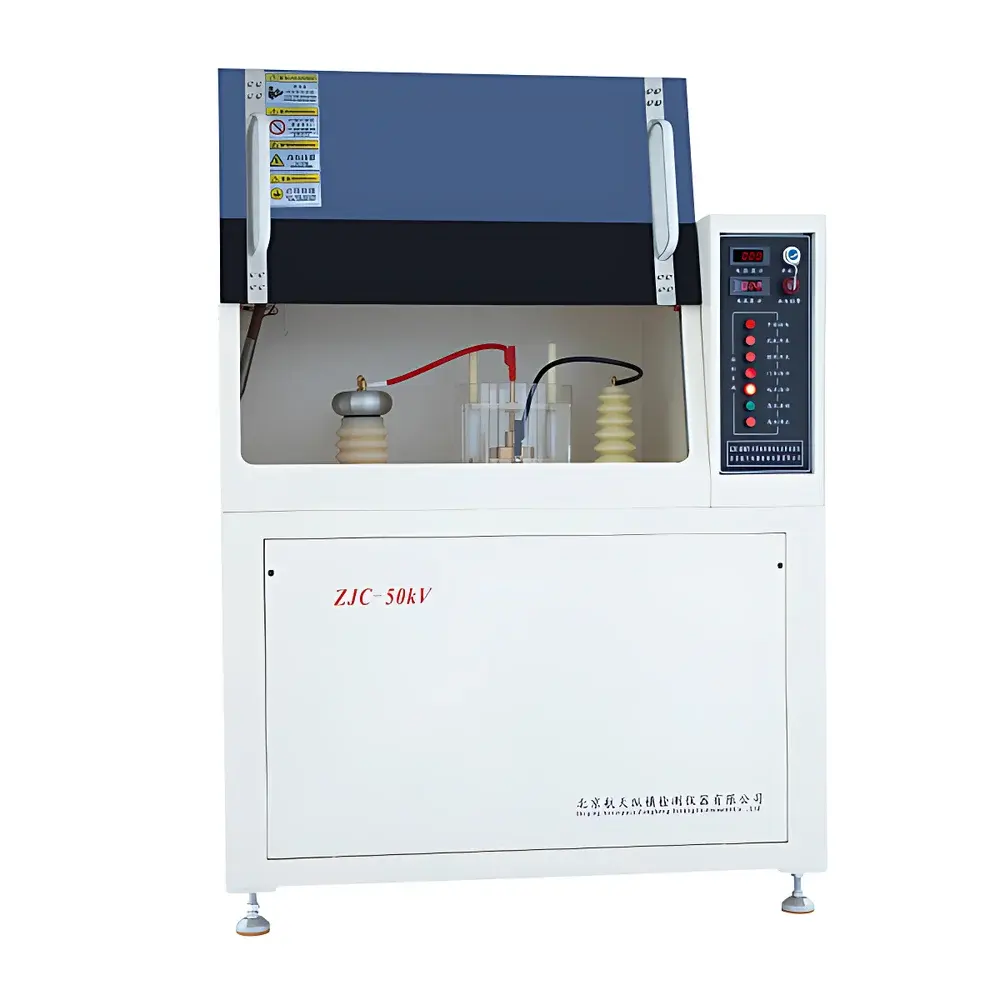
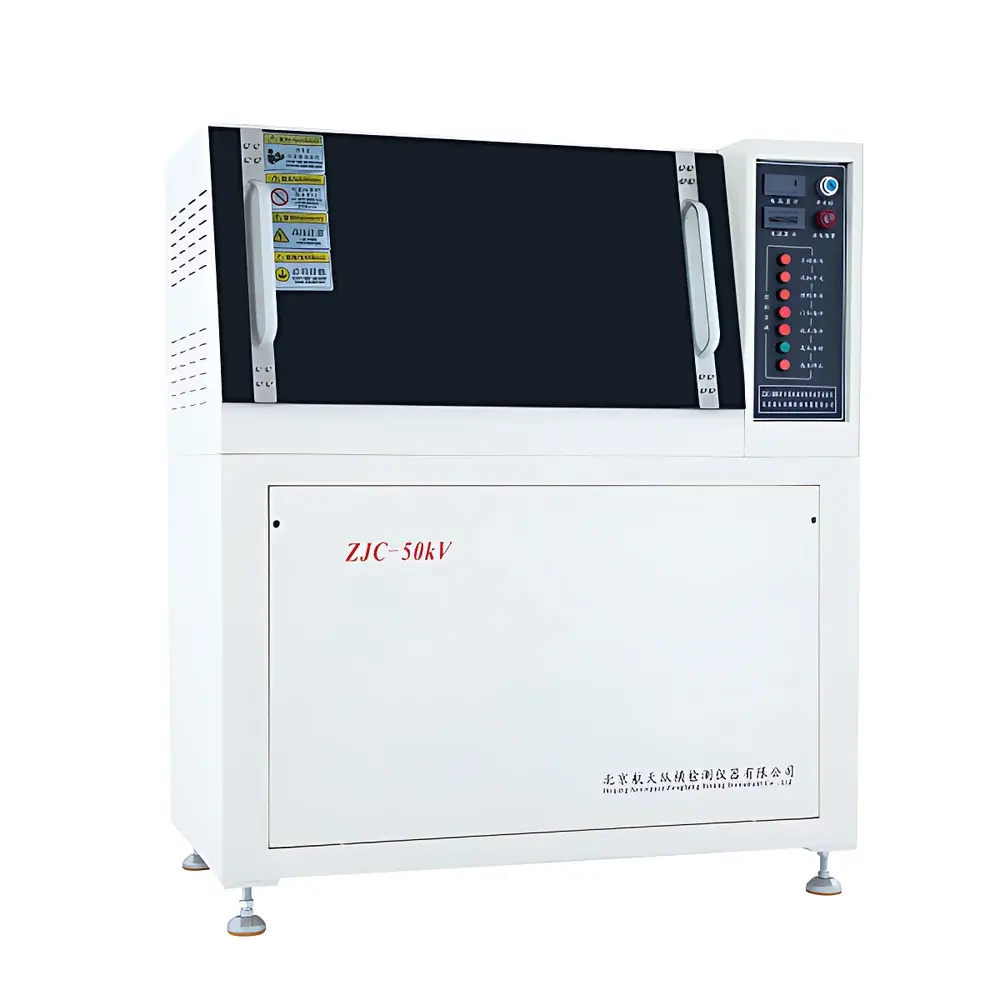
Aerospace ZJC-150KV Dielectric Breakdown Strength Tester
| Brand | Aerospace |
|---|---|
| Origin | Beijing, China |
| Model | ZJC-150KV |
| Output Voltage | AC/DC 0–150 kV |
| Measurement Range | AC/DC 15–150 kV |
| Accuracy | ≤1% |
| Ramp Rate | 0.01–5 kV/s |
| Hold Time | 0–8 h |
| Leakage Current Setting | 1–30 mA |
| Input | AC 220 V ±10%, 50 Hz ±1% |
| Power Output | 15 kVA |
| Dimensions (L×W×H) | 1980 × 1220 × 1750 mm |
| Weight | 350 kg |
| Environmental Operating Range | 15–30 °C, RH ≤85% |
| Grounding Requirement | Dedicated earth electrode ≥1.5 m depth |
Overview
The Aerospace ZJC-150KV Dielectric Breakdown Strength Tester is a precision high-voltage testing system engineered for the quantitative evaluation of electrical insulation integrity in solid dielectric materials. It operates on the principle of controlled voltage ramping—either sinusoidal AC (50 Hz) or steady-state DC—until dielectric failure occurs, enabling direct measurement of breakdown voltage and subsequent calculation of dielectric strength (kV/mm). Designed in strict accordance with international standard test methodologies—including ASTM D149, IEC 60243-1, and multiple GB/T standards—the instrument delivers traceable, reproducible results essential for quality assurance, R&D validation, and regulatory compliance in electrical insulation material development and manufacturing.
Key Features
- Full-range dual-mode output: AC 0–150 kV and DC 0–150 kV, both continuously adjustable with programmable ramp rates from 0.01 to 5 kV/s.
- High-fidelity voltage measurement via calibrated high-voltage resistive dividers and digital A/D conversion, achieving ≤1% full-scale accuracy per IEC 61000-4-30 Class A requirements.
- Integrated safety architecture including hardware-based overcurrent cutoff (<0.1 s response), mechanical high-voltage limit switches, zero-voltage startup enforcement, and interlocked safety door monitoring with real-time software feedback.
- Self-contained discharge system with automatic post-test residual charge dissipation and audible/visual DC discharge alarm—eliminating reliance on external grounding rods.
- Modular high-voltage subsystem: custom-wound oil-immersed transformer (rated 15 kVA), precision autotransformer regulator, and optically isolated PLC control loop ensuring long-term stability under continuous operation.
- Dedicated grounding interface compliant with GB/T 16895.3 and IEC 61000-5-2, requiring minimum 1.5 m driven earth rod for electromagnetic immunity and operator protection.
Sample Compatibility & Compliance
The ZJC-150KV accommodates standardized electrode configurations—including 25 mm and 75 mm diameter brass disk electrodes, spherical electrodes, and custom fixtures for films, sheets, coatings, and molded components—within an insulated oil bath (ASTM D877-compliant mineral oil supplied separately). It supports testing per GB/T 1408.1–2016 (AC breakdown), GB/T 1408.2–2016 (DC breakdown), GB/T 1695–2005 (vulcanized rubber), GB/T 3333 (cable paper), HG/T 3330 (insulating varnish films), and ASTM D149 (standard test method for dielectric breakdown voltage of solid electrical insulating materials at commercial power frequencies). All test sequences are fully auditable and support GLP/GMP documentation workflows, including electronic signatures, audit trails, and 21 CFR Part 11–compliant data integrity controls within the embedded software environment.
Software & Data Management
The proprietary Windows-based test platform provides deterministic real-time control, dynamic curve acquisition (voltage vs. time), and multi-sample comparative analysis with zoom, overlay, and region-specific statistical interrogation. Test parameters—including ramp profile, hold duration, termination criteria, and leakage current thresholds—are configurable per test sequence and stored with metadata (operator ID, timestamp, environmental logs). Raw data exports to CSV, Excel (.xlsx), and Word-compatible report templates; all datasets retain full traceability to calibration certificates and system configuration snapshots. Role-based access control enforces user-specific parameter locking, while hardware-enforced write-once archiving prevents post-acquisition modification—ensuring compliance with ISO/IEC 17025 clause 7.5.2 and FDA 21 CFR Part 11 Subpart B.
Applications
This system is routinely deployed in polymer R&D labs evaluating polyimide films, epoxy resins, and silicone elastomers; in wire & cable manufacturing for jacketing compound qualification; in capacitor and transformer component suppliers verifying paper, film, and composite barrier performance; and in academic institutions conducting fundamental studies on space charge accumulation and partial discharge inception under sustained electric stress. Its dual AC/DC capability enables direct comparison of polarization-dependent breakdown mechanisms, while programmable dwell times support accelerated aging protocols aligned with IEC 60270 and IEEE Std 930 reliability modeling frameworks.
FAQ
What standards does the ZJC-150KV explicitly support?
It complies with GB/T 1408.1–2016, GB/T 1408.2–2016, GB/T 1695–2005, GB/T 3333, HG/T 3330, GB/T 12656, and ASTM D149—covering both AC and DC dielectric strength determination across diverse material classes.
Is the system suitable for continuous 24/7 operation?
Yes. The oil-cooled transformer, forced-air cabinet ventilation, and thermal monitoring circuitry enable uninterrupted duty cycles up to 8 hours per test sequence without derating.
How is data integrity ensured during regulatory audits?
All test records include immutable timestamps, operator authentication tokens, calibration verification logs, and cryptographic hash signatures—fully satisfying 21 CFR Part 11 §11.10(a) and ISO/IEC 17025:2017 clause 7.5.2 requirements.
Can custom electrode geometries be integrated?
Yes. The electrode positioning frame accepts user-supplied fixtures per ASTM D149 Annex A2 specifications, provided mechanical clearance and creepage distances meet IEC 60664-1 insulation coordination guidelines.
What maintenance intervals are recommended?
Annual verification of high-voltage divider linearity, biannual oil dielectric strength testing (per ASTM D877), and quarterly inspection of grounding resistance (<5 Ω) constitute the minimal preventive maintenance protocol.



