
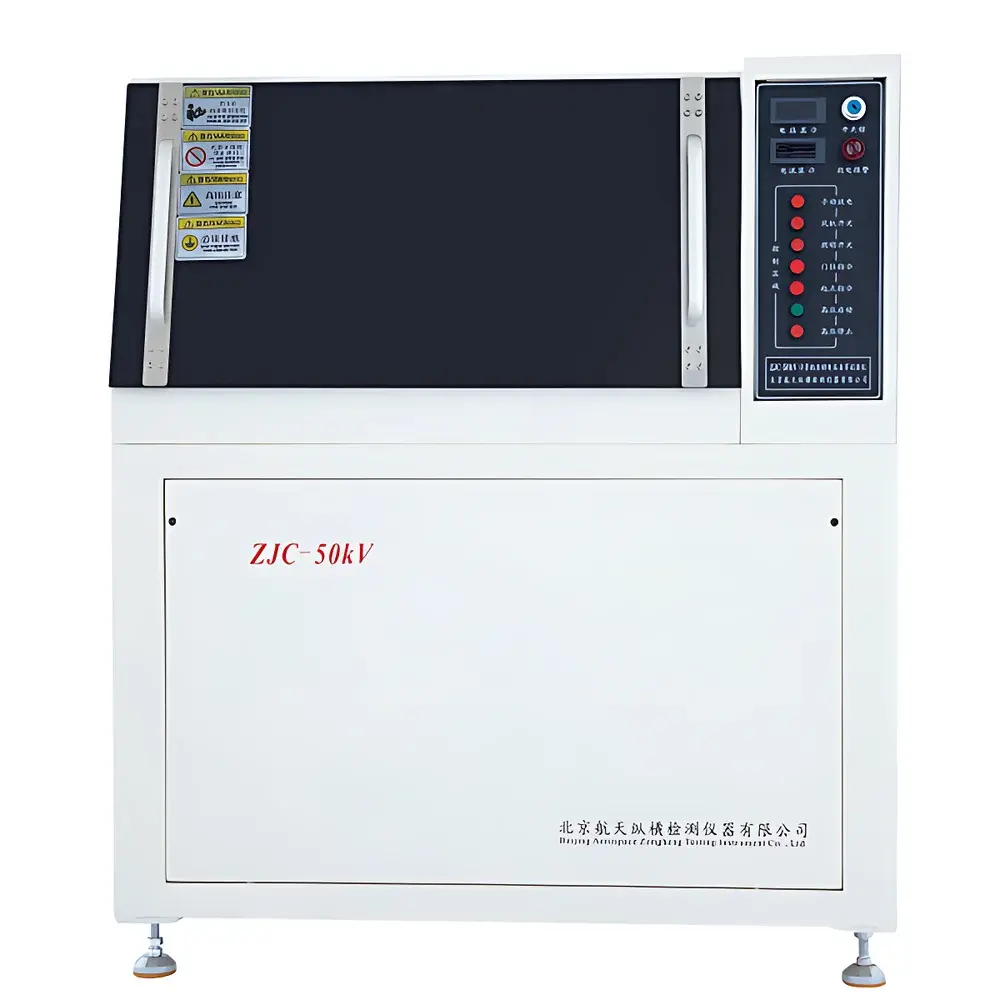
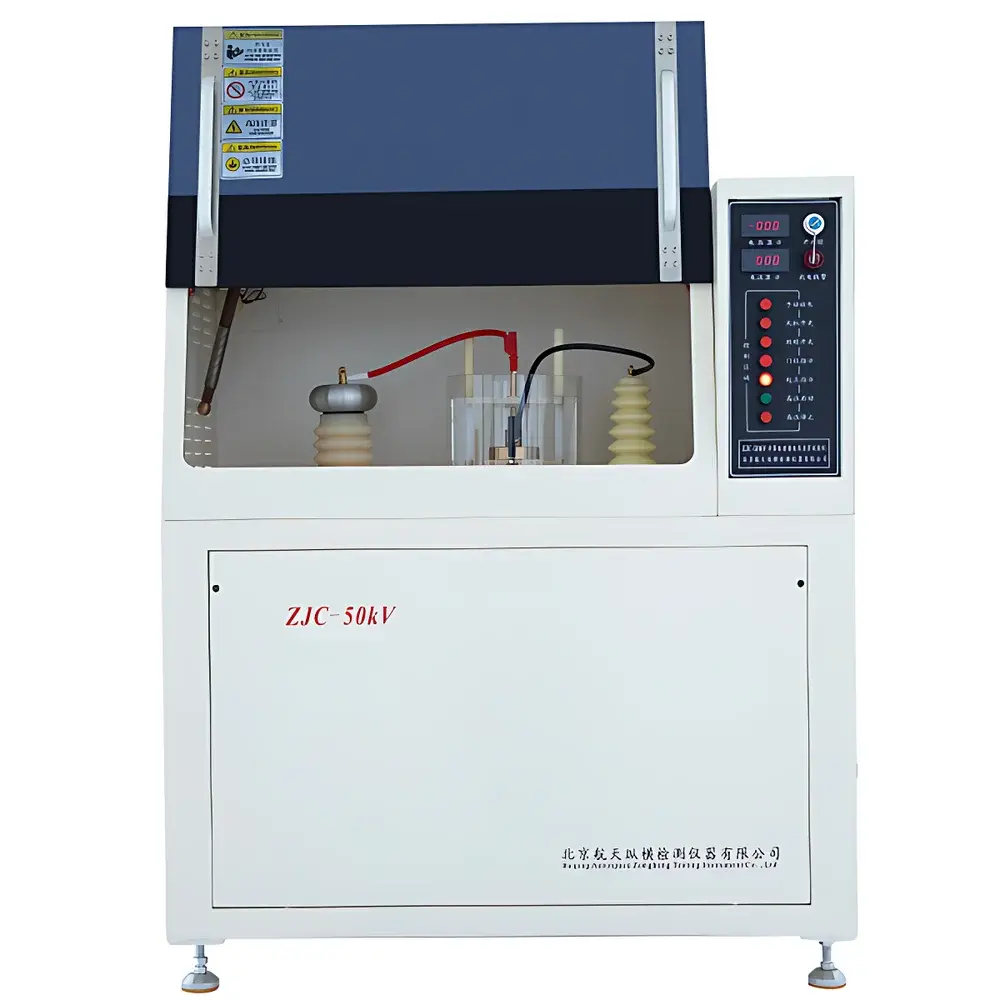

Aerospace ZJC-150KV Dielectric Strength Tester
| Brand | Aerospace |
|---|---|
| Origin | Beijing, China |
| Model | ZJC-150KV |
| Maximum Output Voltage | 150 kV |
| Voltage Ramp Rate | 0.1–3 kV/s (adjustable) |
| Electrode Configuration | 12.5 mm polished spherical electrodes (Ra ≤ 0.2 µm), fixed gap 2.5 mm ± 0.05 mm |
| Breakdown Current Threshold | 1–100 mA (programmable), response time ≤ 10 µs |
| Temperature Control | Integrated oil bath, stability ±1 °C at 25 °C |
| Humidity Limit | <70 % RH in test chamber |
| Compliance | IEC 60156, ASTM D877, GB/T 507, GB 2536 |
Overview
The Aerospace ZJC-150KV Dielectric Strength Tester is a precision high-voltage testing system engineered for quantitative assessment of dielectric breakdown strength in insulating liquids—primarily mineral and synthetic transformer oils. It operates on the fundamental principle of electric field-induced ionization: when a steadily increasing AC voltage is applied across a defined electrode gap immersed in the test oil, localized electron avalanches initiate at microscopic impurities or gas voids. Once the critical electric field intensity (kV/mm) is exceeded, a conductive plasma channel forms—resulting in catastrophic dielectric failure. The instrument captures this threshold voltage with sub-millisecond temporal resolution and automatically computes the mean breakdown voltage from statistically valid replicate tests. Designed for metrological rigor rather than operational convenience, it adheres to the physical constraints and procedural mandates of international standardization—ensuring data traceability, inter-laboratory comparability, and regulatory acceptability in power utility, manufacturing QA, and third-party certification environments.
Key Features
- High-stability 150 kV AC high-voltage generator with <3% waveform distortion (50/60 Hz), digitally regulated ramp control (0.1–3 kV/s) and ±1% step accuracy
- IEC 60156–compliant spherical electrode assembly: 12.5 mm diameter tungsten carbide spheres, surface roughness Ra ≤ 0.2 µm, mechanically constrained gap of 2.5 mm ± 0.05 mm
- Real-time current monitoring at 100 MS/s sampling rate; programmable trip threshold (1–100 mA) with ≤10 µs circuit interruption latency
- Integrated thermostatic oil bath system maintaining sample temperature at 25 °C ± 1 °C via PID-controlled recirculation (1 L/min flow, ±0.3 °C controller accuracy)
- Hermetically sealed test chamber with humidity monitoring (<70 % RH), mechanical interlock on 5 mm tempered glass shield, and helium-leak–verified sealing (≤1×10⁻⁹ Pa·m³/s)
- Automated outlier rejection: discards flashover events <10 kV and applies statistical filtering per IEC 60156’s six-test protocol (median-of-three reporting)
Sample Compatibility & Compliance
This tester is validated for use with hydrocarbon-based insulating oils—including unused and in-service transformer oils, silicone fluids, and ester-based dielectrics—within viscosity limits of 5–40 cSt at 40 °C. All operational protocols conform strictly to the measurement geometry, conditioning requirements, and statistical reporting rules of IEC 60156 (routine testing), ASTM D877 (historical parallel-plate method), and GB/T 507 (Chinese national standard). It supports dual-electrode configurations (spherical per IEC, flat-plate per ASTM) with documented calibration traceability to NIM (National Institute of Metrology, China). Data output meets GLP audit requirements: full timestamping, operator ID logging, environmental parameter capture (temperature/humidity), and uneditable raw waveform archives. Optional firmware upgrade enables 21 CFR Part 11–compliant electronic signatures and audit trail generation.
Software & Data Management
The embedded Windows-based control software provides deterministic test sequencing, real-time oscillographic display of voltage/current transients, and automated report generation in PDF/XLSX formats. Each test record includes: raw breakdown voltage values, pass/fail status against GB 2536 thresholds (≥35 kV/2.5 mm for new oil; ≥30 kV/2.5 mm for service-aged oil), deviation from historical median, and trend analysis using exponentially weighted moving averages (EWMA). Calibration logs, maintenance events (e.g., electrode polishing cycles, filter replacements), and reference standard verifications (e.g., 40 ±1 kV certified oil) are stored in a relational SQLite database with role-based access controls. Exported datasets retain ISO/IEC 17025–required metadata: uncertainty budget components (voltage divider ratio, gap tolerance, thermal drift), equipment ID, and environmental context.
Applications
- Routine quality assurance of newly manufactured transformer oils prior to equipment filling
- Condition monitoring of in-service insulating oils in power transformers, reactors, and bushings
- Research into aging mechanisms: correlation of breakdown voltage decay with dissolved gas analysis (DGA), acidity, and particle count
- Validation of oil reclamation processes (vacuum dehydration, clay filtration, electrostatic purification)
- Third-party certification testing for ISO 55001 asset management compliance and grid code adherence (e.g., IEEE C57.106)
- Supporting root-cause analysis of insulation failures through comparative breakdown mapping across multiple sampling points
FAQ
What standards does the ZJC-150KV explicitly support out-of-the-box?
IEC 60156 (primary mode), ASTM D877 (via optional flat-plate electrode kit), GB/T 507, and GB 2536. Firmware includes preloaded test templates with auto-enforced parameter limits per standard.
Is external temperature/humidity control required?
No—the integrated oil bath maintains sample temperature at 25 °C ±1 °C, and the sealed chamber incorporates passive desiccant and RH sensor feedback. Ambient lab conditions must remain within 15–30 °C and <70 % RH.
How is electrode wear monitored and compensated?
Surface roughness is verified annually via profilometry (Ra ≤ 0.2 µm required); gap distance is re-verified using certified gauge blocks before each calibration cycle. A diamond-lapping toolkit is included for in-house refurbishment.
Can test data be exported to LIMS or SAP QM modules?
Yes—CSV and XML exports include all metadata required for LIMS ingestion. Optional OPC UA server module enables real-time integration with enterprise MES/QMS platforms.
What maintenance intervals are recommended for long-term accuracy?
Daily: electrode cleaning with acetone + anhydrous ethanol; weekly: oil bath fluid inspection; quarterly: HV transformer oil filtration; annually: helium leak test, voltage divider calibration, and sphere radius verification.



