
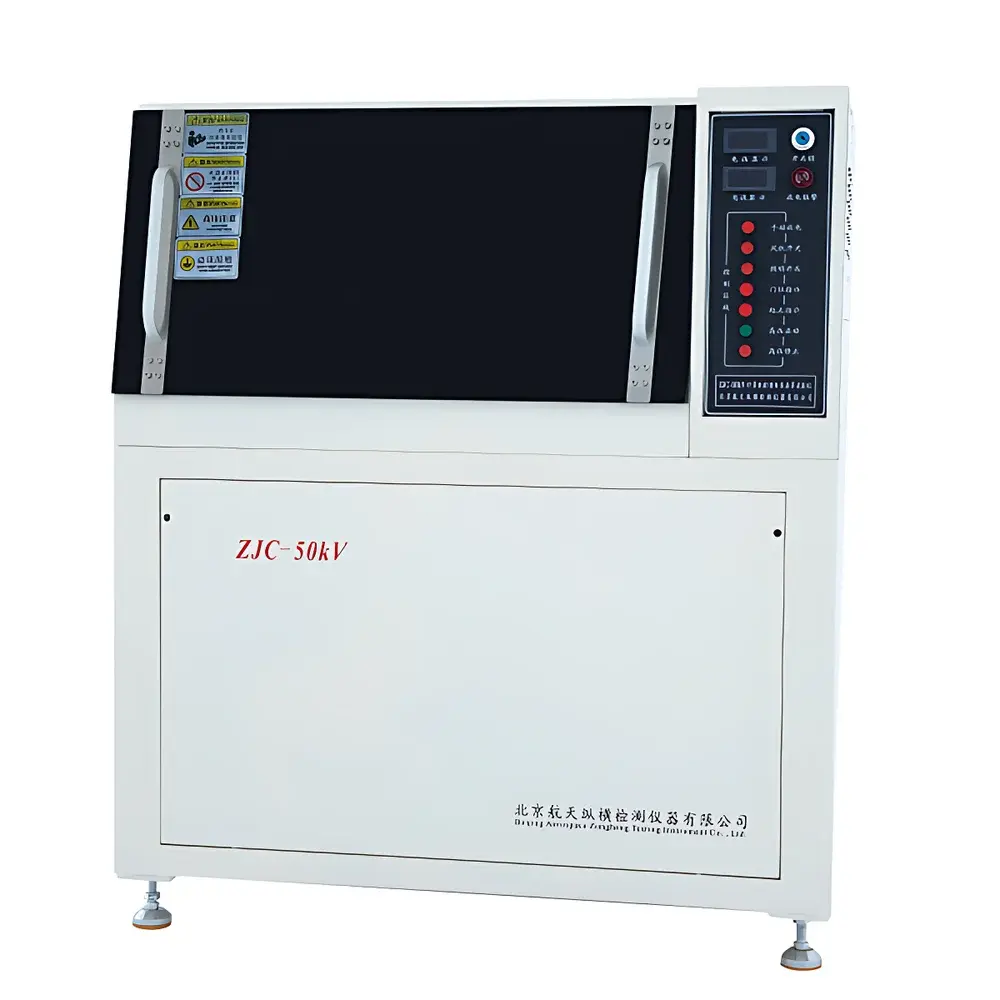
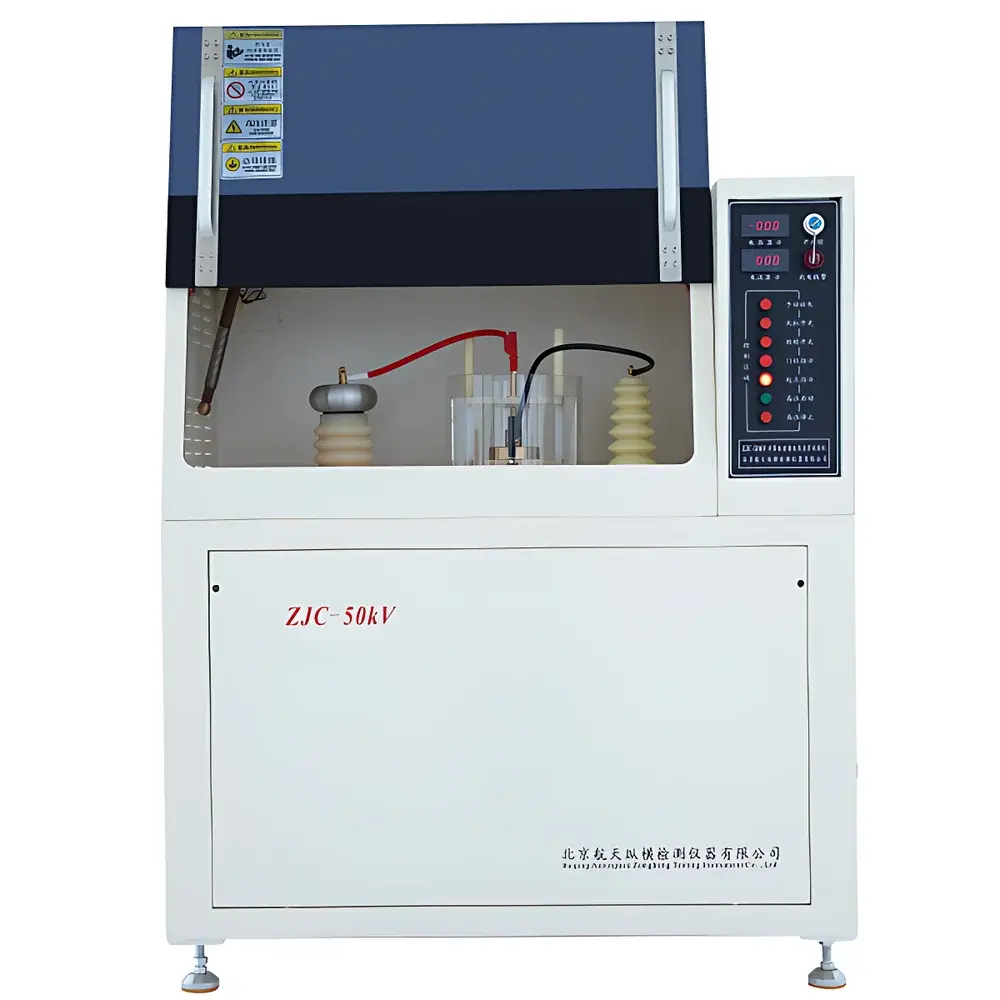
Aerospace ZJC-150KV Dielectric Strength Tester / High-Voltage Breakdown Testing System
| Brand | Aerospace |
|---|---|
| Origin | Beijing, China |
| Model | ZJC-150KV |
| Maximum Output Voltage | 150 kV AC/DC |
| Voltage Range | 0–100 kV AC/DC |
| Ramp Rate | 0.05–10 kV/s (continuously adjustable) |
| Measurement Accuracy | ≤1% for AC/DC voltage |
| Output Ripple Factor | ≤2% |
| Test Duration | 0–48 h (current-free mode) |
| Oil Bath Temperature Range | Ambient to 300 °C |
| Electrode Configurations | φ25 mm & φ75 mm stainless steel electrodes |
| Power Rating | 10 kW |
| Dimensions (L×W×H) | 1600 × 1100 × 1500 mm |
| Working Height | 940 ± 30 mm |
| Work Surface | 1600 × 1100 mm |
| Overcurrent Protection | 1–100 mA |
| Sampling Capacitor | 100 pF / 100 kV |
| Interface | Bilingual (English/Chinese) touchscreen + PC-based control software |
| Safety Compliance | IEC 61010-1, IEC 60243-1, GB/T 1408.1, ASTM D149, ISO 60243-1 |
Overview
The Aerospace ZJC-150KV Dielectric Strength Tester is a precision-engineered high-voltage breakdown testing system designed for quantitative evaluation of the dielectric strength and voltage endurance of solid insulating materials under controlled AC or DC stress conditions. Operating on the principle of controlled voltage ramping across standardized electrode configurations immersed in dielectric oil or exposed to ambient gas media, the instrument complies with core international test standards including IEC 60243-1, ASTM D149, ISO 60243-1, and GB/T 1408.1. Its architecture integrates a high-stability high-voltage transformer, digitally regulated autotransformer, real-time current/voltage acquisition module, and oil-immersed test chamber—enabling reproducible measurement of electrical breakdown thresholds, time-lag to failure, and insulation degradation kinetics. The system supports both destructive breakdown characterization and non-destructive withstand testing up to 48 hours at rated voltage, making it suitable for R&D laboratories, quality assurance departments, and third-party certification facilities engaged in polymer, composite, ceramic, and laminated material qualification.
Key Features
- Full-range programmable voltage output from 0 to 100 kV AC/DC, with maximum capability up to 150 kV for margin testing and safety validation.
- Continuously adjustable ramp rate (0.05–10 kV/s) supporting three standardized test modes: stepwise voltage escalation, constant-rate ramping, and fixed-voltage endurance hold.
- Dual-electrode configuration (φ25 mm and φ75 mm stainless steel) compliant with ASTM D149 and IEC 60243-1 electrode geometry requirements; interchangeable via tool-free mounting.
- Integrated oil bath chamber with temperature control (ambient to 300 °C), enabling thermal aging studies and hot-condition dielectric testing per IEC 60243-2.
- Embedded safety architecture featuring dual-channel hardware interlocks: emergency stop buttons with protective covers, normally-closed safety relays, door-position sensing, and independent mechanical overtemperature cutoffs for heating elements.
- Comprehensive electrical safety design: 30 mA residual-current device (RCD) with ≤0.1 s trip response; grounded cold-rolled steel enclosure (≥1.2 mm thickness); color-coded wiring per IEC 60445; fire-retardant cable glanding; and IP54-rated control cabinet with dust-proof ventilation.
- Bilingual (English/Chinese) HMI interface with real-time waveform display, event logging, and configurable pass/fail criteria; full PC integration via Ethernet for remote operation and data export.
Sample Compatibility & Compliance
The ZJC-150KV accommodates rigid and semi-rigid sheet, film, and molded specimens up to 150 mm × 150 mm × 25 mm. Specimen conditioning follows standardized environmental protocols: preconditioning at 23 ± 2 °C and 50 ± 5% RH for ≥24 h (per IEC 60243-1 Annex A), with optional high-humidity (95 ± 3% RH), elevated-temperature (up to 275 °C), or liquid-immersion (distilled water, transformer oil, or heated cylinder oil) treatments as specified in product-specific test plans. Media selection—including ambient air (with silicone anti-flashover collars), transformer oil (for routine tests), or overheated cylinder oil (for thermal-class validation)—is fully documented in test reports. All mechanical and electrical safety subsystems conform to IEC 61010-1 (Safety Requirements for Electrical Equipment for Measurement, Control, and Laboratory Use) and meet structural requirements for GLP-compliant test environments.
Software & Data Management
Control and data acquisition are managed through Aerospace’s proprietary BreakTest™ v3.2 software suite, installed on an industrial-grade embedded PC housed in a slide-out drawer for service access. The software supports automated test sequencing, real-time voltage/current/time plotting, digital oscilloscope-style capture of breakdown transients, and timestamped event tagging (e.g., “voltage hold initiated”, “breakdown detected”, “overcurrent trip”). Raw data exports to CSV and XML formats; summary reports include statistical analysis (mean, SD, CV%) across replicate specimens. Audit-trail functionality records all user actions, parameter changes, and calibration events with user ID and timestamp—meeting FDA 21 CFR Part 11 requirements for electronic records when configured with Windows OS audit policies. Firmware and software backups are supplied on encrypted USB drive; communication protocols (Modbus TCP, OPC UA) and register mapping documentation are provided for MES/SCADA integration.
Applications
This system is routinely deployed in polymer formulation labs evaluating epoxy resins, polyimides, and silicone elastomers for aerospace wire insulation; in power equipment manufacturing for validating bushings, spacers, and transformer barriers; and in academic research investigating nanocomposite dielectrics and bio-based insulating films. It supports comparative screening of material batches per ISO 27385, qualification of new insulation systems against UL 746C, and accelerated life modeling under combined thermal–electrical stress per IEEE Std 930. End-use validation includes compliance testing for IEC 60695-2-10 (fire hazard – glow-wire flammability), IEC 60068-2-30 (damp heat cycling), and MIL-STD-202 Method 302 (dielectric withstanding voltage).
FAQ
What standards does the ZJC-150KV comply with for dielectric testing?
It meets IEC 60243-1 (electric strength of insulating materials), ASTM D149 (dielectric breakdown voltage of solid electrical insulating materials), ISO 60243-1, GB/T 1408.1, and supports test execution per UL 746C, IEC 60695-2-10, and IEEE Std 930.
Can the system perform both AC and DC breakdown tests?
Yes—it delivers fully isolated, polarity-switchable DC output and true sinusoidal AC output (50/60 Hz), each independently calibrated and traceable to national metrology institutes.
Is remote monitoring and control supported?
Yes—via Ethernet-connected PC with BreakTest™ software; optional Modbus TCP or OPC UA gateway enables integration into plant-wide SCADA or LIMS platforms.
What safety certifications apply to the instrument’s electrical architecture?
The system carries CE marking per the Low Voltage Directive (2014/35/EU) and EMC Directive (2014/30/EU); its enclosure and wiring follow IEC 61010-1 Edition 3.1 requirements for laboratory equipment.
How is calibration maintained and verified?
Factory calibration includes NIST-traceable HV probe verification at 10, 30, 60, and 100 kV points; annual recalibration is recommended, with internal self-diagnostics and reference voltage checks available via software.



