
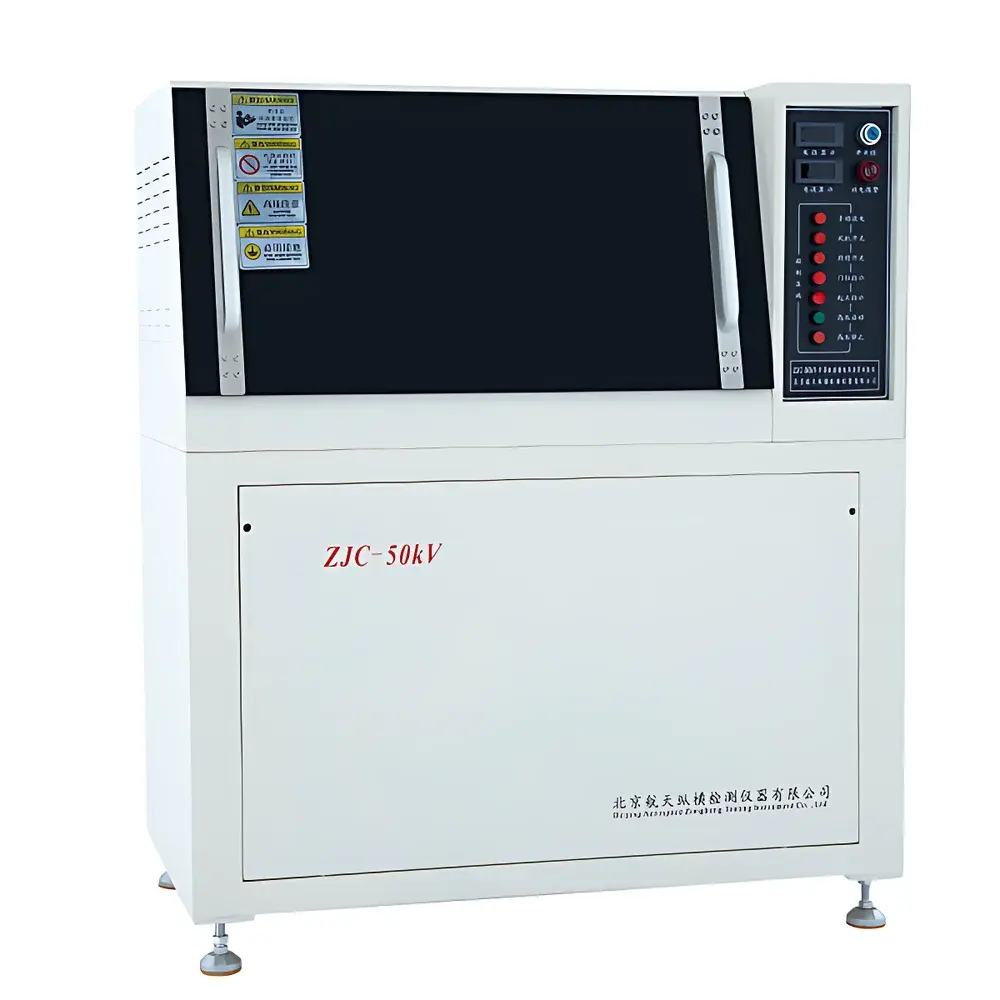
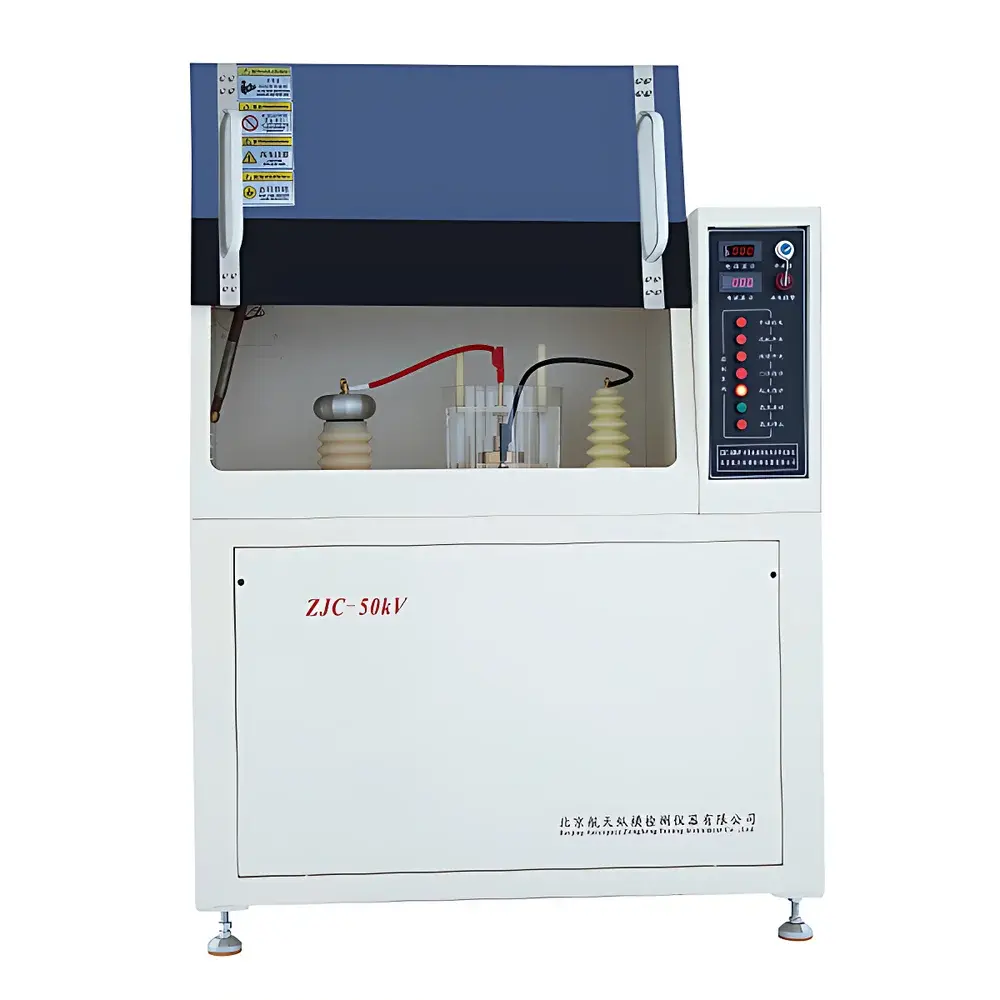
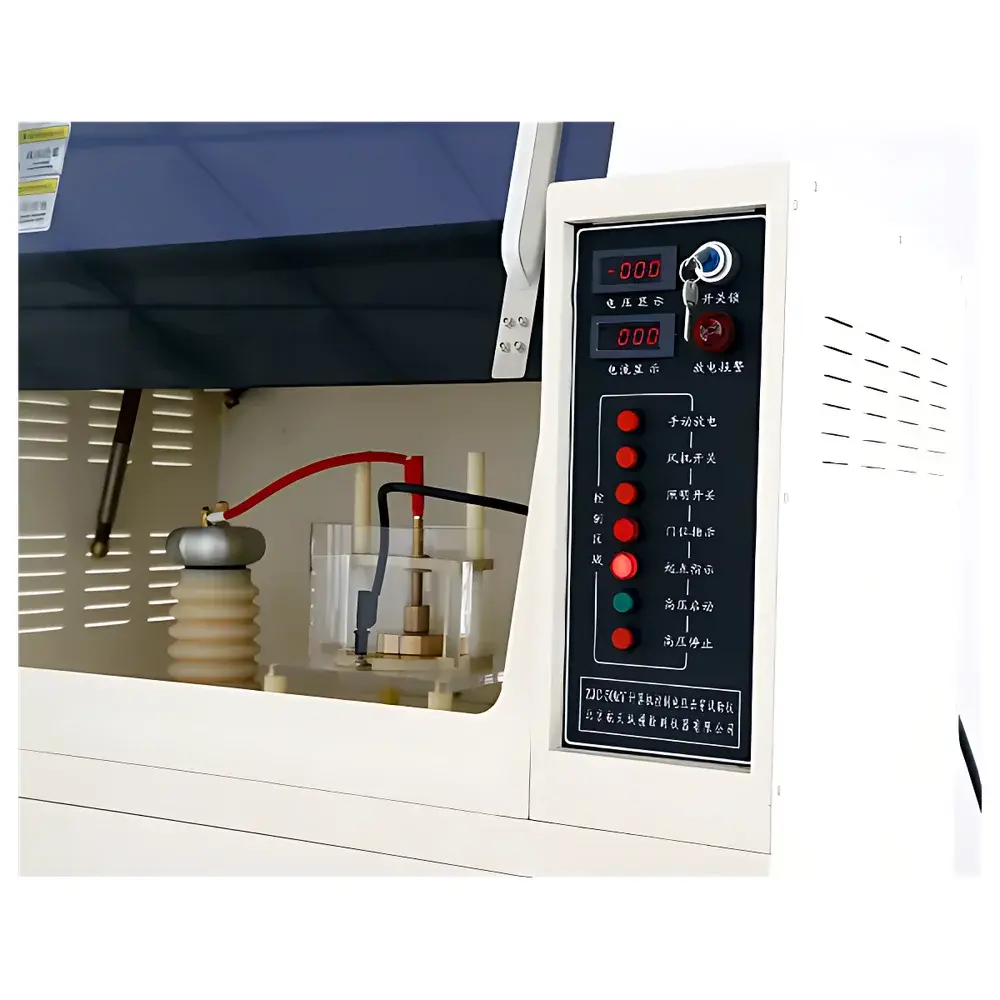
Aerospace ZJC-150KV Electrical Voltage Breakdown Tester
| Brand | Aerospace |
|---|---|
| Origin | Beijing, China |
| Model | ZJC-150KV |
| Maximum Output Voltage | 150 kV |
| Compliance | GB/T 1408.1–2016, IEC 60243-1:2013, ASTM D149–20 |
| Electrode Configurations | Cylindrical (6.4 mm & 25 mm diameter), Parallel-plate, Needle-to-plate |
| Voltage Ramp Rates | 0.5–2 kV/s (adjustable) |
| Sample Thickness Range | 0.1–3 mm |
| Environmental Control | 23 ± 2 °C, 50 ± 5 % RH (optional oil bath or SF₆ gas chamber) |
| Safety Standards | IEC 61010-1, Dual Grounding, Interlocked Enclosure, Emergency Stop |
Overview
The Aerospace ZJC-150KV Electrical Voltage Breakdown Tester is a precision high-voltage test system engineered for the quantitative evaluation of dielectric strength in solid insulating materials—including polymers, elastomers, laminates, films, and composite substrates—under controlled electrostatic stress. It operates on the fundamental principle of dielectric breakdown: when subjected to an increasing electric field, insulating materials undergo irreversible conduction due to intrinsic structural failure (intrinsic breakdown), localized partial discharge (discharge-induced breakdown), or thermal runaway (thermal breakdown). The instrument applies either AC (50/60 Hz) or DC voltage across standardized electrode configurations, monitoring real-time leakage current and voltage response until catastrophic failure occurs. The resulting breakdown voltage (Ub) is normalized against specimen thickness (d) to yield dielectric strength (Eb = Ub/d), expressed in kV/mm—a critical parameter for material qualification in high-reliability sectors such as aerospace wiring insulation, EV battery separators, power transformer bushings, and medical device encapsulants.
Key Features
- High-voltage generator with stable 150 kV DC/AC output, <±2% voltage accuracy and ripple factor <3%, based on high-frequency inverter topology for improved regulation and transient response.
- Modular electrode system supporting interchangeable configurations per IEC 60243-1 and ASTM D149: cylindrical electrodes (6.4 mm and 25 mm diameter), parallel-plate (25 mm × 25 mm), and needle-to-plate for localized stress analysis.
- Precision vertical actuation mechanism with calibrated contact force control (20 N ± 0.5 N) and surface roughness ≤0.8 µm Ra on brass/stainless steel electrodes to minimize field distortion.
- Explosion-resistant test chamber with polycarbonate observation window, optional SF₆ gas inlet port, vacuum compatibility, and integrated oil-bath interface for immersion testing per GB/T 1408.1.
- Dual-channel, 16-bit analog-to-digital acquisition at ≥1 kHz sampling rate, enabling dynamic waveform capture of pre-breakdown leakage current transients and arc inception events.
- Comprehensive safety architecture compliant with IEC 61010-1: redundant grounding, door interlock circuitry, overvoltage/overcurrent cutoff (<10 ms response), audible/visual alarm, and emergency stop with mechanical latch.
Sample Compatibility & Compliance
The ZJC-150KV accommodates flat, non-porous specimens 0.1–3 mm thick with uniform geometry and surface integrity—free from scratches, contaminants, or moisture ingress. It supports testing in ambient air, transformer oil, silicone fluid, or sulfur hexafluoride (SF₆) environments to replicate service conditions across applications. All operational protocols align with internationally recognized standards: GB/T 1408.1–2016 (Chinese national standard for electrical strength testing), IEC 60243-1:2013 (methods for determining dielectric strength of solid insulating materials), and ASTM D149–20 (standard test method for dielectric breakdown voltage of solid electrical insulating materials at commercial power frequencies). Test reports include traceable metadata—temperature, humidity, electrode type, ramp rate, and breakdown polarity—and are structured to satisfy ISO/IEC 17025 accreditation requirements for calibration laboratories.
Software & Data Management
The system integrates a Windows-based control platform supporting both manual and automated test sequences. Users define ramp profiles (linear, stepwise, or gradient), set voltage hold durations, and configure pass/fail thresholds. Real-time voltage–time and current–time plots are rendered during testing, with synchronized environmental logging (via external sensor inputs). Acquired data are stored in binary format with ASCII export capability (.CSV, .XLSX) and PDF report generation—including calculated Eb, statistical summaries (mean, SD, CV%), and graphical overlays for comparative analysis. Audit trails record operator ID, timestamp, parameter changes, and system events—fully compliant with FDA 21 CFR Part 11 for electronic records and signatures in regulated environments. Optional LabVIEW API and TCP/IP remote command interface enable integration into automated QA workflows.
Applications
- Quality assurance of polymer films used in lithium-ion battery separators under high-voltage DC stress.
- Evaluation of epoxy resin systems for aerospace-grade printed circuit board (PCB) substrates exposed to lightning-induced transients.
- Screening of silicone rubber gaskets in high-voltage switchgear for partial discharge resistance and long-term aging behavior.
- R&D validation of nanocomposite dielectrics incorporating BNNTs or Al₂O₃ nanoparticles for enhanced breakdown thresholds.
- Regulatory compliance testing for medical device insulation per IEC 60601-1, including creepage and clearance verification under humidified conditions.
- Accelerated life testing of cable jacketing compounds under combined thermal–electrical stress in oil-immersed chambers.
FAQ
What voltage ranges does the ZJC-150KV support, and is DC testing included?
Yes—the system delivers 1–150 kV DC and 1–150 kV AC (50/60 Hz) with programmable ramp rates from 0.1 to 5 kV/s.
Can the instrument perform step-stress or time-lag breakdown tests?
Yes. The software supports multi-stage step-up protocols, timed voltage holds, and automatic retest sequencing after breakdown recovery.
Is calibration traceable to national metrology institutes?
All high-voltage sensors and current monitors are factory-calibrated against NIM (National Institute of Metrology, China) reference standards; full calibration certificates with uncertainty budgets are provided.
Does the system meet electromagnetic compatibility (EMC) requirements for laboratory use?
Yes—it complies with EN 61326-1:2013 for EMC in industrial environments and includes internal filtering and shielding to prevent interference with adjacent instrumentation.
How is sample thickness measured and incorporated into dielectric strength calculations?
Specimen thickness is entered manually or imported via digital micrometer interface; Eb is computed automatically using Eb = Ub/d, with unit conversion to kV/mm or MV/m.



