
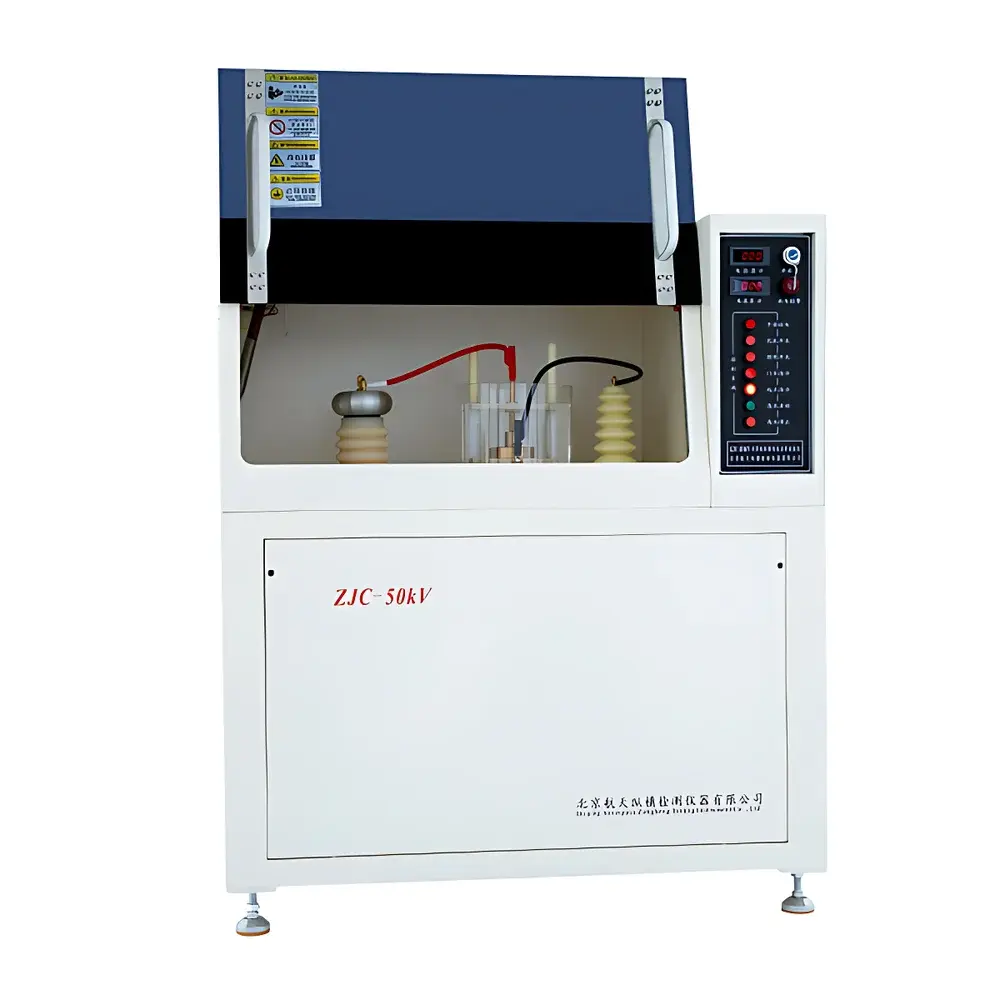
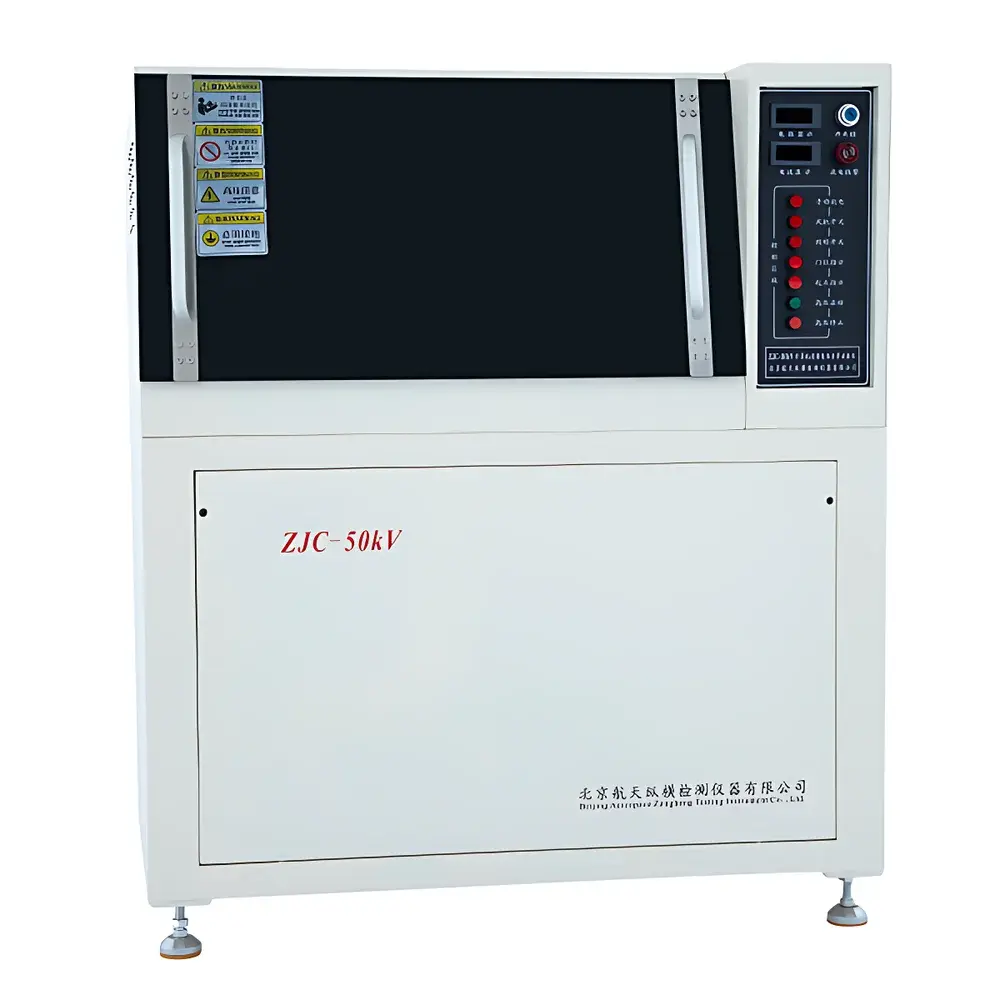
Aerospace ZJC-150KV Power Frequency Voltage Breakdown Tester / Dielectric Strength Tester
| Brand | Aerospace |
|---|---|
| Origin | Beijing, China |
| Model | ZJC-150KV |
| Breakdown Voltage Range | 0–150 kV AC/DC |
| Voltage Accuracy | ≤2% |
| Rise Rate | 0.1–10 kV/s |
| Output Power | 5–10 kVA |
| Test Medium | Insulating oil or air |
| Electrode Options | 25 mm & 75 mm disc, 6 mm sphere, parallel-plate, cylindrical, conical, wire-type |
| Safety Protection | Nine-level interlock system (including door interlock, overcurrent cutoff <0.1 s, grounding monitoring ≤4 Ω, discharge circuitry) |
| Compliance | GB/T 1408.1–2006, GB/T 1408.2–2006, GB/T 1695–2005, ASTM D149–2022 |
| Operating Environment | 15–30 °C, 30–85% RH |
| Dimensions (L×W×H) | 700×800×1300 mm or 1900×1300×1700 mm |
| Weight | 100–200 kg |
| Warranty | 3 years full coverage, lifetime technical support |
Overview
The Aerospace ZJC-150KV Power Frequency Voltage Breakdown Tester is an engineered solution for determining the dielectric strength and electrical breakdown characteristics of solid and liquid insulating materials under standardized AC (50 Hz) or DC voltage stress. Based on the fundamental principle of controlled voltage ramping until electrical failure—defined as a sustained conductive path through the test specimen—the instrument applies precisely regulated high-voltage fields across defined electrode geometries. It conforms to the core physical measurement paradigm described in IEC 60243 and ASTM D149: the test quantifies the maximum electric field (kV/mm) a material can withstand before catastrophic insulation failure occurs. Designed for laboratory-based quality control, R&D validation, and regulatory compliance testing, the ZJC-150KV integrates a robust high-voltage transformer, digitally synchronized PLC-controlled rise-rate modulation, and real-time current/voltage acquisition to ensure traceable, repeatable, and auditable results in accordance with GLP-aligned workflows.
Key Features
- Full-range programmable voltage output: 0–150 kV AC (50 Hz) and 0–150 kV DC, with continuous adjustment and digital calibration traceability.
- High-fidelity voltage ramp control: Adjustable rise rate from 0.1 kV/s to 10 kV/s, enabling compliance with both step-stress and linear-ramp test protocols per ASTM D149 Annex A1.
- Nine-tier safety architecture: Includes hardware-enforced door interlocks, automatic 0.1-second overcurrent disconnection, redundant grounding monitoring (≤4 Ω), integrated oil-immersed discharge circuits, and dual-mode manual/automatic discharge systems for DC residual charge mitigation.
- Modular electrode suite: Standardized configurations include 25 mm and 75 mm parallel-disc electrodes (per GB/T 1408.1), 6 mm spherical electrodes (for localized stress evaluation), cylindrical, conical, and wire-type fixtures for specialized geometries such as cables or thin films.
- Industrial-grade control core: Siemens-sourced data acquisition module, Panasonic stepper motor-driven autotransformer, and isolated high-voltage sensing circuitry (imported Japanese voltage/current transducers) ensure long-term stability and signal integrity.
- Comprehensive environmental integration: Equipped with dedicated insulating oil bath (20 L), grounding mat (2 m × 1.5 m), and Class 0 rubber insulating gloves—meeting IEC 61482 and ASTM F1506 requirements for operator protection.
Sample Compatibility & Compliance
The ZJC-150KV supports standardized evaluation of diverse dielectric media including thermoset and thermoplastic polymers (e.g., epoxy resins, polyethylene films), elastomers (vulcanized rubber per GB/T 1695), ceramics, glass substrates, varnishes, impregnated fiber composites (e.g., transformer board), and insulating oils (per IEC 60156). Test specimens must meet dimensional and surface finish criteria specified in GB/T 1408.1 Clause 6 and ASTM D149 Section 7 to ensure valid field distribution. All test procedures align with internationally recognized frameworks: GB/T 1408.1–2006 (AC breakdown), GB/T 1408.2–2006 (DC-specific methodology), and ASTM D149–2022 (industrial frequency dielectric strength). The system supports audit-ready documentation for ISO/IEC 17025-accredited laboratories and satisfies pre-submission requirements for UL, CE, and CCC certification pathways involving insulation coordination analysis.
Software & Data Management
The embedded Windows-based control software provides full IEC 61508-compliant human-machine interface with real-time oscillographic visualization of voltage, leakage current, and time-domain breakdown events. Each test session automatically logs timestamped raw data—including peak voltage, breakdown instant, pre-failure current drift, and rise-rate profile—into encrypted binary files (.zjcbin) with SHA-256 checksums. Export functionality supports CSV, Excel (.xlsx), and Word (.docx) formats for downstream statistical analysis (e.g., Weibull distribution fitting per IEC 60243-2). Audit trail features record all user actions (login/logout, parameter changes, report generation) with immutable timestamps, satisfying FDA 21 CFR Part 11 electronic record requirements when deployed in GMP environments. Data retention policies are configurable; default settings retain ≥10,000 test records with automated backup to external NAS or network drives.
Applications
This tester serves critical roles across multiple sectors: polymer formulation labs assessing comparative dielectric performance of new resin blends; cable manufacturers validating jacket and insulation integrity per ICEA T-28-533; capacitor film producers qualifying biaxially oriented polypropylene (BOPP) layers; aerospace composites suppliers verifying lightning strike protection coatings; and transformer oil reclamation facilities performing routine dielectric fluid health monitoring. It also supports academic research into space charge accumulation dynamics in nanodielectrics and partial discharge inception voltage mapping in multi-layer laminates. Its dual AC/DC capability enables direct comparison of polarization-dependent breakdown mechanisms—essential for evaluating materials intended for HVDC transmission components or pulsed-power applications.
FAQ
What standards does the ZJC-150KV explicitly support?
It is configured and validated for GB/T 1408.1–2006, GB/T 1408.2–2006, GB/T 1695–2005, and ASTM D149–2022. Optional firmware modules extend compatibility to IEC 60243-1 and JIS C 2101.
Can the system perform step-stress testing?
Yes—programmable hold periods at intermediate voltages (1–300 s per step) are supported via the PLC sequencer, enabling staircase and up-and-down methods per IEC 60243-2 Annex B.
Is remote operation possible?
The system includes Bluetooth 5.0 wireless interface for local tablet-based monitoring and emergency stop; however, full parameter control requires wired Ethernet connection to prevent latency-induced safety risks.
How is calibration maintained over time?
Voltage sensors are factory-calibrated against NIM-traceable reference standards; annual recalibration is recommended using certified high-voltage dividers (e.g., HVR-150 from MTE Corp) and documented in the built-in calibration log.
What electrical infrastructure is required?
A dedicated 220 V ±10 %, 50 Hz ±1 % single-phase supply with minimum 32 A circuit breaker, isolated earth ground (<4 Ω), and upstream surge suppression meeting IEC 61000-4-5 Level 4 specifications.



