
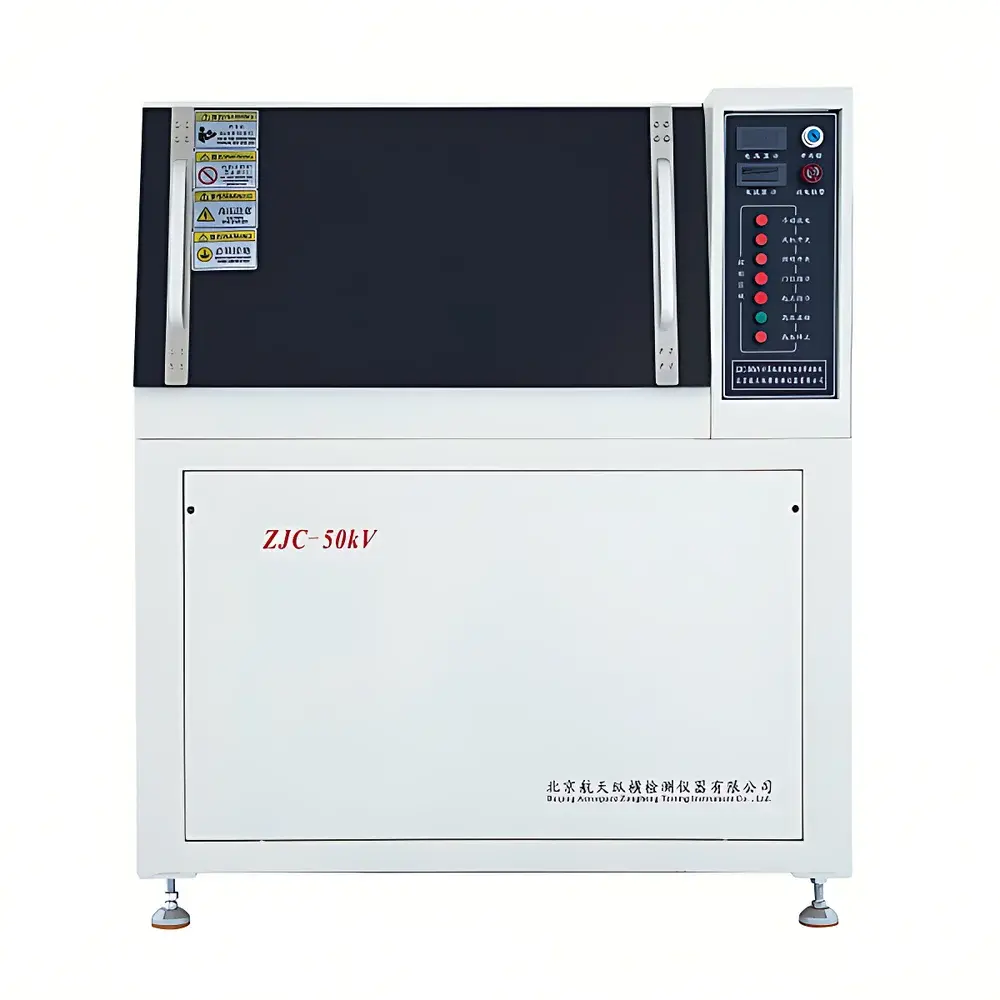
Aerospace ZJC-50KV Dielectric Breakdown Strength Tester
| Brand | Aerospace |
|---|---|
| Origin | Beijing, China |
| Model | ZJC-50KV |
| Maximum Output Voltage | 50 kV AC/DC |
| Voltage Measurement Range | 0–50 kV (AC/DC) |
| Power Capacity | 5 kVA |
| Rising Rate | 0.1–5 kV/s |
| Voltage Measurement Accuracy | ≤1% |
| Test Modes | Ramp-up, Step-up, and Hold-at-Voltage (Dielectric Withstand) |
| Safety Protections | Nine-level interlock system including overvoltage cutoff, overcurrent trip, short-circuit detection, safety door interlock, zero-voltage reset, post-test automatic discharge (electromagnetic + resistive), independent grounding, and software operation validation |
| Dimensions (L×W×H) | 1200 × 1050 × 1500 mm |
| Net Weight | ~200 kg |
| Compliance | GB/T 1408.1–2016, GB/T 1408.2–2016, GB/T 1695–2005, GB/T 507–2002, DL 429.9–1991, ASTM D149–2022 |
Overview
The Aerospace ZJC-50KV Dielectric Breakdown Strength Tester is an engineered high-voltage test system designed for precise determination of dielectric strength and voltage withstand capability of solid and liquid insulating materials under standardized AC (48–62 Hz) or DC stress conditions. Based on the principle of controlled electric field application across a defined electrode geometry, the instrument applies a continuously increasing or stepwise voltage until electrical breakdown occurs—manifested by a rapid, irreversible current surge indicating loss of insulating integrity. The system measures the peak voltage at breakdown and calculates dielectric strength (kV/mm) using standardized sample thickness protocols per IEC 60243-1 and ASTM D149. It supports both destructive breakdown characterization and non-destructive dielectric withstand verification, making it essential for quality control in insulation material manufacturing, transformer oil certification, cable component validation, and R&D laboratories operating under GLP or ISO/IEC 17025 frameworks.
Key Features
- High-stability 50 kV AC/DC output with dual-mode regulation: linear ramp (0.1–5 kV/s) and programmable step-up sequences
- Integrated 5 kVA power supply with active current limiting (0–100 mA range) and real-time overcurrent detection
- Nine-layer hardware and firmware safety architecture, including electromagnetic discharge circuitry, mechanical safety door interlock, redundant grounding paths, and zero-voltage startup enforcement
- Digital voltage measurement with ≤1% full-scale accuracy, traceable to national metrological standards
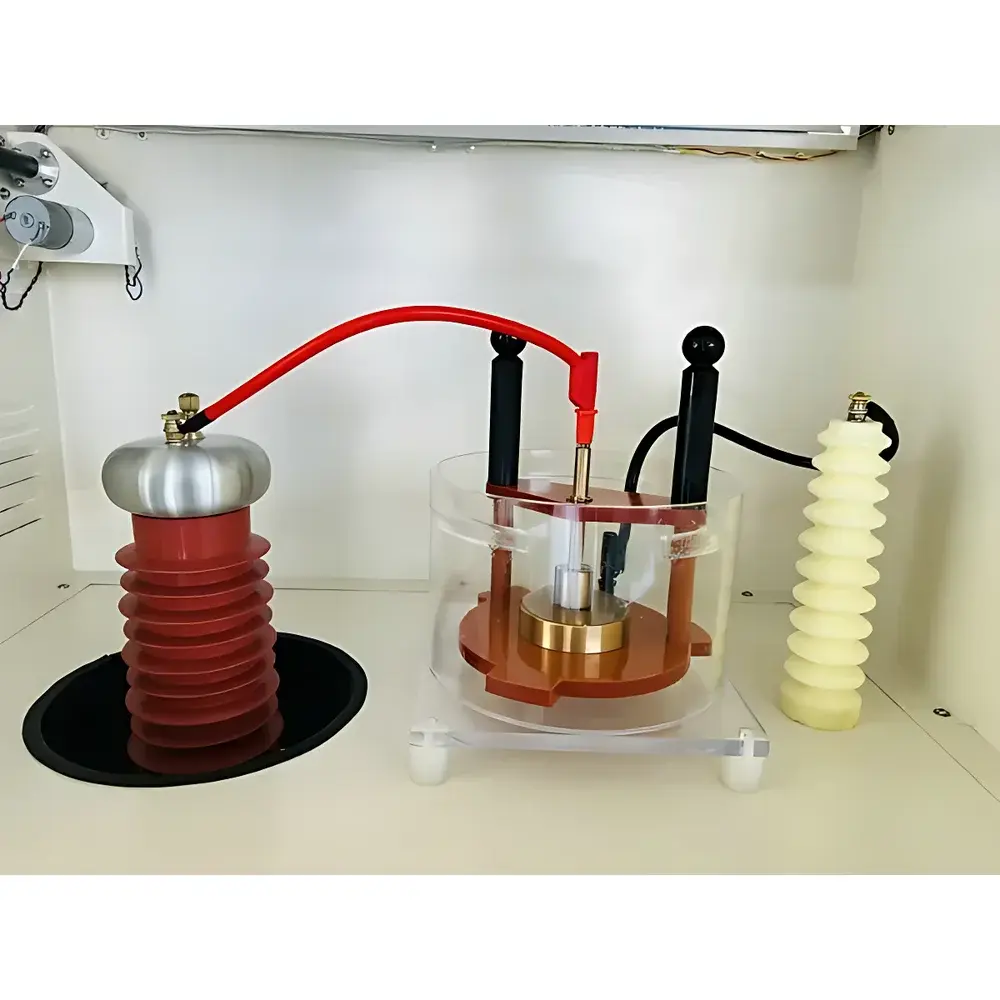
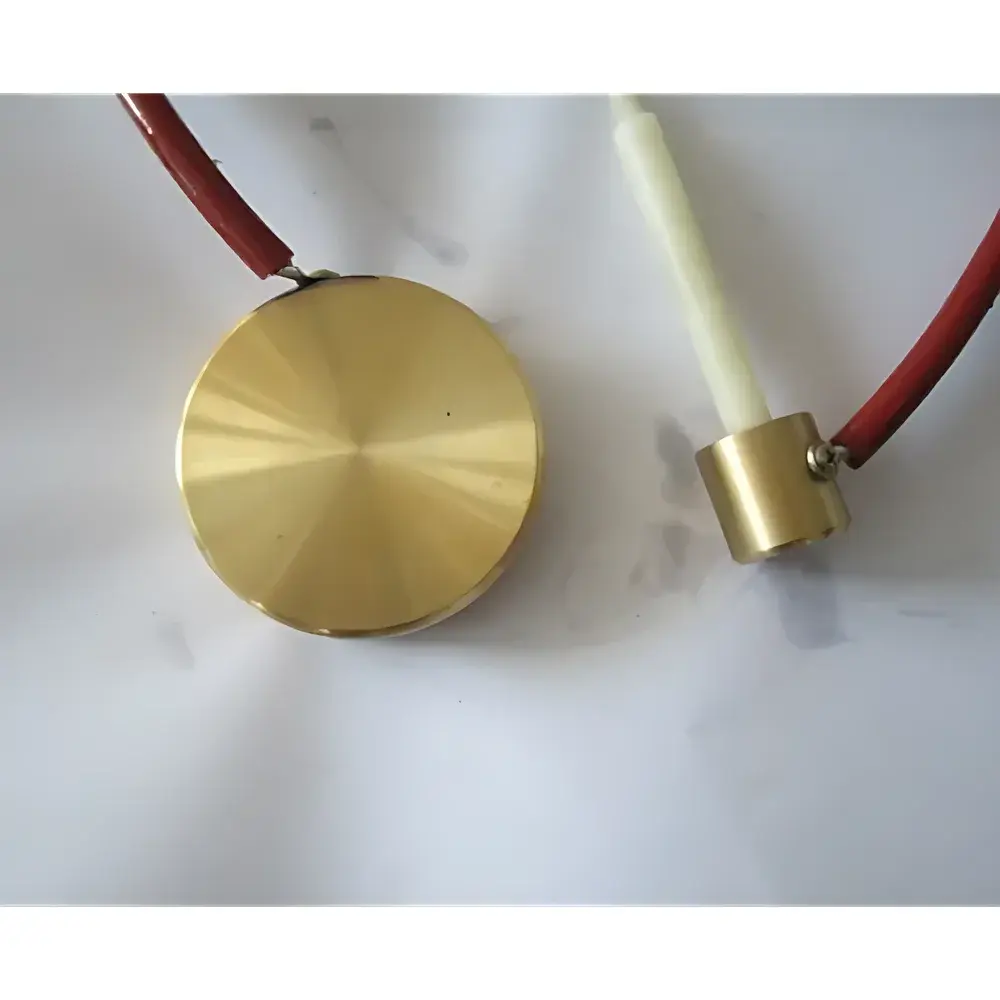
- Modular electrode configuration support for standard configurations (e.g., spherical-spherical, plate-plate per ASTM D149 and GB/T 1408.1), compatible with air, oil, and silicone fluid immersion testing environments
- Front-panel tactile controls and rear-panel I/O interfaces for external PLC synchronization and remote trigger integration
Sample Compatibility & Compliance
The ZJC-50KV accommodates a broad spectrum of insulating media, including polymeric films (e.g., PET, PI), thermoset resins (epoxy, phenolic), elastomers (silicone rubber, EPDM), ceramic substrates, fiber-reinforced laminates (G10/FR4), impregnated paper (cable paper, capacitor paper), varnish-coated windings, and liquid dielectrics (mineral oil, synthetic esters). All test methodologies adhere strictly to internationally harmonized standards: GB/T 1408.1–2016 (equivalent to IEC 60243-1), GB/T 1408.2–2016 (DC-specific procedures), ASTM D149–2022, GB/T 507–2002 (for insulating oils), and DL 429.9–1991. The system’s design enables compliance-ready documentation generation—including test logs with timestamped voltage/current traces, operator ID, environmental temperature/humidity metadata, and pass/fail status per specified hold durations—supporting audit readiness for ISO 9001, IATF 16949, and FDA 21 CFR Part 11–aligned electronic records when paired with validated LIMS integration.
Software & Data Management
While the base unit operates via embedded microcontroller logic for standalone execution of preconfigured test routines, optional PC-based software provides extended functionality: automated sequence scripting (ramp/step/hold combinations), real-time oscillographic display of voltage vs. current waveforms, statistical batch reporting (mean, SD, Weibull analysis), and CSV/PDF export compliant with laboratory data integrity requirements. All stored results include immutable audit trails—recording parameter changes, manual overrides, calibration events, and system fault codes—with time-stamped digital signatures. Software modules are validated per GAMP 5 guidelines and support role-based access control (RBAC) to enforce separation of duties between operators, supervisors, and QA reviewers.
Applications
- Quality assurance of insulating components in power transformers, switchgear, and rotating machinery
- Material qualification for aerospace wire harnesses (per SAE AS4373 and MIL-STD-202)
- Development and screening of high-dielectric-strength nanocomposites and ceramic-polymer hybrids
- Periodic verification of dielectric fluids used in HV bushings and circuit breakers
- Failure analysis of aged insulation systems via comparative breakdown voltage trending
- Support for third-party certification testing to UL 746, IEC 60674, and EN 60851 standards
FAQ
What voltage types does the ZJC-50KV support?
It delivers both AC (50/60 Hz, sinusoidal) and DC outputs, with independent calibration and protection circuits for each mode.
Can the system perform tests in oil immersion?
Yes—the chamber design permits full submersion of samples in standard insulating oils; optional oil-level sensors and temperature monitoring kits are available.
Is the instrument suitable for testing thin films (<0.1 mm)?
When used with precision micro-electrodes (sold separately) and thickness-compensated calculation algorithms, it meets ASTM D877 and IEC 60674-2 requirements for film evaluation.
How is calibration traceability maintained?
Voltage dividers are calibrated annually against NIM-traceable reference standards; certificate includes uncertainty budgets per ISO/IEC 17025 Annex A.
Does the system meet electromagnetic compatibility (EMC) requirements for lab environments?
It complies with GB/T 18268.1–2010 (IEC 61326-1) for industrial EMC immunity and emission limits, verified via third-party testing reports.



