
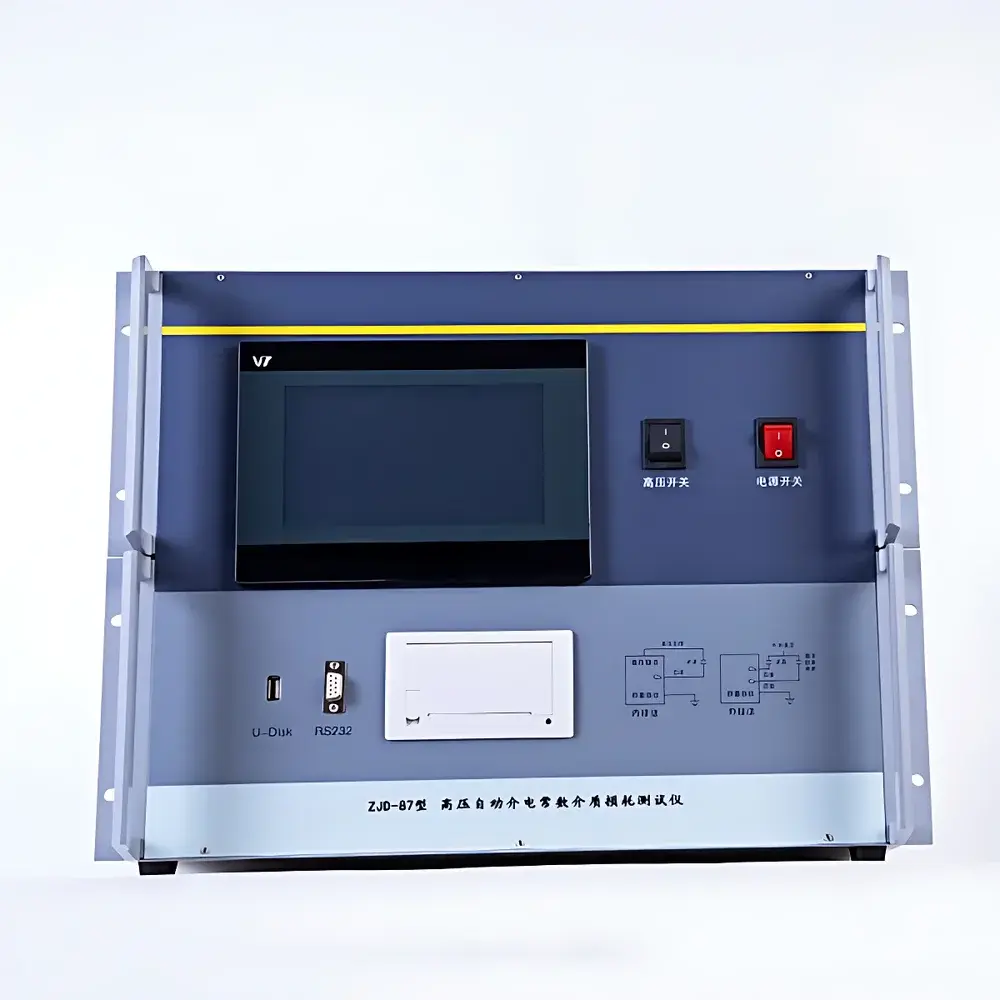
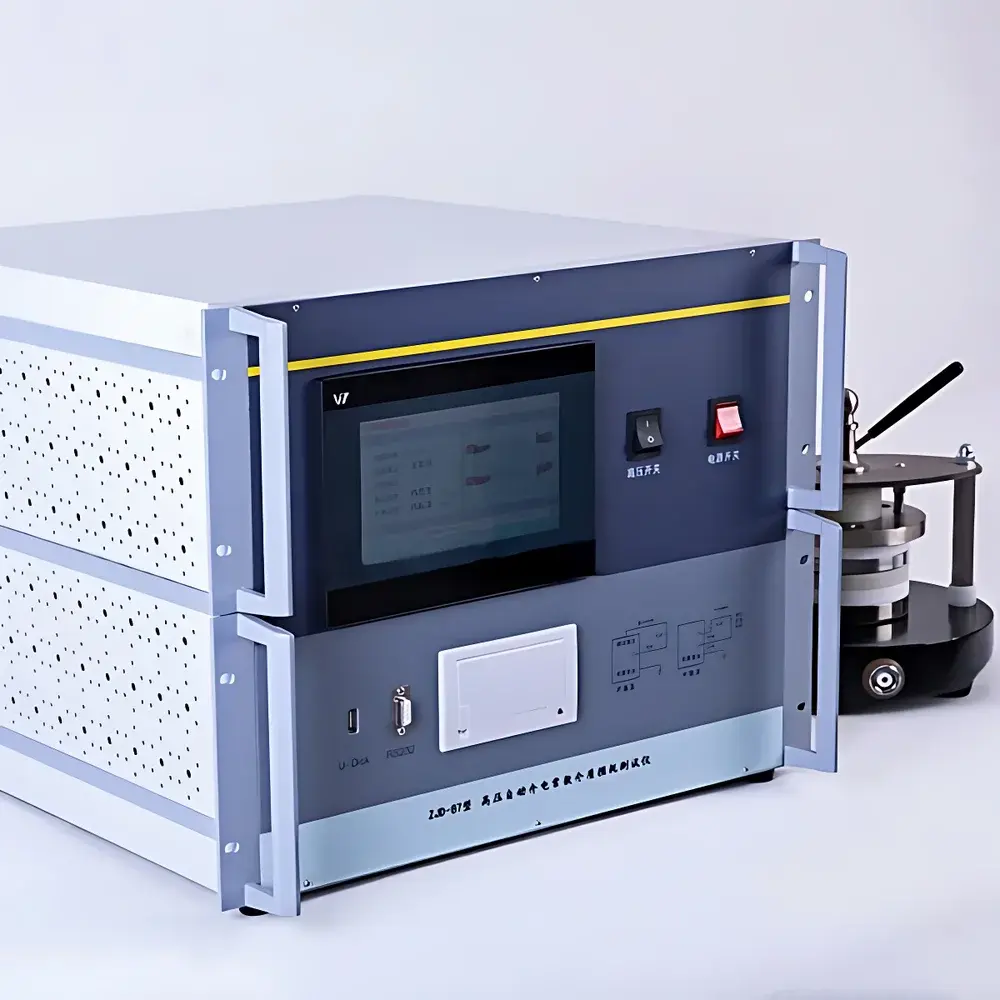
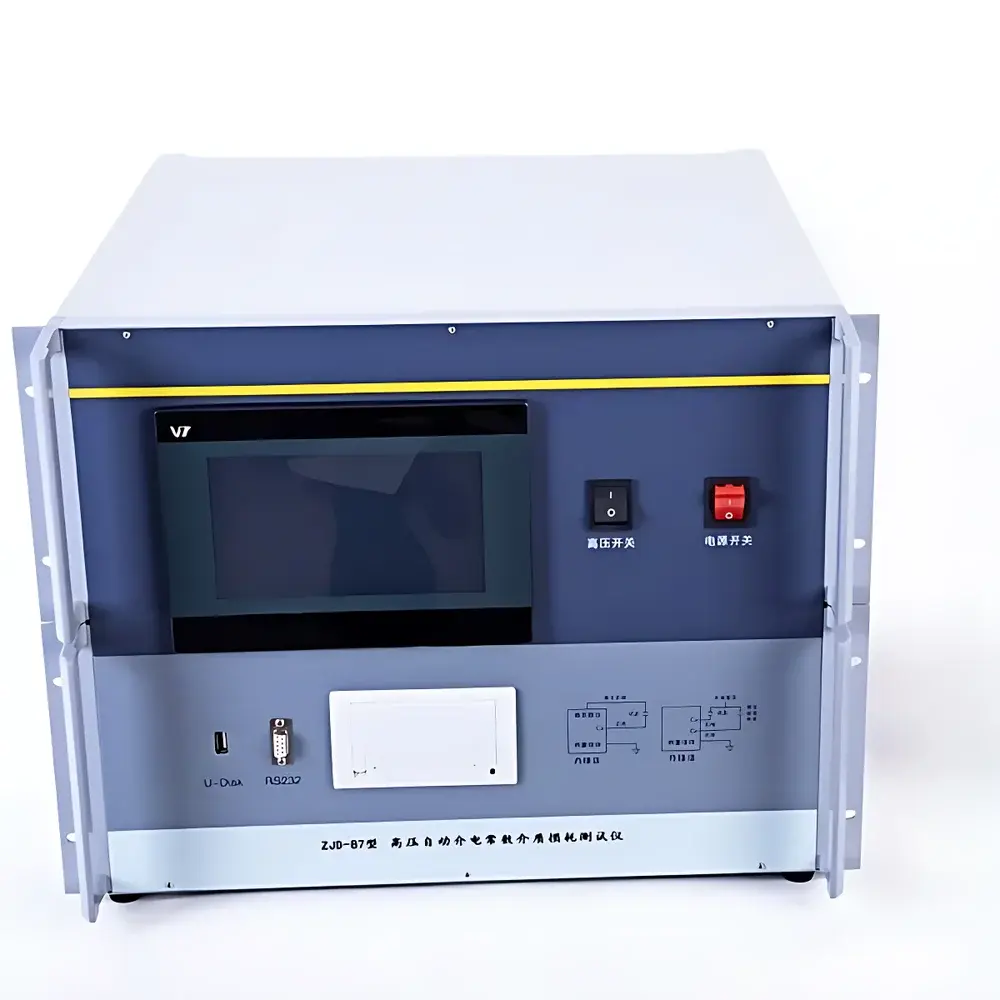
Aerospace ZJD-87 Dielectric Constant and Dissipation Factor Analyzer
| Brand | Aerospace |
|---|---|
| Origin | Beijing, China |
| Manufacturer Type | Authorized Distributor |
| Product Origin | Domestic (China) |
| Model | ZJD-87 Dielectric Constant and Dissipation Factor Analyzer |
| Price Range | USD 11,200 – 21,000 (FOB Beijing) |
Overview
The Aerospace ZJD-87 Dielectric Constant and Dissipation Factor Analyzer is a precision impedance-based measurement system engineered for the quantitative characterization of dielectric properties in solid, liquid, and powdered insulating materials. It operates on the principle of AC impedance spectroscopy—applying a sinusoidal voltage across a sample under controlled frequency, amplitude, and environmental conditions, then resolving the resulting current vector into its in-phase (resistive) and quadrature (capacitive) components. From this, the instrument calculates the relative permittivity (εr)—a dimensionless measure of a material’s ability to store electrical energy—and the dissipation factor (tan δ), defined as the ratio of energy lost to energy stored per cycle. These parameters are fundamental to electromagnetic design validation, insulation integrity assessment, and high-frequency signal integrity analysis across electronics, power transmission, aerospace composites, and advanced functional ceramics.
Key Features
- Broadband frequency coverage from 10 Hz to 1 GHz (optional extended-range modules available up to 10 GHz via coaxial probe or waveguide fixtures)
- High-resolution capacitance measurement range: 0.01 pF to 100 μF, with basic accuracy of ±0.05% reading ±0.05 pF
- Dissipation factor resolution down to 1×10⁻⁵, enabling detection of ultra-low-loss dielectrics such as fused silica or polytetrafluoroethylene (PTFE)
- Configurable electrode systems: standard guarded parallel-plate electrodes (50 mm diameter, Ni-plated brass), optional three-terminal liquid test cell, and high-frequency open-ended coaxial probe
- Integrated environmental control interface supporting external temperature-humidity chambers (−40 °C to +200 °C; 20–95% RH) with real-time feedback synchronization
- Comprehensive bias capability: superimposed DC voltage up to ±1 kV for polarization-dependent characterization of ferroelectrics and electrolytic dielectrics
- Lock-in amplifier architecture with >80 dB noise rejection, 16-bit ADC resolution, and digital phase-sensitive detection for stable low-signal measurements
Sample Compatibility & Compliance
The ZJD-87 accommodates standardized sample geometries per major international test protocols. Solid specimens include discs (50 mm or 100 mm Ø, thickness 0.1–5 mm), conforming to GB/T 1409–2016, ASTM D150–14, and IEC 60250. Liquid samples are measured in precision-machined cells with fixed 1 mm or 2 mm electrode gaps, aligned with GB/T 5654–2007 and IEC 60247. Thin films may be stacked or mounted on conductive substrates per IPC-TM-650 2.5.5. All configurations support guard electrode functionality to suppress fringing-field errors and surface leakage currents. The system is designed to meet traceability requirements under ISO/IEC 17025, supports audit-ready calibration logs, and facilitates compliance reporting for GLP/GMP environments through configurable metadata tagging and electronic signature workflows compliant with FDA 21 CFR Part 11.
Software & Data Management
The proprietary ZJD-Control Suite provides a Windows-based GUI with multi-parameter scripting, real-time Lissajous and Nyquist plotting, and automated sweep sequencing. Users can define custom test templates aligned with specific standards—including stepwise frequency sweeps, voltage ramping, and isothermal hold sequences—with full parameter logging at each data point. Raw impedance data (Z′, Z″), derived values (ε′, ε″, tan δ), and environmental telemetry (T, RH) are exported in CSV, Excel, or HDF5 formats. Built-in algorithms apply temperature compensation using user-defined or material-specific permittivity temperature coefficients (e.g., +0.1%/°C for epoxy resins). Audit trails record operator ID, timestamp, instrument configuration, and calibration status for every test session. Software updates are delivered via secure HTTPS with cryptographic signature verification.
Applications
- Quality assurance of PCB laminates (e.g., FR-4, Rogers RO4000® series) across 1 MHz–10 GHz bands per IPC-TM-650
- R&D evaluation of polymer nanocomposites, ceramic-polymer hybrids, and ferroelectric thin films under variable thermal and electric bias conditions
- Condition monitoring of transformer oil and cable insulation via tan δ trending per IEC 60422 and DL/T 421–2018
- Failure analysis of delaminated capacitors, moisture-damaged encapsulants, or thermally aged elastomers using frequency-domain relaxation mapping
- Validation of low-loss microwave substrates (e.g., alumina, quartz, sapphire) for 5G RF front-end modules and satellite communication components
FAQ
What frequency ranges does the ZJD-87 support out-of-the-box?
The base configuration covers 10 Hz to 1 GHz. Optional high-frequency modules extend coverage to 10 GHz using calibrated coaxial probes or waveguide-based fixtures.
Is the system compatible with ASTM D150 and GB/T 1409 test methods?
Yes—the instrument’s electrode geometry, voltage regulation, and environmental synchronization fully satisfy the physical and procedural requirements of both standards.
How is calibration traceability maintained?
Factory calibration uses NIST-traceable reference capacitors (0.02% accuracy) and precision resistors. Annual recalibration by an ILAC-accredited laboratory is recommended; certificates include uncertainty budgets per ISO/IEC 17025.
Can the system perform temperature-dependent dielectric spectroscopy?
Yes—when coupled with a certified environmental chamber, the ZJD-87 synchronizes temperature setpoints, dwell times, and measurement triggers to generate Arrhenius or Vogel–Fulcher–Tammann plots.
What safety protections are implemented during high-voltage testing?
Hardware interlocks disable output if ground continuity is lost or enclosure doors are opened. Overvoltage, overcurrent, and arc-detection circuits interrupt operation within <10 ms upon anomaly detection.



