
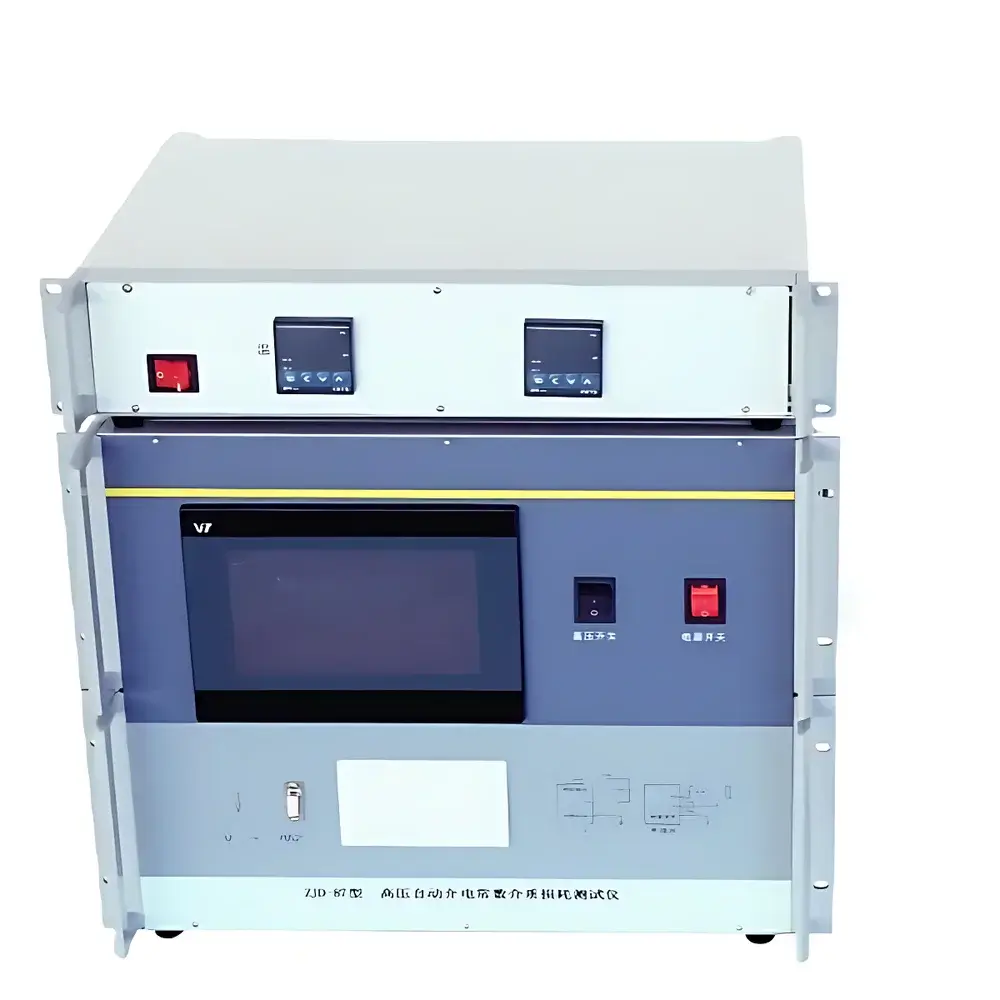
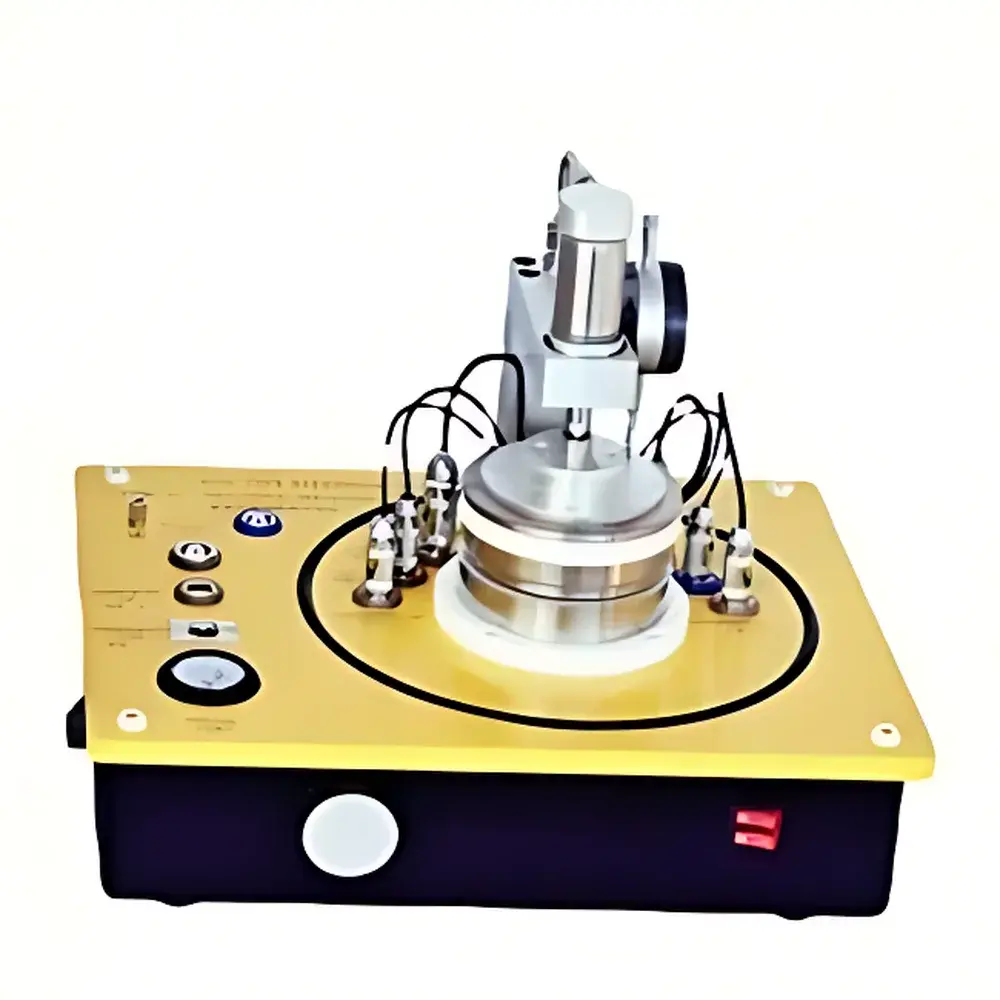
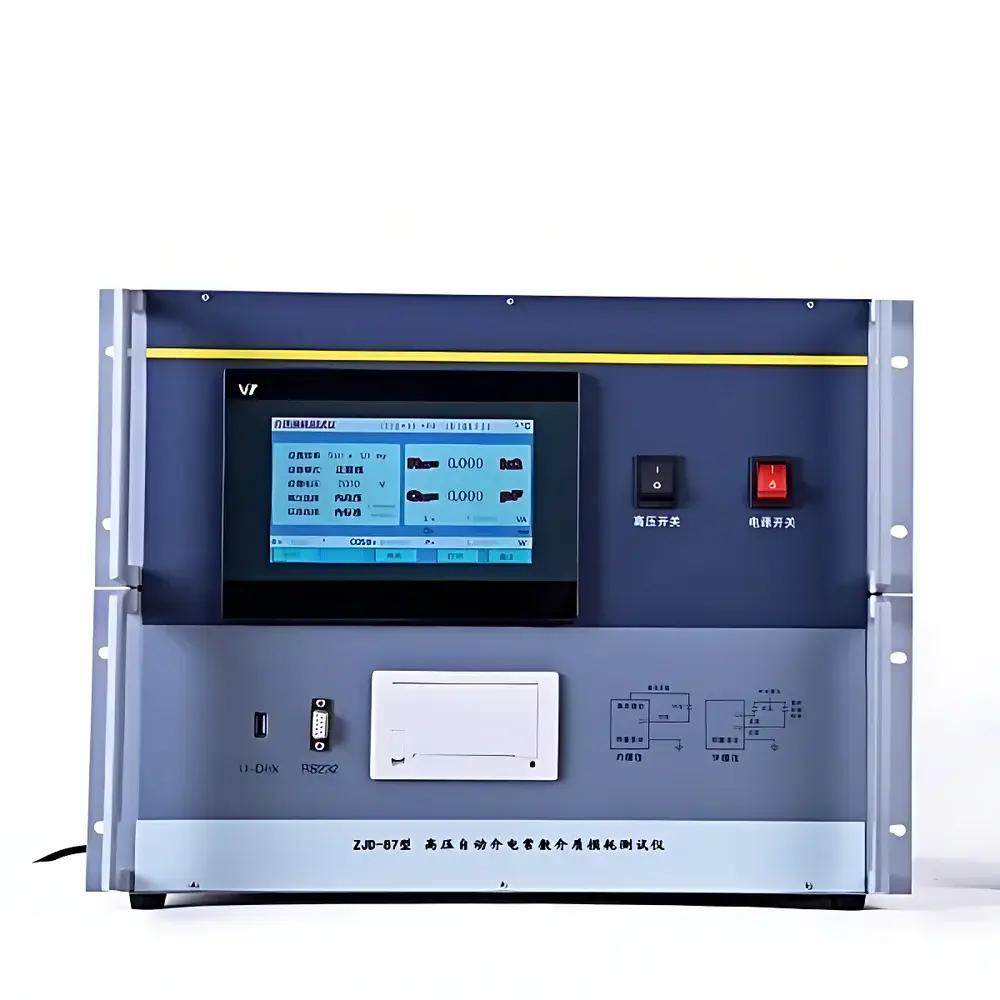
Aerospace ZJD-87 High-Voltage Automatic Dielectric Constant and Dissipation Factor Analyzer
| Brand | Aerospace |
|---|---|
| Origin | Beijing, China |
| Manufacturer Type | Authorized Distributor |
| Product Category | Domestic |
| Model | ZJD-87 |
| Price Range | USD 7,000 – 14,000 |
Overview
The Aerospace ZJD-87 High-Voltage Automatic Dielectric Constant and Dissipation Factor Analyzer is an engineered precision instrument for the quantitative characterization of dielectric properties in solid, liquid, and semi-solid insulating materials under controlled high-voltage AC excitation. It operates on the principle of series/parallel resonance-based impedance spectroscopy, utilizing a digitally synthesized signal source (1 kHz–160 MHz) with harmonic distortion ≤0.1% and amplitude stability ±0.5%. The system implements dual-closed-loop digital compensation architecture to isolate parasitic inductance (<5 nH) and residual capacitance, enabling accurate extraction of complex permittivity (ε* = ε′ − jε″) and loss tangent (tan δ = ε″/ε′) across wide voltage (0.5–10 kVrms) and frequency (40 Hz–160 MHz) ranges. Designed to meet stringent metrological requirements for electrical insulation assessment, the ZJD-87 delivers calibrated measurements traceable to national standards (JJG 563-2004), supporting compliance-driven workflows in power equipment R&D, polymer formulation QA/QC, and high-frequency substrate qualification.
Key Features
- High-voltage resonance measurement platform with programmable gradient ramping (0.5–10 kV, 1 V step resolution) and IGBT-driven 200 mA output capability
- Dual-mode operation: internal high-voltage excitation (3 pF–60 nF @ 10 kV; 60 pF–1 μF @ 0.5 kV) and external HV coupling (3 pF–1.5 μF @ 10 kV; 60 pF–30 μF @ 0.5 kV)
- Ultra-low-loss electrode system fabricated from aerospace-grade stainless steel (1Cr13Ni9Ti), featuring mirror-finished parallel plates (Φ98 mm high-voltage electrode, 75.43 cm²; Φ50 mm sensing electrode, 19.63 cm²) with Ra ≤ 0.2 μm surface roughness
- Precision gap control mechanism (0–5 mm range, 0.01 mm vernier resolution) and dynamic pressure regulation (0–1.0 MPa) for reproducible sample contact conditions
- Integrated thermal management subsystem with dual 500 W heaters, achieving 30-min ramp to 180 °C and ±1 °C steady-state temperature stability
- Multi-frequency adaptive signal generation (40–70 Hz continuous, ±0.01 Hz accuracy) and full-range current detection (5 μA–5 A)
- Four-tier hardware interlock system: overcurrent, overvoltage, arc detection, and thermal rise protection
- Background loss compensation algorithm based on digital phase-locked loop (baseline tan δ ≤ 3 × 10⁻⁵)
Sample Compatibility & Compliance
The ZJD-87 supports standardized testing of diverse dielectric media—including transformer oils, epoxy resins, polyimide films, ceramic substrates, silicone elastomers, and nanocomposite dispersions—across ASTM D150-18 (Standard Test Methods for Dielectric Constant and Dissipation Factor of Electrical Insulating Materials), IEC 60250:1969 (Determination of the Dielectric Constant and Dissipation Factor of Solid Electrical Insulating Materials at Power, Audio and Radio Frequencies), GB/T 1409-2016 (Measurement of Permittivity and Dielectric Loss of Solid Insulating Materials), GB/T 1693-2007 (Rubber—Determination of Dielectric Constant and Dielectric Loss Tangent), and GB/T 5654-2007 (Liquid Electrical Insulating Materials—Test Methods for Dielectric Constant and Dissipation Factor). Its vacuum chamber (ultimate vacuum ≤3 × 10⁻² MPa) and shielded measurement topology satisfy electromagnetic compatibility requirements for high-sensitivity tan δ measurement down to 1 × 10⁻⁶ resolution. The instrument’s metrological design conforms to GLP-aligned data integrity principles, including timestamped audit trails, user-access controls, and electronic signature readiness per FDA 21 CFR Part 11 guidance.
Software & Data Management
The analyzer integrates a real-time multi-core distributed processing unit with dual communication interfaces (RS-232 and USB 3.0) for synchronized acquisition, storage, and remote command execution. Firmware implements automatic parameter self-calibration, amplitude stabilization, and interference rejection via adaptive digital filtering. All measurement records—including raw impedance spectra, derived εr, tan δ, Cx, Lx, Q-factor, and environmental metadata (temperature, pressure, vacuum level)—are stored in structured binary format with embedded CRC-32 checksums. Optional software modules support CNAS-compliant report generation (PDF + CSV export), batch statistical analysis (mean, SD, Cp/Cpk), and trend monitoring against historical reference datasets. Thermal printer output includes traceable calibration identifiers, operator ID, and test condition stamps required for accredited laboratory documentation.
Applications
- Quality assurance of high-frequency capacitor dielectrics (e.g., MLCC base materials, RF ceramics)
- Insulation aging evaluation in power transformers and bushings via tan δ vs. voltage/frequency profiling
- Temperature-dependent permittivity mapping of thermosetting polymers and thermoplastic elastomers per ASTM D150 Annex A3
- Dielectric screening of nanofilled composites where interfacial polarization dominates low-frequency response
- Development of low-loss microwave substrates (e.g., PTFE-glass laminates) requiring precise ε′/tan δ separation at 1–100 MHz
- Batch verification of dielectric fluids (mineral oil, synthetic esters, silicone oils) per IEC 60296 and GB/T 5654
FAQ
What is the maximum test voltage supported by the ZJD-87?
The instrument supports internal high-voltage excitation up to 10 kVrms with programmable ramping (1 V increments) and built-in arc detection.
Does the system comply with FDA 21 CFR Part 11 requirements?
Yes—the firmware enforces role-based access control, electronic signatures, and immutable audit logs for all measurement and configuration events.
Can the ZJD-87 measure liquid samples without contamination risk?
Yes—its sealed vacuum chamber and chemically inert stainless-steel electrodes (1Cr13Ni9Ti) enable repeatable testing of oils, solvents, and suspensions with integrated cleaning protocols.
Is temperature control integrated or external?
Temperature regulation is fully integrated: dual 500 W heating elements, PID-controlled feedback, and ±1 °C uniformity across the electrode interface.
How often does the system require factory calibration?
Annual recalibration is recommended; however, weekly verification using certified 10 pF standard capacitors and monthly Q-factor validation with DR-8 mica references maintain in-house metrological continuity.



